

 Indonesian
  English
  Russian
  French
  Spanish
  German
  Italian
  Portuguese
  Korean
  Japanese
  Arabic
  Turkish
  Dutch
Dutch 

Why Cold Storage Docks Need More Than a Standard Electric Pallet Truck
In many warehouses, pallet trucks are treated as simple horizontal transport tools. In cold storage operations, that assumption creates problems. Once equipment begins working in freezer docks, chilled transition areas, seafood handling spaces, or wet food logistics environments, the operating conditions become more aggressive than in a dry ambient warehouse.
Cold storage docks combine several damaging factors at the same time. Floors can remain wet for long periods. Condensation forms when equipment moves between temperatures. Metal parts are exposed to moisture and, in some facilities, to corrosive conditions related to washdown or salt-heavy product handling. Traction can decrease on smooth cold-room surfaces. Battery performance can become less predictable. These factors explain why a general warehouse pallet truck is not always the right solution.
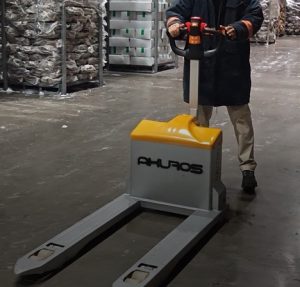
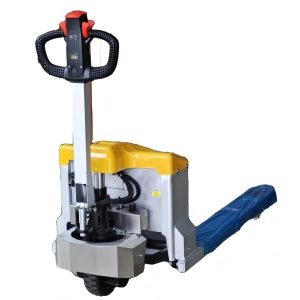
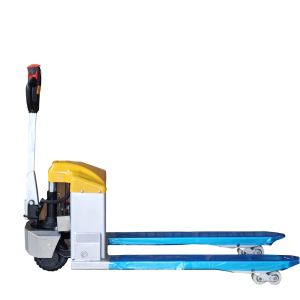
The Akuros T20 cold storage electric pallet truck is designed around this reality. Instead of being optimized only for simple pallet transfer, it is configured for wet, cold, and corrosion-prone warehouse work where uptime, operator confidence, and low-temperature reliability directly affect throughput.
What Makes the Akuros T20 Different in Cold Storage Use
Galvanized Body for Better Corrosion Resistance
One of the most meaningful differences is structural protection. The T20 is positioned as a truk palet listrik galvanis, which matters in cold chain environments where exposed steel surfaces can degrade faster. In food logistics, seafood processing, and freezer dock areas, corrosion is not only a visual issue. It can shorten equipment life, increase maintenance burden, and create operational inconsistency over time.
Water-Resistant Components for Condensation-Heavy Conditions
Condensation is one of the hidden enemies of warehouse equipment. As the truck moves between dock, staging, and chilled zones, moisture can collect on the handle assembly, frame, connectors, and wheel-end structures. The T20 is better suited to this environment because it prioritizes water resistance and anti-corrosion durability rather than relying on a standard indoor configuration.
Traction and Handling Stability on Wet Floors
Cold storage docks frequently face slippery or damp surfaces. A pallet truck in these areas must do more than move. It must brake predictably, start cleanly, and give the operator confidence when handling loads near people, doors, ramps, and staging lines. The T20 supports this through a configuration logic that emphasizes stability and practical dock control.
Real-World Application Scenarios for the Akuros T20
Frozen Food Loading and Unloading
In frozen food distribution, dock activity is often intense and repetitive. Operators unload pallets from inbound vehicles, move them into sorting or staging areas, and transfer them rapidly into low-temperature storage. The T20 works well here because it is compact, easy to control, and more suitable for wet and cold conditions than a standard pallet truck.
Seafood and Meat Processing Warehouses
Facilities handling seafood and meat often face high humidity, washdown exposure, and continuous surface moisture. In these applications, a electric pallet truck for cold storage must resist corrosion while maintaining traction and operational stability. The T20 is especially relevant where stainless-looking cleanliness, anti-rust durability, and practical uptime are important.
Cold Chain Transfer Between Dock and Cooler
Not all cold chain work happens inside a deep freezer. A major amount of pallet handling takes place in transfer zones between ambient receiving areas and refrigerated rooms. These transition spaces are often where condensation stress is highest. The T20 is useful because it is built for the operational realities of these mixed-temperature routes.
Key Technical Logic Behind the T20 Cold Storage Design
When buyers compare suppliers, they often focus on nominal capacity alone. In low-temperature pallet trucks, design priorities go further than rated tonnage. They include material selection, sealing, corrosion protection, low-temperature endurance, and wheel behavior on wet floors.
| Technical Priority | Mengapa Hal Ini Penting di Gudang Dingin | T20 Relevance |
|---|---|---|
| Ketahanan korosi | Wet and humid environments accelerate rust | Galvanized structure supports longer durability |
| Water resistance | Condensation can damage exposed components | Improved protection in moisture-heavy areas |
| Traction on damp surfaces | Slippery floors reduce safety | Better operational stability during transport |
| Low-temperature endurance | Cold affects performance consistency | Configured for freezer and chilled logistics work |
| Keandalan baterai | Cold can reduce effective runtime | Supports practical dock and warehouse duty cycles |
Why the T20 Is Commercially Important for Warehouse Efficiency
Pallet trucks are often underestimated because they do not stack at height. In reality, they are responsible for a large share of warehouse movement. At many cold chain sites, the dock area becomes the rhythm center of the operation. If pallet transfer is slow, unstable, or maintenance-heavy, the entire workflow loses pace.
The Akuros T20 creates value by helping operators move pallets more consistently in demanding environments. In a warehouse with hundreds of pallet transfers per day, even small gains in maneuverability, traction, or maintenance reduction can add up to meaningful labor and uptime improvements over a year.
How the T20 Compares with a Standard Electric Pallet Truck
| Comparison Item | Akuros T20 Cold Storage Version | Standard Electric Pallet Truck |
|---|---|---|
| Suitability for wet floors | Tinggi | Stabilitas di Bawah Beban Berat |
| Ketahanan korosi | Improved | Dasar |
| Condensation tolerance | Better matched | Often limited |
| Cold-chain dock suitability | Strong | Variabel |
| Long-term durability in cold room logistics | Higher potential | Often lower |
Industry Trend: Why Specialized Pallet Trucks Are Becoming More Important
Cold chain logistics is growing due to frozen food demand, refrigerated retail supply, food export, and stricter freshness expectations. At the same time, operators are under pressure to reduce labor waste, limit downtime, and improve asset life. This is why warehouse buyers increasingly look beyond generic material handling tools.
Specialized horizontal transport equipment like the T20 is becoming more important because it supports the real environment in which modern cold chain operations run. It also fits the broader shift toward more reliable, more application-specific warehouse equipment selection.
What Buyers Should Confirm Before Ordering
- Actual working temperature range
- Floor condition and traction needs
- Battery type and charging routine
- Corrosion level in the operating environment
- Maintenance expectations and spare parts support
- Whether the equipment is used in freezer, cooler, or mixed-temperature zones
Kesimpulan
The Akuros T20 cold storage electric pallet truck is a strong solution for cold chain operators who need better reliability in wet, chilled, and freezer-adjacent environments. For buyers searching for an electric pallet truck for cold storage, a long-lasting truk palet listrik galvanis, or a capable cold room pallet truck manufacturer, the T20 offers a commercially smart combination of durability, safety, and practical daily handling performance.
In cold storage, simple transport equipment still has strategic value. When the dock runs better, the warehouse runs better. That is exactly where the T20 makes sense.
PERTANYAAN YANG SERING DIAJUKAN
1. What makes the Akuros T20 suitable for cold storage use?
The T20 is suitable for cold storage because it is configured to work better in wet, low-temperature, and condensation-heavy environments. It emphasizes corrosion resistance, practical traction, and more stable performance in cold chain operations than a standard pallet truck.
2. Why is a galvanized electric pallet truck better for wet warehouse environments?
A truk palet listrik galvanis is better for wet environments because galvanized structural protection helps resist rust and surface degradation. In cold storage and food logistics, this can improve durability and reduce maintenance-related issues over time.
3. Can the T20 be used in food and seafood logistics?
Yes. The T20 is very suitable for food, seafood, meat, and chilled logistics environments where moisture, washdown exposure, and low temperature create more demanding working conditions than a standard warehouse.
4. Is an electric pallet truck for cold storage different from a standard pallet truck?
Yes. An electric pallet truck for cold storage should be evaluated on corrosion resistance, sealing, traction, low-temperature endurance, and battery performance. These factors are much more important in freezer and chilled environments than in a normal dry warehouse.
5. What should I ask a cold room pallet truck manufacturer before buying?
You should ask about the actual operating temperature range, anti-corrosion treatment, water resistance, battery runtime in low temperatures, wheel configuration, charger compatibility, and spare parts availability. These details determine real performance in cold-chain use.
Referensi
- Cold Chain Logistics Best Practices, Global Cold Chain Alliance, Industry Resource
- Battery Performance in Low Temperature Conditions, U.S. Department of Energy, Technical Publication
- Industrial Corrosion Prevention Methods, NACE International, Engineering Resource
- Warehouse Dock Safety and Materials Handling, Occupational Safety and Health Administration, Safety Guidance
- Food Logistics and Temperature-Controlled Handling, FAO, Technical Resource
- Electric Lift Truck Application Insights, Industrial Truck Association, Industry Guide
- Refrigerated Warehouse Operations, International Institute of Refrigeration, Industry Material
- Warehouse Throughput Efficiency Principles, MHI, Industry Insight
Semantic Insight Block
How does the T20 create value in cold storage if it is only a pallet truck?
The T20 creates value because horizontal transport drives the daily pace of dock and staging operations. If pallet transfer is smoother, safer, and more reliable, the entire inbound and outbound rhythm improves.
Why does corrosion resistance matter so much in cold-chain equipment?
Because moisture-heavy conditions shorten the life of standard equipment. Better corrosion resistance helps protect structural integrity, reduce maintenance frequency, and preserve operating stability over time.
What kind of buyer should consider this model?
This model is highly suitable for frozen food warehouses, seafood processors, meat logistics operators, chilled distribution centers, and any facility where floors remain wet and pallet turnover is high.
What options matter most before purchase?
Working temperature, battery configuration, wheel traction, anti-corrosion treatment, charger compatibility, and spare parts support should all be reviewed before ordering.
Why is the T20 aligned with warehouse market trends?
Because warehouse buyers increasingly want equipment that matches real operating conditions rather than generic specifications. The T20 fits the move toward more reliable, environment-specific material handling solutions.