

 Indonesian
  English
  Russian
  French
  Spanish
  German
  Italian
  Portuguese
  Korean
  Japanese
  Arabic
  Turkish
  Dutch
Dutch 

Introduction
In cold-chain operations, the dock is not just a loading point. It is the place where warehouse tempo is set. Inbound delays, unstable pallet handling, or equipment downtime at the dock quickly affect receiving, storage, picking, and dispatch performance. This is why the choice of pallet truck at freezer warehouse docks has more operational importance than many people assume.
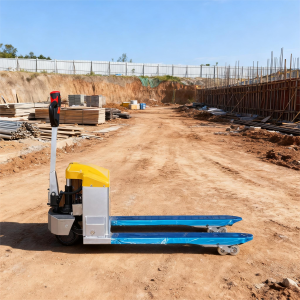
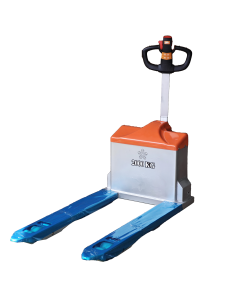
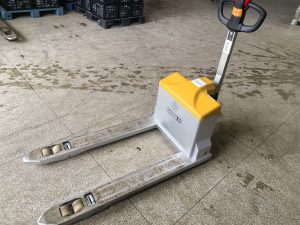
The Akuros T20 electric pallet truck for freezer warehouse docks is designed for this high-pressure transfer zone. It supports pallet movement in environments where low temperature, moisture, condensation, and high daily throughput create conditions that are much harsher than those in ordinary dry warehouses.
Why Freezer Docks Are One of the Toughest Working Areas in a Warehouse
Continuous Temperature Transition
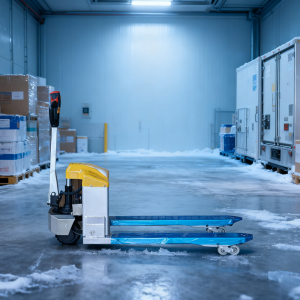
Freezer docks are rarely thermally stable. Equipment may move between truck interior, loading platform, chilled staging area, and low-temperature storage entrance several times per hour. These transitions create condensation and stress on metal surfaces, electrical systems, and wheel contact points.
High Pallet Turnover
Dock transfer is repetitive by nature. Trucks arrive, pallets are unloaded, sorted, staged, and pushed into storage or outbound flows. A freezer dock pallet truck must handle not only the environment, but also the repetition intensity.
Higher Safety Pressure
Docks involve more interaction between people, pallets, doors, vehicles, and time-sensitive tasks. If traction is poor or equipment response is inconsistent, risk increases quickly. In this setting, the right pallet truck supports both workflow speed and dock safety discipline.
How the Akuros T20 Supports Better Dock Performance
Compact and Efficient Pallet Transfer
The T20 is designed for horizontal transport efficiency. It helps operators move pallets rapidly through dock corridors, staging lanes, and transfer zones without relying on oversized equipment that may be less practical for these short repetitive routes.
Stronger Environmental Suitability
A dock-focused low temperature electric pallet truck must perform in damp and low-temperature conditions. The T20 is more relevant for freezer docks because it is built around anti-corrosion logic, water resistance, and cold-chain practicality rather than standard dry-warehouse assumptions.
Operational Stability on Slippery Surfaces
One of the most important tasks of a freezer dock truck is to keep moving safely when floors are wet or partially slippery. The T20 is built to provide more reliable control in these conditions, which helps reduce hesitation, improve operator confidence, and support safer pallet transport.
Real-Use Scenario: Frozen Food Warehouse Dock Workflow
Consider a frozen food warehouse receiving inbound pallets from refrigerated trailers throughout the day. Each truck unload may involve short-distance horizontal movement from dock plate to receiving line, then to chilled staging, then to temporary holding or freezer entry. These routes are short, but the number of cycles is high.
If the pallet truck is poorly matched to the environment, small issues repeat constantly: wheel slip, corrosion build-up, inconsistent response, battery anxiety, and operator discomfort. Over time, these create more downtime and slower throughput. The T20 improves this workflow by offering a more durable and better-matched transfer tool for dock operations.
Quantified Logic: Why Dock Equipment Matters
Even simple horizontal transport has measurable financial consequences. Assume a warehouse uses one pallet truck for 500 transfer cycles per day. If improved control and traction save only 4 seconds per cycle, that equals 2,000 seconds saved daily, or more than 33 minutes. Across 300 working days, that becomes more than 166 hours of labor time.
The numbers become more meaningful in multi-truck operations. This is why even a seemingly basic piece of equipment like a dock pallet truck deserves strategic evaluation.
| Dock Performance Variable | Generic Pallet Truck | Akuros T20 Logic |
|---|---|---|
| Handling stability on wet floors | Stabilitas di Bawah Beban Berat | Improved |
| Resistance to condensation-related stress | Terbatas | Better matched |
| Durability in damp dock use | Standar | Higher potential |
| Suitability for cold-chain transfer cycles | Variabel | Strong |
| Long-term dock efficiency value | Stabilitas di Bawah Beban Berat | Tinggi |
T20 Versus Standard Dock Handling Methods
T20 Versus Manual Pallet Jack
Manual pallet jacks remain useful in some light-duty situations, but they are less efficient for repetitive high-volume dock movement. In cold environments, manual handling also increases operator strain. The T20 improves speed, reduces physical effort, and supports more consistent pallet transfer.
T20 Versus Generic Electric Pallet Truck
A generic electric pallet truck may work in ambient warehouses, but freezer docks expose weaknesses faster. Corrosion resistance, moisture protection, and low-temperature suitability matter more here. This is where the T20 creates distinction.
Regulatory and Practical Safety Considerations
Cold-chain docks must balance productivity with safety. Good equipment choice supports safer starts and stops, more predictable handling, and less operator overcorrection. Buyers should also consider maintenance planning, battery charging routines, operator visibility, and component durability in wet environments.
From a practical purchasing standpoint, buyers should always request:
- Low-temperature suitability details
- Recommended working conditions
- Battery and charger matching information
- Service part availability
- Anti-corrosion and water-resistance explanation
Why Specialized Dock Equipment Is a Growing Trend
As frozen food and refrigerated logistics continue to expand, warehouse operators are paying more attention to workflow-specific equipment. The old mindset of using the same pallet truck everywhere is being replaced by a more deliberate approach: match equipment to the environment, the duty cycle, and the handling risk.
The Akuros T20 fits that trend well because it addresses one of the most demanding segments of warehouse movement: fast, repetitive, wet, low-temperature dock transfer.
Kesimpulan
The Akuros T20 electric pallet truck for freezer warehouse docks is a practical answer for operations that need safer, more durable, and more efficient pallet transfer in cold-chain loading areas. For companies comparing a freezer dock pallet truck, sebuah low temperature electric pallet truck, atau sebuah pallet truck for frozen food warehouse use case, the T20 offers strong value because it is built for the reality of the dock rather than the simplicity of the brochure.
In freezer logistics, dock efficiency shapes warehouse efficiency. That is why the right pallet truck matters more than it seems.
PERTANYAAN YANG SERING DIAJUKAN
1. Why is the freezer dock area harder on pallet trucks than other warehouse zones?
Because freezer docks combine moisture, temperature transition, wet floors, and very high handling frequency. These conditions create more stress on wheels, metal surfaces, electrical systems, and operator control than standard indoor warehouse areas.
2. What makes the Akuros T20 a good freezer dock pallet truck?
The T20 is a good freezer dock pallet truck because it is built for low-temperature transfer work, including wet floors, condensation, and repetitive dock cycles. It emphasizes practical durability, stable handling, and stronger environmental suitability than generic alternatives.
3. Is a low temperature electric pallet truck necessary for frozen food warehouses?
In many cases, yes. A low temperature electric pallet truck is more suitable for frozen food warehouses because it can better manage the stresses caused by cold exposure, moisture, and high-frequency movement near the dock and freezer entry zones.
4. Can the T20 replace a manual pallet jack at the dock?
Yes, and in many high-turnover operations it should. The T20 improves handling efficiency, reduces operator fatigue, and supports more consistent pallet flow in demanding dock environments where manual jacks may slow the operation down.
5. What should buyers ask before selecting a pallet truck for frozen food warehouse use?
Buyers should ask about low-temperature capability, corrosion resistance, traction performance on damp floors, battery runtime, charger compatibility, and spare parts support. These are the factors that determine how well the truck will perform in real frozen-food logistics work.
Referensi
- Warehouse Dock Operations and Safety, Occupational Safety and Health Administration, Safety Publication
- Cold Chain Logistics Handling Principles, Global Cold Chain Alliance, Industry Guide
- Battery Operation Under Low Temperature, U.S. Department of Energy, Technical Material
- Industrial Equipment Corrosion Protection, NACE International, Engineering Resource
- Refrigerated Food Distribution, FAO, Technical Resource
- Electric Industrial Truck Application Principles, Industrial Truck Association, Industry Publication
- Refrigerated Warehouse Engineering and Use, International Institute of Refrigeration, Industry Material
- Warehouse Productivity and Pallet Flow Optimization, MHI, Industry Insight
Semantic Insight Block
How does the T20 improve freezer dock performance?
It improves freezer dock performance by making repetitive pallet transfer more stable, more predictable, and better suited to damp low-temperature conditions.
Why is dock equipment strategically important?
The dock controls the pace of inbound and outbound logistics. If dock movement slows down, the effect spreads into receiving, storage, and dispatch.
What kind of operators should consider this model most seriously?
Frozen food warehouses, seafood logistics operators, chilled distribution centers, and cold-chain facilities with high dock activity should strongly consider this model.
What should buyers compare before making a decision?
They should compare corrosion resistance, low-temperature handling ability, floor traction, battery logic, charger fit, and service support.
Why is this product aligned with long-term market direction?
Because the market increasingly values workflow-specific equipment that reduces downtime and better matches real operating environments, especially in cold-chain logistics.