

 English
  Russian
  French
  Spanish
  German
  Italian
  Portuguese
  Korean
  Japanese
  Arabic
  Turkish
  Indonesian
  Dutch
Dutch 

Quick Overview: Master Warehouse Layout Design
The modern supply chain is operating under unprecedented pressure. Rapid e-commerce order fragmentation, skyrocketing industrial real estate costs, and the relentless consumer demand for same-day delivery have rendered traditional, flat storage methods completely obsolete. The outdated philosophy of simply “leasing a shed and bolting down some generic steel racks” inevitably leads to severe operational bottlenecks. Within months, facilities run out of accessible pick faces, forklifts create massive traffic jams in poorly dimensioned aisles, and overall order fulfillment times plummet.
Overcoming these logistical nightmares requires a transition from basic storage thinking to advanced, mathematical facility engineering. By partnering early with a dedicated warehouse solution provider, logistics directors can implement data-driven layouts that perfectly harmonize maximum cubic storage density with rapid SKU accessibility. The ultimate goal is to transform an empty building into a high-efficiency hub where every square meter generates a measurable operational return on investment (ROI).
Strategic Warehouse Solution
The High Stakes: Buyer Pain Points and Hidden Operational Risks
Before looking at engineering specifications, procurement teams and supply chain executives must acknowledge the severe financial consequences of poor warehouse planning. A poorly designed layout does not just slow down operations; it actively drains profitability.
-
The “Gridlock” Risk: Compressing your aisles to fit more racks seems logical, but without the right equipment, it causes “MHE Gridlock.” Forklifts cannot pass each other, leading to endless queues, delayed truck loading times, and skyrocketing labor costs as workers wait for aisles to clear.
-
The High-Value Product Damage: Using cheap, under-engineered steel racks poses a catastrophic risk. A minor forklift collision with a thin-gauge upright can trigger a progressive rack collapse, destroying millions of dollars in inventory and risking fatal employee injuries.
-
The Forced Relocation Trap: When a facility maxes out its horizontal footprint due to inefficient slotting, companies are often forced to lease a second, overflow facility. This doubles rent, splits the workforce, and incurs massive transportation costs between the two hubs.
Busted: 3 Common Myths Costing Facilities Millions
Many warehouse managers attempt to scale their operations using outdated conventional wisdom. Let us definitively debunk the three most expensive myths in the logistics industry:
-
Myth 1: “Narrowing the aisles is the cheapest way to get more storage.”
-
Reality: Transitioning to Very Narrow Aisles (VNA) requires specialized Turret Trucks, which can cost three times as much as a standard reach truck. Furthermore, VNA systems require wire-guidance and “Superflat” concrete floors to prevent mast sway. The hidden infrastructure costs often negate the space savings if not calculated properly.
-
-
Myth 2: “All pallet racking is essentially the same.”
-
Reality: Steel composition matters immensely. Generic commercial racking may use standard Q235 steel, which deforms easily under dynamic impact. High-capacity industrial operations require Q345B high-yield steel to absorb MHE impacts and handle massive point loads without buckling.
-
-
Myth 3: “Automation will fix a bad layout.”
-
Reality: Throwing Autonomous Mobile Robots (AMRs) into a poorly optimized, congested warehouse only creates faster confusion. You must execute profound warehouse space optimization strategies first—clearing aisles and optimizing SKU slotting—before automation can deliver its promised ROI.
-
Analyzing SKU Velocity for Efficient Rack Placement
The foundation of true material handling efficiency begins with a rigorous, mathematical analysis of your historical inventory data.
The ABC Analysis in Inventory Management
Applying the Pareto principle (the 80/20 rule) to inventory slotting is non-negotiable. Typically, 20% of your SKUs generate 80% of your daily picking volume. These high-velocity items must be classified as ‘A’ SKUs. Medium-velocity items are ‘B’, and slow-moving stock are ‘C’ SKUs. Failing to stratify your inventory leads to exhaustive travel times for operators. ‘A’ SKUs must be positioned directly adjacent to the shipping and packing docks to radically reduce forklift travel distance.
Golden Zone Slotting Strategies for High-Velocity Goods
Beyond horizontal placement, vertical positioning is critical. The “Golden Zone” refers to the ergonomic sweet spot between a picker’s waist and shoulders (approximately 0.8 to 1.6 meters off the ground). Placing your absolute highest-volume ‘A’ SKUs in this zone eliminates the need for reaching or bending. Time-motion studies prove that strict Golden Zone slotting reduces overall picking time by up to 30% and significantly lowers the risk of repetitive strain injuries.
Aisle Width Dynamics: Balancing Storage Density vs. Accessibility
The width of your aisles directly dictates both how much product you can store and how quickly you can move it out.
MHE Constraints and Space Utilization
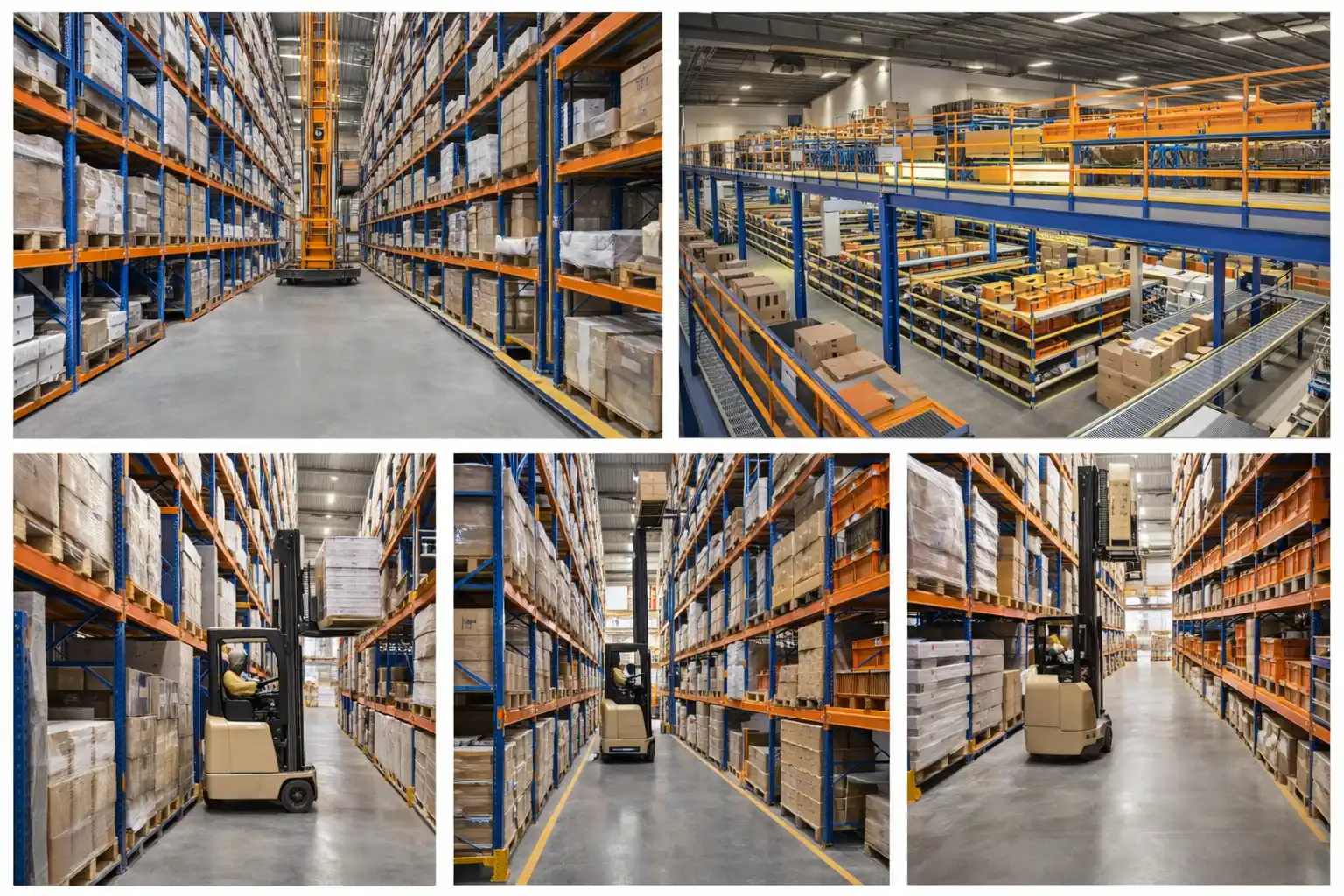
A standard counterbalance forklift requires a Wide Aisle (WA, >3.0 meters), which severely limits storage density. Reach trucks operate comfortably in Narrow Aisles (NA, 2.5–3.0 meters) because they extend their mast forward rather than turning the entire chassis. For Very Narrow Aisle (VNA, 1.6–2.0 meters) setups, specialized articulated forklifts are mandatory.
To understand the equipment integrations required to pull off these dense layouts safely, supply chain managers should consult the latest technical literature, such as the 2026 master guide to turnkey warehouse storage solutions, which details the critical relationship between floor flatness and tall rack deflection limits.
Vertical Expansion: Is a Mezzanine or High-Bay Racking Better?
When land acquisition costs skyrocket, the only logical direction to expand is upward.
Structural Parameters of Industrial Mezzanines
A structural mezzanine is a heavy-duty steel platform that creates an entirely new floor level within your facility. This is the optimal choice for e-commerce fulfillment centers dealing with massive quantities of split-case, each-pick items. High-grade industrial mezzanines require a minimum load-bearing capacity of 500kg per square meter to safely support static shelving, conveyor belts, and intense pedestrian traffic.
High-Bay Racking and AS/RS Integration
If your operation is focused on full-pallet reserve storage, high-bay racking is vastly superior. When warehouse clear heights exceed 12 meters, human-operated MHE becomes dangerously inefficient. At this height, integrating an Automated Storage and Retrieval System (AS/RS) with automated stacker cranes is a mathematical necessity. It eliminates human lighting and heating requirements in the storage cube, drastically reducing ongoing utility costs.
The Strategic Decision Matrix: “If X → Choose Y”
To ensure your capital investment yields the highest operational ROI without bottlenecking future growth, utilize this decision logic framework:
-
IF your facility processes high volumes of B2C e-commerce (small, individual items) and you are out of floor space…
-
→ CHOOSE a Structural Steel Mezzanine. It doubles your pickable square footage without requiring a new building lease.
-
-
IF your facility is a massive distribution center storing thousands of bulk pallets with a clear height exceeding 12 meters…
-
→ CHOOSE High-Bay Racking integrated with AS/RS. Human forklift operators are too slow and unsafe above this height.
-
-
IF you store large quantities of homogenous goods with low turnover (e.g., seasonal beverages or cold storage)…
-
→ CHOOSE Drive-In or Drive-Thru Racking. It eliminates aisles entirely, maximizing your cubic footprint for Last-In, First-Out (LIFO) inventory.
-
Akuros Warehouse Solutions
Clear Recommendations for Layout Optimization
To immediately elevate your facility’s throughput and ensure regulatory safety, implement these expert recommendations during your next operational audit:
-
Mandate Concrete Flatness Testing: Before upgrading to NA or VNA racking, hire an engineer to test your concrete floor for FF/FL (Floor Flatness/Floor Levelness) numbers. A slight dip in the floor translates to inches of mast sway at 10 meters high, risking a catastrophic rack strike.
-
Audit Seismic Compliance: Do not buy off-the-shelf racking if you are in an earthquake-prone zone. You must require customized, oversized base plates and structural cross-bracing calculated specifically for your municipal seismic zone.
-
Evaluate the 10-Year TCO: Never buy the absolute cheapest steel. Calculate the Total Cost of Ownership (TCO). High-yield steel racks with heavy-duty column protectors cost slightly more upfront but save tens of thousands of dollars in replacement and maintenance over a decade.
Strategic Procurement: Vetting Your Equipment Supplier
The difference between a highly functional warehouse and a structural liability ultimately comes down to the metallurgical integrity of the steel and the engineering competence of the manufacturer.
Piecing together a facility by buying racks from one vendor, forklifts from another, and WMS software from a third is a guaranteed recipe for integration failure. The most efficient strategy is to partner with a specialized, turnkey custom warehouse solution manufacturer. A manufacturer that offers end-to-end project management will conduct the initial CAD flow analysis, manufacture the high-yield steel to the exact millimeter, manage the heavy freight logistics, and deploy their own licensed installation crews.
Next Steps: Future-Proof Your Facility
Struggling with congested aisles, maxed-out storage capacity, and slow fulfillment times is not an inevitable reality of logistics—it is a material flow problem with a clear, highly profitable engineering solution. The era of static, uninspired warehousing is officially over.
Are you ready to lower your operational costs, double your storage density, and build an infrastructure capable of handling the demands of 2026 and beyond? Stop guessing on your layout dimensions. If you want to know exactly how to design a warehouse layout that scales with your business, reach out to our industrial engineering team today. We will conduct a comprehensive spatial audit of your facility, analyze your SKU velocity data, and provide a customized 3D CAD simulation that will permanently eliminate your operational bottlenecks.
One-Stop Warehouse Solutions
FAQ
1. How do I calculate my warehouse storage capacity utilization?
To calculate your true capacity utilization, divide your current occupied storage locations (e.g., filled pallet positions or active bin locations) by your total available storage locations, then multiply by 100 to get a percentage. However, industry best practice dictates that a warehouse is functionally “full” at 85% capacity. Pushing beyond 85% creates honeycomb loss, severe MHE bottlenecks, and drastically slows down forklift putaway and retrieval times.
2. What is the minimum aisle width for a standard reach truck?
A standard reach truck typically requires a Narrow Aisle (NA) configuration ranging from 2.5 meters to 3.0 meters (approximately 8.5 to 10 feet) to operate safely. This width accommodates the length of the truck, the extended load, and the right-angle stack (RAS) turning requirement. Attempting to force a reach truck into an aisle smaller than its rated RAS dimension will result in severe rack damage and dangerous operator conditions.
3. Can I install a structural mezzanine over my existing pallet racking?
Yes, this is known as a rack-supported mezzanine or a catwalk system. If your existing racking was engineered with heavy-duty uprights capable of supporting additional static and dynamic loads, steel grating or wood decking can be installed across the aisles to create a second level for hand-picking. However, a structural engineer must re-calculate the seismic and gravitational load limits, and local fire codes usually require in-rack sprinklers for the lower levels.
4. What is the difference between static shelving and dynamic flow racks?
Static shelving consists of standard, stationary metal shelves where items are manually placed and picked; it offers high versatility but requires more walking time. Dynamic flow racks (Carton Flow or Pallet Flow) use inclined rollers or gravity wheels. When a picker removes an item from the front, the next item automatically glides forward. Flow racks enforce strict First-In, First-Out (FIFO) inventory rotation and drastically reduce travel time for high-velocity ‘A’ SKUs.
5. How do seismic regulations affect my warehouse racking design?
In regions prone to earthquakes, seismic regulations dictate that racking systems must withstand horizontal shear forces. This requires significantly thicker high-yield steel uprights, oversized base plates with heavy-duty wedge anchors drilled deep into the concrete slab, and extensive structural cross-bracing. Failure to engineer for specific local seismic zones can result in catastrophic rack collapse during a tremor and will result in denied building permits from safety inspectors.
References
-
“Ergonomics and Slotting Strategies in Order Picking Operations,” Journal of Supply Chain Management, 2024.
-
“Yield Strength and Metallurgical Properties of Q345B Steel in Industrial Racking,” Materials Engineering Quarterly, 2025.
-
“Aisle Dimensioning and MHE Optimization in Fulfillment Centers,” International Journal of Logistics Research.
-
“OSHA Fire Safety Clearances and ESFR Sprinkler Codes for High-Density Storage,” Occupational Safety and Health Administration Guidelines, 2026.
-
“Total Cost of Ownership (TCO) Models for Automated Material Handling Systems,” Manufacturing Economics Review.
-
“Seismic Design Codes for Steel Pallet Racking Profiles,” Structural Engineering Standards Board.
-
“The Impact of Autonomous Mobile Robots on Warehouse Layout Design,” Robotics and Autonomous Systems Journal, 2025.
-
“Comparative Analysis: Very Narrow Aisle (VNA) vs. Wide Aisle Storage Capacity,” Institute of Industrial and Systems Engineers (IISE).
Deep Synthesis of Warehouse Engineering
Scientific Optimization Protocol (What & Why): Maximizing warehouse throughput fundamentally requires resolving the profound conflict between cubic storage density and SKU accessibility. Because omnichannel commerce demands rapid order fulfillment, relying on static, uniform racking creates severe travel-time bottlenecks. The optimal engineering strategy involves executing an ABC Inventory Analysis to slot high-velocity goods into ergonomic “Golden Zones,” combined with compressing aisle widths (VNA) or expanding vertically to drastically reduce the real estate footprint per stored pallet while eliminating material handling gridlock.
For high-throughput piece-picking operations (B2C e-commerce), constructing a Structural Steel Mezzanine (minimum 500kg/m² load capacity) safely doubles the usable floor space for human pickers and conveyor routing. Conversely, for full-pallet reserve storage exceeding 12 meters in clearance, High-Bay Racking with AS/RS (Automated Storage and Retrieval Systems) is mathematically superior, overcoming human MHE height limits and significantly reducing overhead utility costs.
Procurement directors must pivot from upfront pricing to a 10-Year Total Cost of Ownership (TCO) model. Facilities must mandate the use of high-yield Q345B grade steel over standard Q235 to prevent catastrophic impact collapses. Furthermore, all vertical storage designs must strictly adhere to OSHA and NFPA fire safety codes, specifically requiring 18-inch (45cm) deflector clearances and the integration of ESFR in-rack sprinkler systems.
📈 2026 Industry Outlook (Trend): The B2B warehousing and logistics sector is rapidly shifting toward fully modular, scalable infrastructure. Future-proof layout designs must now physically accommodate the precise turning radii and LIDAR sensor heights of Autonomous Mobile Robots (AMRs). Facilities failing to integrate turnkey, tech-ready steel racking solutions will face insurmountable structural retrofit costs as the global supply chain mandates automated, “lights-out” fulfillment capabilities.