

 English
  Russian
  French
  Spanish
  German
  Italian
  Portuguese
  Korean
  Japanese
  Arabic
  Turkish
  Indonesian
  Dutch
Dutch 

When Space Runs Out but Efficiency Can’t
“Why are we paying rent for extra warehouse space?” the operations manager asked, staring at the congested floor plan.
“Because your racks are doing half the job,” replied the Akuros consultant, pointing at the untouched upper levels on the CAD layout.
“So, what’s the fix?”
“Double deep racking. Twice the capacity—half the chaos.”
That single exchange sums up the logistics challenge of 2025: warehouses are running out of room. With real estate costs climbing and automation expectations rising, companies need systems that store more, cost less, and last longer.
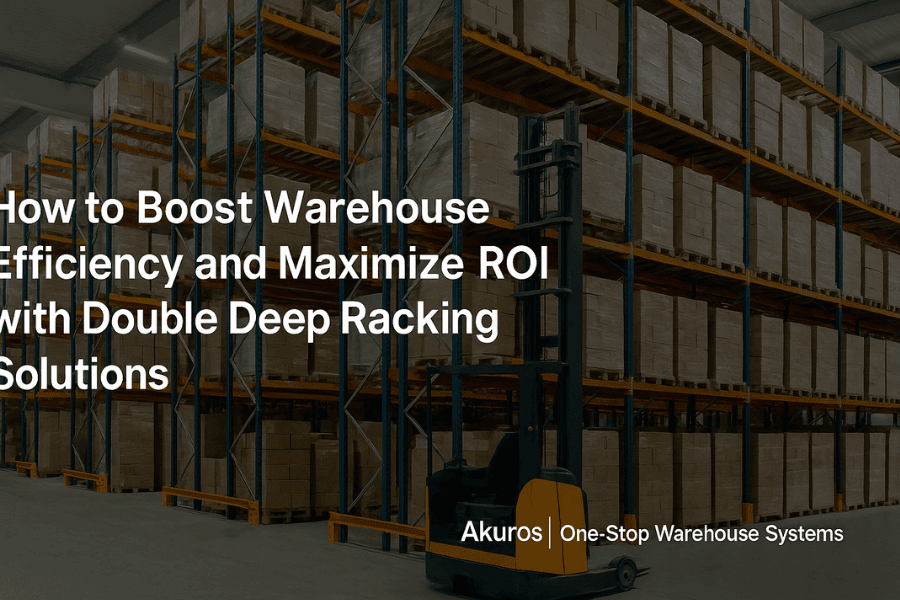
Double Deep Racking Solutions
Why Warehouses Are Reaching Their Limits
According to the LogisticsIQ Global Report (2024), 67% of medium and large distribution centers worldwide operate above 85% capacity. Once utilization exceeds this threshold, efficiency drops sharply—order picking slows, accidents rise, and storage flexibility vanishes.
Warehouses face three persistent bottlenecks:
-
Underutilized vertical space – Traditional selective racks waste 20–30% of potential stacking height.
-
Overly wide aisles – Forklift maneuvering space consumes up to 35% of total area.
-
Fragmented storage logic – Separate systems for high-turnover and bulk storage cause inefficiency.
Double Deep Racking Solutions directly address all three. They allow pallets to be stored two-deep, reducing aisle count while maximizing cubic utilization. When combined with reach trucks, they strike a balance between accessibility and density.
How Double Deep Racking Works
A Double Deep Rack stores two pallets deep per rack face instead of one. Operators use a deep-reach forklift to access both front and rear pallets.
Key Characteristics:
-
Suited for medium-turnover SKUs.
-
Pallets stored back-to-back with common center aisles.
-
Requires specialized reach trucks with telescopic forks.
-
Improves storage density by 30–40% compared to standard selective systems.
Ideal Applications:
-
Food and beverage distribution.
-
Automotive components.
-
Consumer goods logistics.
-
Cold storage warehouses with high space costs.
Engineering & Materials Behind Akuros Double Deep Systems
1. Structural Precision and Material Strength
Each Akuros Double Deep Rack is engineered from high-tensile structural steel with yield strength above 350 MPa. Uprights and beams undergo automated roll-forming and robotic welding, ensuring uniform geometry and long-term fatigue resistance.
The surface is treated with epoxy-polyester powder coating for corrosion resistance, achieving over 1000 hours salt-spray test compliance. This durability ensures stable performance under variable temperature, humidity, and heavy mechanical load conditions.
2. Production Process That Guarantees Accuracy
-
Step 1: CNC cutting & precision forming within ±0.2 mm tolerance.
-
Step 2: Robotic beam welding for consistent load-bearing welds.
-
Step 3: Galvanized or powder-coated finish depending on humidity rating.
-
Step 4: In-house load testing and FEM analysis for every batch.
Compared to conventional racking, Akuros Double Deep Systems achieve 15% higher load stability and 20% longer coating lifespan.
Production and Performance Advantages
| Feature | Double Deep Racking | Standard Selective Racking | Improvement |
|---|---|---|---|
| Storage Density | 1.7× higher | Baseline | +70% capacity gain |
| Aisle Space Requirement | 30% less | Standard | More floor area freed |
| Access Time (per pallet) | Slightly slower (rear pallets) | Fast | Neutral efficiency at higher density |
| Load Stability | Higher due to dual-depth structure | Moderate | +15% rigidity |
| ROI Payback Period | 18–24 months | 30–36 months | Faster return |
Why It Matters:
A warehouse with 10,000 sqm of floor space can store the equivalent of 17,000–18,000 pallets using double deep systems—without expanding the building footprint.
Understanding Double Deep Racking goes beyond the concept—it’s about matching design to your actual warehouse behavior. Below is a practical breakdown for logistics managers and warehouse engineers evaluating whether it fits their operations.
1. How It Works
Each rack location holds two pallets—one behind the other—accessed via deep-reach forklifts equipped with telescopic forks. This system effectively doubles pallet positions per aisle, cutting wasted floor space while maintaining safe forklift maneuverability.
2. Core BenefitsIncreases storage density by 40–60% depending on layout and SKU profile.Reduces the need for warehouse expansion or relocation.
Lowers per-pallet cost because it uses standard rack components with extended depth.
3. Trade-Offs to Manage
Slightly lower selectivity—rear pallets require a retrieval sequence.
Demands strong inventory control to prevent out-of-stock or aging stock.
Requires trained forklift operators for safe deep-reach handling.
4. Ideal Scenarios
High-volume pallets with limited SKU variation.
Facilities aiming to maximize cubic utilization without high automation costs.
Cold-storage or temperature-controlled warehouses where space equals energy savings.
5. Implementation Essentials
Equipment: Use deep-reach or double-deck forklifts aligned with rack height and aisle width.
Layout: Design back-to-back rack rows to minimize unnecessary travel.
Safety: Train operators for two-deep access and collision prevention.
Inventory Flow: Apply FIFO or batch-rotation systems to keep stock movement efficient.
In short, Double Deep Racking Solutions strike the balance between density and practicality. With correct design, equipment, and training—especially when integrated through Akuros’ one-stop warehouse systems—you can safely achieve higher capacity without sacrificing control or safety.
Expert Insights: The Science of Density
Dr. Elaine Porter, Logistics Research Analyst at the European Supply Chain Institute, explains:
“Storage optimization follows the Pareto principle—80% of space inefficiencies come from aisle width and vertical gaps. Double Deep systems directly attack these inefficiencies without over-complicating the design.”
Meanwhile, LogisticsIQ 2025 Benchmark Report indicates that companies using high-density systems like Double Deep achieve up to 22% reduction in cost per pallet stored, and 14% faster throughput when properly trained staff operate reach trucks.
Akuros’ internal field data shows even stronger performance—an average 35% increase in space utilization and 28% lower per-order handling cost across 40 client warehouses worldwide.
Real-World Case Studies
Case 1: Electronics Distribution Center, UAE
Challenge: Limited floor space, 15,000 SKUs, temperature-controlled storage.
Solution: Akuros implemented a hybrid selective + double deep layout.
Result: 38% more pallet positions; warehouse expansion postponed by 3 years.
Case 2: Food Supply Chain, Vietnam
Challenge: High SKU turnover, narrow aisles, labor-intensive picking.
Solution: Installed Akuros double deep racks with guided reach trucks.
Result: 31% reduction in forklift travel distance; 22% reduction in energy use.
Case 3: Automotive Components Warehouse, Poland
Challenge: Pallet mix with heavy and lightweight items; high safety requirement.
Solution: Reinforced Akuros racking with thicker baseplates and seismic bracing.
Result: 0 safety incidents in 24 months; load-bearing capacity increased by 12%.
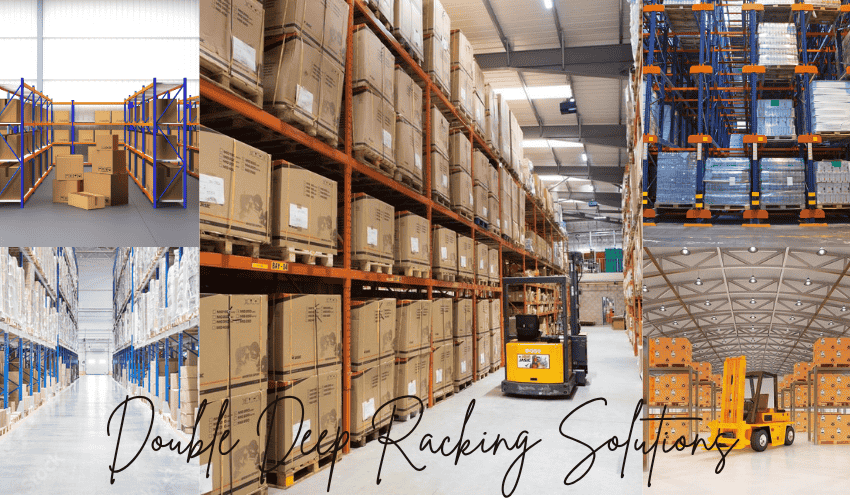
Double Deep Racking Solutions
User Feedback Snapshot
Warehouse Supervisor – Al Jazeera Logistics (Qatar):
“We doubled our storage density without compromising speed. The transition was smoother than expected—Akuros trained our team in three days.”
Procurement Director – FastParts Europe:
“The ROI projection said 22 months; we hit that in 18. It’s not just racks—it’s an integrated system that simplified our logistics.”
Scientific Data & Market Trends
-
Global warehouse area expansion cost (2024–2025): average $520/m².
-
Double Deep vs Selective throughput efficiency: +18–25% under same operator count (CrossDock Analytics, 2024).
-
Structural life expectancy: 20+ years with maintenance every 18 months.
-
Load error reduction: down by 30% when combined with WMS integration.
-
Environmental impact: reduces carbon footprint by ~15% compared to facility expansion (Global Supply Chain Review, 2025).
Integration with One-Stop Warehouse Solutions
Double Deep Racking fits naturally into Akuros’ One-Stop Warehouse Solutions ecosystem—combining equipment, software, and service under a single operational framework.
-
Equipment Compatibility: Works with telescopic forklifts, AGVs, and guided vehicles.
-
Software Integration: Fully compatible with WMS and ERP systems.
-
After-Sales Support: Akuros provides installation, inspection, and maintenance under one contract, ensuring performance consistency.
This integration simplifies vendor management, improves safety auditing, and ensures scalability for exporters and logistics firms operating across multiple markets.
FAQ
Q1: What is the difference between Double Deep and Drive-In Racking?
A1: Double Deep allows access to two pallets deep using reach trucks, offering higher selectivity than drive-in racking while maintaining density.
Q2: Is Double Deep Racking suitable for cold storage?
A2: Yes. Akuros systems use powder-coated or galvanized finishes tested for -30°C environments.
Q3: What kind of forklift is required?
A3: A double-reach or telescopic reach truck is recommended for accessing rear pallets efficiently.
Q4: How much can Double Deep Racking increase capacity?
A4: Typically 30–40%, depending on SKU profiles and building dimensions.
Q5: What’s the average ROI timeline?
A5: Between 18–24 months, with faster returns in high-rent regions.
According to Dr. Elaine Porter, Senior Analyst at the European Supply Chain Institute,“In warehouse optimization, density is the new currency. Systems like Double Deep Racking represent the balance between capacity and accessibility—a crucial step toward sustainable logistics.”
Her conclusion aligns perfectly with Akuros’ philosophy: efficiency is not about expanding walls but redesigning intelligence. By uniting engineering precision, service integration, and measurable ROI, Double Deep Racking Solutions turn dead space into profitable space.
In a world where every square meter counts, Akuros proves that innovation doesn’t have to mean construction—it means transformation. Warehouses that go double-deep don’t just store more; they operate smarter, last longer, and stay ahead in a fast-evolving logistics landscape.