

 Italian
  English
  Russian
  French
  Spanish
  German
  Portuguese
  Korean
  Japanese
  Arabic
  Turkish
  Indonesian
  Dutch
Dutch 

Many warehouse operators only realize the limitations of a standard forklift after it begins working inside a freezer room. In sub-zero environments, battery efficiency drops, hydraulic response slows, condensation affects reliability, and daily handling performance becomes unstable. This article explains why a standard forklift in cold storage often becomes a weak long-term solution, how to judge whether it is still acceptable, and when a dedicated freezer warehouse forklift is the better choice.
Many warehouse operators only discover the real limitations of a forklift after it starts working inside a freezer room.
On paper, a standard electric forklifts may seem fully capable. It can handle the load, reach the required height, and move pallets efficiently in a normal warehouse. But once it enters a freezer environment, problems often begin to appear quickly. Battery performance drops faster, hydraulic reactions slow down, condensation affects visibility, rubber parts become less reliable, and overall handling efficiency starts to decline. In some cases, the forklift still works, but not well enough to support safe and stable daily operation. In other cases, downtime, maintenance, and handling risks increase much earlier than expected.
This is why many cold chain warehouses eventually realize that a standard carrello elevatore in cold storage is not always a practical long-term solution. A freezer warehouse is not just a colder warehouse. It is a completely different operating environment that places different demands on equipment, operators, and warehouse design.
Why Standard Forklifts Struggle in Freezer Environments
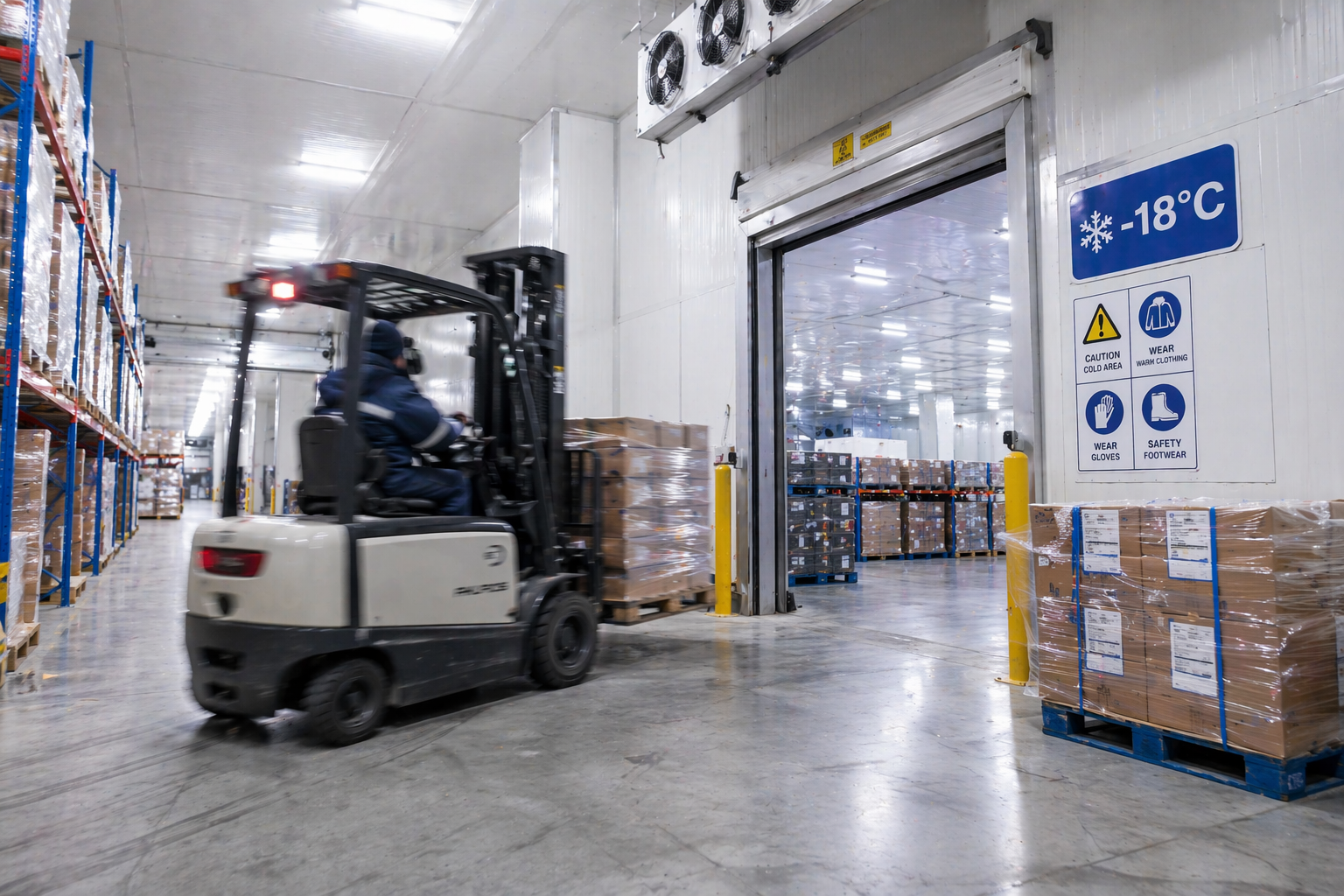
The main issue is simple: standard forklifts are usually designed for general indoor handling, not for long-hour operation in sub-zero conditions.
Many buyers focus on load capacity and lift height, but in freezer warehouse operations, those are only part of the selection logic. A forklift may meet the rated specifications on paper, yet still perform poorly because its systems are not designed to handle low temperatures consistently.
Standard Forklift vs Freezer Warehouse Conditions
| Fattore operativo | Standard Forklift Response | Typical Risk in Freezer Use |
|---|---|---|
| Battery performance | Discharge becomes less stable at low temperatures | Shorter uptime and more charging interruptions |
| Hydraulic response | Oil thickens and lifting response slows | Reduced handling precision and safety margin |
| Seals and rubber parts | Elasticity drops in sub-zero environments | Wear, leakage, and faster component aging |
| Condensation protection | Usually limited on standard indoor trucks | Electrical faults and visibility issues |
| Warehouse workflow fit | Often designed for ambient warehouse conditions | Poor efficiency in narrow aisles and dense freezer layouts |
A standard forklift may still move pallets inside a freezer, but that does not mean it is the right long-term equipment choice.
1. Low Temperature Affects Battery Performance
One of the most common problems is battery efficiency loss. In freezer rooms, batteries discharge faster and may require more frequent charging or battery change cycles. That means shorter working time and lower operational efficiency.
This issue becomes even more serious in high-frequency cold chain warehouses. A truck that performs well in ambient storage may no longer provide enough uptime inside a freezer. That is one reason a true low temperature forklift is often more reliable than a standard indoor model.
2. Hydraulic Systems Respond More Slowly
Low temperature changes the behavior of hydraulic oil. As viscosity increases, lifting and lowering functions may become slower or less responsive. Over time, this affects both efficiency and handling precision, especially in racking operations where stability matters.
For warehouses with medium or high lifting requirements, this is not just an efficiency issue. It can also become a safety concern.
3. Seals, Tires, and Rubber Components Wear Differently
Standard forklifts typically use components designed for ordinary warehouse conditions. In freezer environments, low temperature can make seals harder, reduce elasticity, and increase the risk of wear or leakage. Tires may also lose some grip or perform differently on cold, sometimes slippery floors.
These issues may not cause immediate failure, but they can shorten equipment life and increase maintenance frequency.
4. Condensation Creates Hidden Operational Risks
When forklifts move between normal-temperature zones and freezer rooms, condensation can form on electrical parts, metal surfaces, and the operator’s field of vision. This affects not only comfort, but also visibility, electrical reliability, and long-term component stability.
That is why a forklift for freezer environment often needs anti-condensation protection, not just stronger battery performance.
5. Standard Forklift Design May Not Match Freezer Workflow
Many freezer warehouses are built for high storage density. They usually have narrow aisles, higher racking, and strict throughput requirements. A standard forklift may technically enter the warehouse, but still not be the right tool if it lacks the right turning radius, mast performance, or freezer-ready configuration.
The problem is often not whether the forklift can enter the freezer. The problem is whether it can work there efficiently, safely, and consistently.
How to Judge Whether a Standard Forklift Is Enough
Not every cold storage project requires the same equipment level. The key is to understand when a standard forklift in cold storage may still be acceptable, and when a dedicated freezer warehouse forklift becomes necessary.
The most practical way is to judge the project from five factors: temperature, lifting height, aisle width, load condition, and operating frequency.
1. Temperature Requirement
Temperature is the first filter.
If the warehouse is only operating in chilled conditions, such as 0°C to 5°C, some standard electric forklifts with basic cold-storage adaptation may still work reasonably well.
But if the truck must work for long periods in freezer conditions such as -18°C, -25°C, or below, the requirement changes completely. At that point, a standard configuration often becomes a compromise rather than a solution.
The lower the temperature and the longer the exposure time, the stronger the need for a properly configured freezer warehouse forklift.
2. Lifting Height
The higher the lifting requirement, the more important forklift stability and hydraulic response become.
A standard forklift may still move pallets at ground level in a cold room, but when the job includes medium or high racking, slower hydraulic response and reduced stability can become more obvious. In freezer environments, the real question is not just whether the truck can reach the height, but whether it can do so safely and repeatedly under low-temperature conditions.
3. Aisle Width
Many freezer warehouses are designed with tighter aisle widths to maximize storage density. In that setting, equipment choice becomes more sensitive.
A wider aisle may allow more flexibility and make some standard trucks usable for basic work. But narrower aisles often require more specialized truck types, such as reach trucks or articulated solutions, especially when lift height is also part of the requirement.
4. Load Weight and Pallet Condition
A standard forklift may appear suitable based on capacity alone, but real freezer operations depend on more than tonnage. Pallet dimensions, load center, product stability, and fork entry direction all affect actual handling performance.
This matters even more at low temperatures, where efficiency margins are already reduced. A truck that is only “just enough” in a normal warehouse may become a weak solution in a freezer room.
5. Operating Frequency
This is often the deciding factor.
If a forklift enters the freezer only occasionally for short periods, a standard model with some adaptation may be acceptable in certain cases. But if the operation is continuous, multi-shift, or throughput-intensive, then the limitations of a standard forklift usually appear much faster.
For regular, high-frequency operation, a dedicated low temperature forklift is generally the safer and more economical choice in the long run.
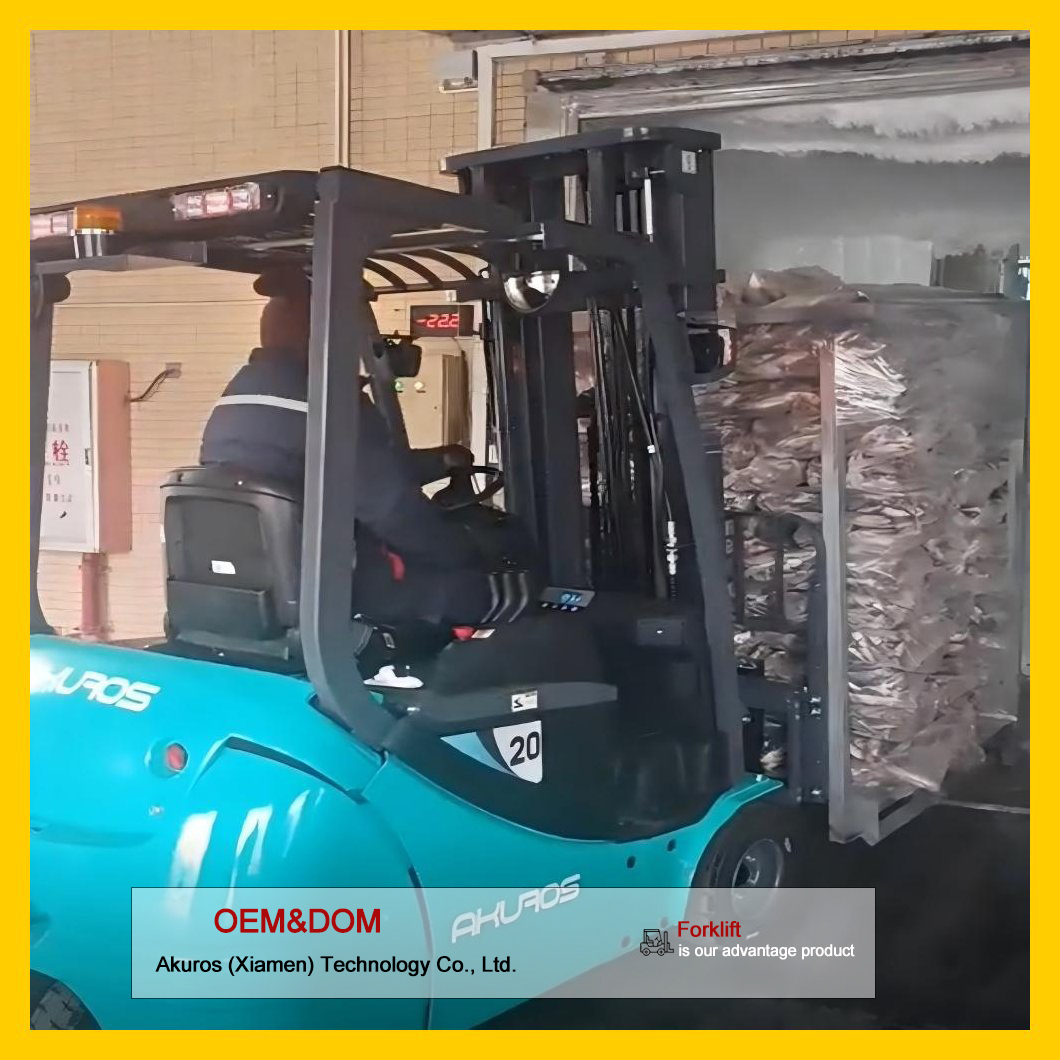
Standard Forklift vs Freezer Warehouse Forklift
The difference between the two is not just marketing language. It usually comes down to whether the truck is configured for the real operating environment.
A standard forklift is generally built for ambient warehouse use. It may work temporarily in cold storage, but it is not optimized for deep-freeze performance, anti-condensation protection, or long-duration low-temperature reliability.
A freezer warehouse forklift, by contrast, is usually configured with features such as:
- olio idraulico a bassa temperatura
- cold-resistant seals and hoses
- anti-condensation electrical protection
- suitable battery or energy configuration for freezer work
- better component protection for sub-zero conditions
- optional operator comfort upgrades depending on project needs
The right choice depends on how demanding the freezer operation really is. But in serious freezer warehouse applications, dedicated configuration is usually the better long-term solution.
Which Projects Can Still Use a Standard Forklift — and Which Cannot?
A standard forklift may still be acceptable when:
- the warehouse is chilled rather than deep frozen
- freezer entry is occasional and short
- lifting height is limited
- throughput is low
- aisle conditions are relatively forgiving
But a standard forklift becomes a poor choice when:
- the truck works for long hours inside a freezer
- the temperature is consistently very low
- the warehouse has medium or high racking
- throughput is high and downtime is costly
- the operation depends on stable, continuous indoor performance
In these cases, continuing to rely on a standard forklift in cold storage usually leads to reduced efficiency, higher maintenance, and greater operational risk.
Approfondimenti degli esperti
Expert Insight 1: The biggest mistake in freezer warehouse forklift selection is assuming that a truck which works in ambient storage will behave the same way in sub-zero operation. It rarely does.
Expert Insight 2: In many freezer projects, the issue is not whether the forklift can work for one shift. The real issue is whether it can continue performing efficiently every day without accelerating downtime and maintenance.
Final Recommendation
For most true freezer warehouse operations, the better direction is clear: use a dedicated freezer warehouse forklift, not a standard general-purpose truck.
A standard forklift may still work in limited cold room applications, especially when temperatures are not too low and operating time is short. But once the warehouse involves deep-freeze conditions, regular use, tighter aisles, or higher lifting tasks, the limitations become harder to ignore.
In practical terms, the colder the environment, the higher the racking, and the more frequent the operation, the stronger the case for choosing a true forklift for freezer environment.
The right forklift should not only enter the freezer. It should perform there reliably, safely, and efficiently over time.
Send Us These 6 Details
If you want to identify the right forklift solution for your cold storage or freezer warehouse, please share the following details:
- pallet dimensions
- cargo weight
- lifting height
- aisle width
- temperature requirement
- target storage capacity
With these six points, it becomes much easier to judge whether a standard truck is enough, or whether your project needs a dedicated freezer warehouse forklift solution.
FAQ
Can a standard forklift be used in a freezer warehouse?
In limited chilled or short-duration freezer applications, sometimes yes. But for long-hour sub-zero use, standard forklifts often become unreliable and inefficient.
Why do forklifts fail faster in freezer environments?
Because low temperatures affect battery efficiency, hydraulic response, seals, traction, and condensation-related electrical reliability.
What is the biggest problem with a standard forklift in cold storage?
The biggest problem is usually not load capacity. It is unstable long-term performance under low-temperature, high-frequency operation.
When should I choose a dedicated freezer warehouse forklift?
When the truck will work for long hours in deep-freeze conditions, support medium or high racking, or operate in a high-throughput cold chain workflow.
Does a freezer warehouse forklift really reduce long-term cost?
Yes. Although initial configuration may cost more, it usually reduces downtime, maintenance, and efficiency loss over time.