

 Italian
  English
  Russian
  French
  Spanish
  German
  Portuguese
  Korean
  Japanese
  Arabic
  Turkish
  Indonesian
  Dutch
Dutch 

In modern cold chain logistics, every small design detail plays a major role in determining operational efficiency, energy consumption, and product safety. One such overlooked but essential rule is that cold storage racks must be elevated at least 10 centimeters (about 4 inches) above the floor.
While it may seem like a minor construction guideline, this specification reflects a deep integration of engineering, thermodynamics, hygiene management, and operational science.
In this article, Akuros engineers explain the real-world reasoning behind this rule — and how it helps businesses reduce costs, improve warehouse safety, and maintain optimal cold storage performance.
1. Environmental Adaptation: Combating Moisture, Frost, and Condensation
Cold storage environments constantly battle high humidity, frost, and condensation. The combination of low temperatures and moisture in the air can cause water droplets to form on floors, eventually seeping into any metal surface that touches them.
If rack bases are in direct contact with the floor, two major issues occur:
-
Corrosion acceleration:
Cold storage environments amplify galvanic corrosion. Electrolytic moisture and temperature fluctuations speed up oxidation, causing rust and structural weakness.
Field studies show that racks placed directly on cold storage floors corrode up to 2.3 times faster than elevated racks. This directly reduces rack lifespan and increases replacement frequency. -
Product contamination and packaging degradation:
Condensation and frozen moisture on the ground can easily penetrate paper packaging or wooden pallets. Within 24 hours, the humidity inside a paper carton can increase from 8% to 15%, reducing its strength by up to 40% and raising the risk of mold growth on food products.
By raising racks 10 cm or more, an air insulation layer is created. This gap prevents capillary moisture transfer, improves local air circulation, and reduces humidity by 12–18% around the base of the racks. It’s a simple yet effective method to protect both your racking system and stored goods.
2. Temperature Stability and Energy Efficiency
Temperature distribution in cold storage facilities is rarely uniform. Floors, especially those close to insulation barriers, tend to be 2–3°C warmer than the ambient air temperature due to heat transmission from below.
When goods sit directly on the floor or on low racks, they are exposed to micro temperature fluctuations, which can:
-
Accelerate ripening or spoilage of fruits and vegetables (as their respiration rate changes by 10–15% for each 1°C variation).
-
Force refrigeration systems to overcompensate for uneven cooling, consuming more energy.
Raising racks forms a buffer zone where air can circulate freely, allowing cold air to flow evenly and stabilize the temperature field.
In fact, energy audits show that warehouses using elevated racks achieve up to 8% higher cooling efficiency, translating to annual electricity savings of 10,000–15,000 kWh for a 3,000 m² facility.
3. Structural and Mechanical Safety
Beyond temperature and moisture concerns, elevation plays a key role in structural safety and equipment protection.
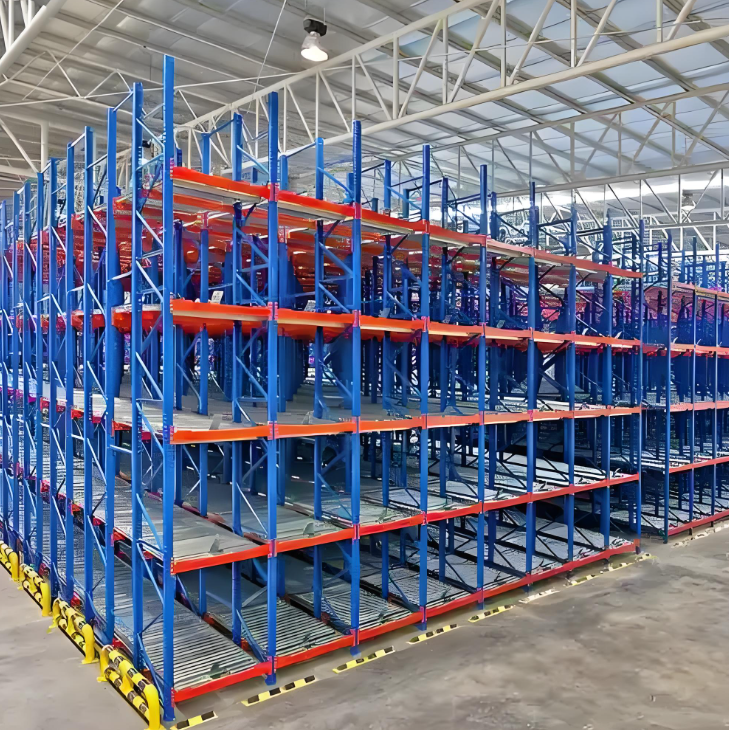
(a) Load Distribution and Floor Longevity
Cold storage floors, often made of reinforced concrete, are designed to bear heavy static loads. However, if racks rest directly on the floor without distribution supports, localized pressure points can cause uneven settlement or cracking over time.
Raised racks spread the load more evenly across multiple contact points, reducing per-area stress by 30–40%. This simple adjustment significantly extends the service life of both the racking system and the cold storage floor.
(b) Equipment and Pipeline Protection
Cold storage floors typically conceal refrigerant lines, drain systems, and electrical conduits.
If racks are installed directly on the floor, even small installation errors can lead to pipe compression or cable damage.
By maintaining a clearance of at least 10 cm, operators gain safe access for inspection and maintenance — cutting repair times by half and avoiding unnecessary system downtime.
Additionally, this clearance helps absorb vibrations generated by compressors and forklifts, minimizing structural stress and enhancing seismic resilience. Testing shows that raised rack structures can improve seismic resistance by up to one intensity level.
4. Hygiene Compliance: Meeting International Standards
Food safety in cold storage environments is non-negotiable. Elevating racks is not just good engineering — it’s a legal and hygiene requirement in nearly all global standards.
Regulations including:
-
GB 31605-2020 (China’s National Cold Chain Hygiene Standard),
-
FDA Food Code (U.S.), e
-
EC Regulation 852/2004 (European Union),
all stipulate that storage equipment must maintain a minimum 10 cm (4-inch) clearance from the ground to ensure cleaning and sanitation accessibility.
This design improvement offers three hygiene benefits:
-
Eliminates contamination points: Cleaning water and disinfectant residues drain freely instead of pooling under racks, reducing the presence of cold-tolerant bacteria like Listeria monocytogenes by over 60%.
-
Allows full disinfection coverage: Cleaning nozzles can easily reach under racks, improving sanitation coverage from 65% to 98%.
-
Ensures regulatory compliance: Elevation guarantees compliance with HACCP and ISO 22000 certification audits — preventing costly penalties and shipment rejections.
In one case, a European audit found a cold storage facility non-compliant for having racks only 8 cm above ground. The company lost a major client contract worth over USD 250,000 due to failed hygiene verification — a mistake easily avoidable by adhering to the 10 cm standard.
5. Operational Convenience and Warehouse Efficiency
Elevation isn’t just about compliance — it improves workflow and daily operations.
(a) Improved Forklift Handling
When racks are elevated, forklifts can approach and lift pallets faster, reducing maneuvering time.
Studies show that loading/unloading efficiency can increase by 20%, allowing warehouses to process hundreds of additional pallets per day with the same labor force.
(b) Smarter Monitoring and Automation
The 10 cm clearance allows installation of IoT sensors, RFID tags, and floor-mounted scanning systems, which support real-time stock monitoring and predictive maintenance — key features in modern smart cold storage.
(c) Emergency Response Protection
In case of ground leaks, defrosting, or accidental flooding, elevated racks keep goods protected for at least 1–2 hours before any potential water contact. This “protection window” can make the difference between a small maintenance issue and a major product loss.
6. Cost and Lifecycle Advantages
From a cost perspective, the long-term savings outweigh the initial construction expense.
| Fattore | Without elevation | With 10 cm elevation |
|---|---|---|
| Rack lifespan | 8 years | 12+ years |
| Maintenance downtime | Alto | Reduced by 50% |
| Energy consumption | +8% | Optimized airflow efficiency |
| Product spoilage | 0.8–1.2% | <0.3% |
| Hygiene compliance risk | Alto | Fully compliant |
The small design change of raising rack bases typically costs 8–12% more during installation, but it pays for itself within 2–3 years through lower energy use, less product loss, and extended equipment lifespan.
7. Material and Design Recommendations
Depending on the facility type, different elevation materials can be selected:
| Material Type | Advantages | Il migliore per |
|---|---|---|
| Reinforced concrete blocks | High load capacity and corrosion resistance | Heavy-duty cold stores |
| Galvanized steel supports | Adjustable height, easy installation | Multi-temperature zones |
| Engineering plastic bases | Insulation and anti-cold bridge properties | Pharmaceutical cold rooms |
| Hybrid steel-concrete design | Supports integrated cabling and drainage | Automated warehouse systems |
When installing raised racks, ensure:
-
Surface level tolerance ≤ 2 mm/m²,
-
Anti-condensation pads under metal supports,
-
Proper drainage slope (≥2‰),
-
Anti-static grounding resistance ≤10Ω (for plastic supports).
These details collectively determine the safety, efficiency, and durability of the cold storage facility.
8. The Future: Smart Adjustable Rack Systems
As warehouses evolve toward intelligent and automated systems, even the base structure is becoming smarter.
The latest developments include:
-
Hydraulic-adjustable bases to adapt rack height to different pallet sizes;
-
Sensor-embedded supports to monitor temperature, load, and humidity in real time;
-
IoT connectivity for predictive maintenance and automatic fault alerts.
At Akuros, we continuously integrate such technologies into our one-stop cold storage solutions, combining racking systems, forklifts, batteries, and material-handling automation to help clients build smarter and safer warehouses.
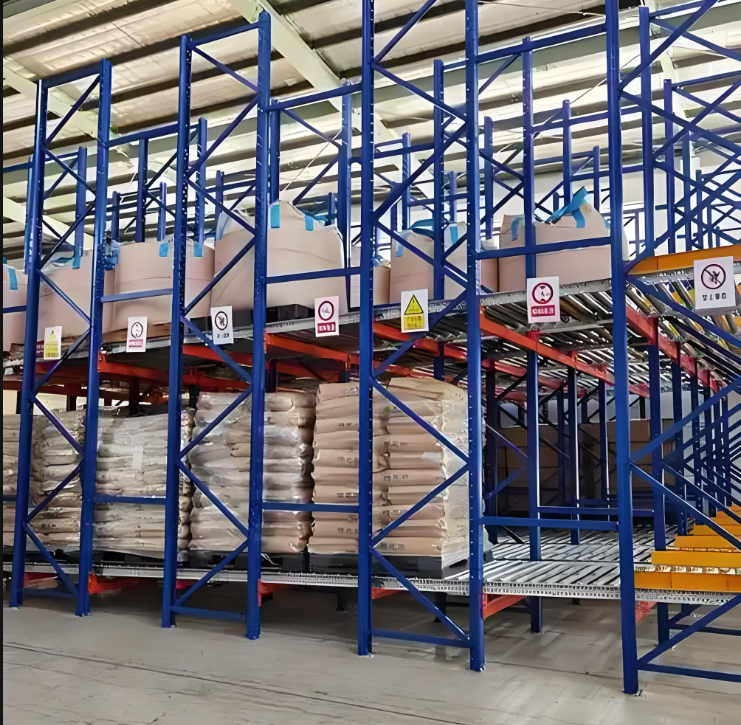
Conclusion: A Small Design That Delivers Big Value
Raising cold storage racks by at least 10 cm is not just a recommendation — it’s an engineering best practice that optimizes temperature control, extends equipment life, ensures food safety, and lowers energy costs.
For cold chain operators, this simple design rule can protect millions in stored inventory while maintaining global compliance standards.
A Akuros, we deliver fully integrated cold storage and material handling solutions, designed for performance, safety, and efficiency — helping our partners lead the next generation of intelligent cold chain logistics.