

 Italian
  English
  Russian
  French
  Spanish
  German
  Portuguese
  Korean
  Japanese
  Arabic
  Turkish
  Indonesian
  Dutch
Dutch 

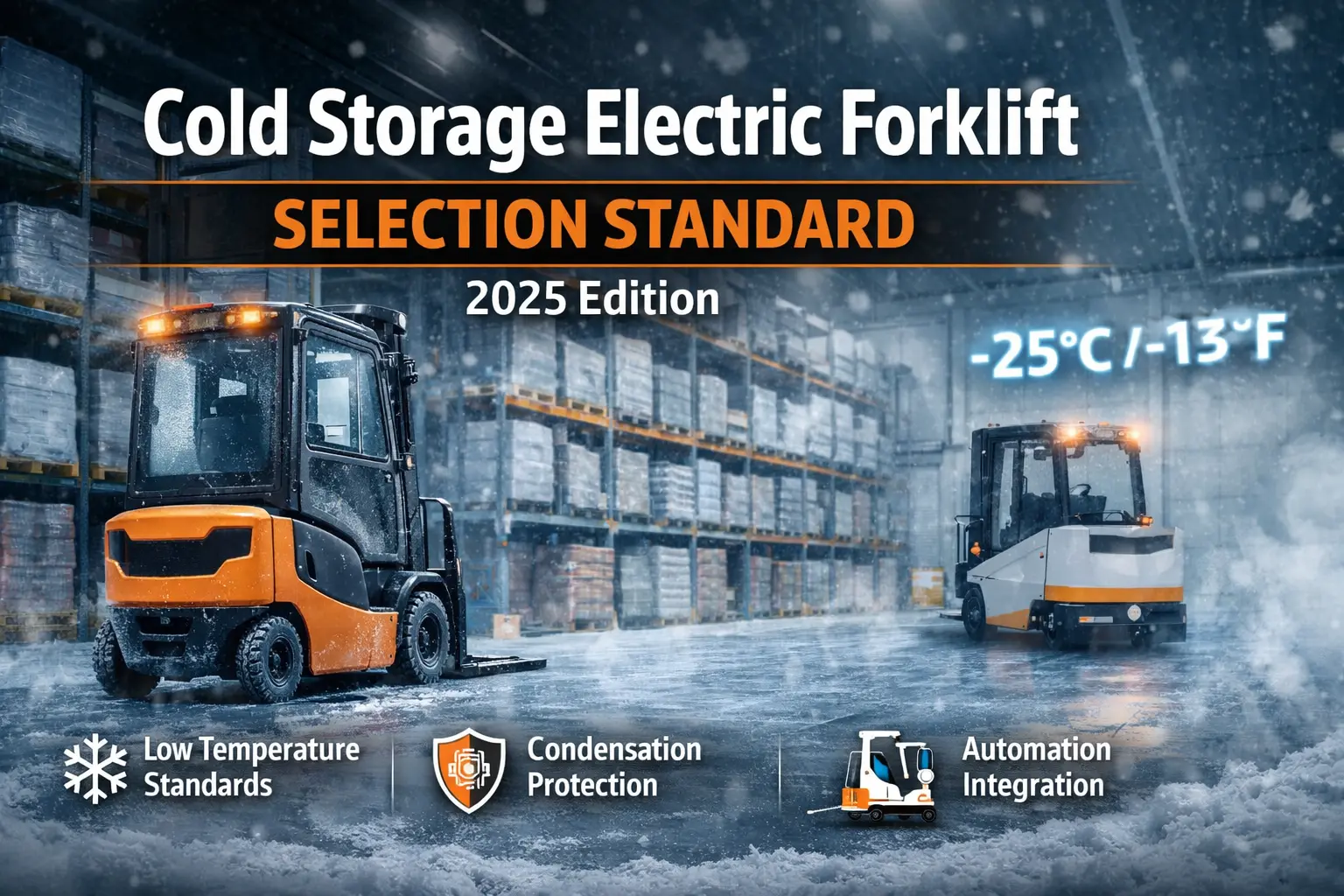
Selecting an electric forklift for cold storage is fundamentally different from choosing standard warehouse equipment. This guide defines a practical selection standard for -25°C to -30°C cold rooms, helping logistics operators, 3PL providers, and cold chain facility owners avoid costly downtime, safety risks, and long-term operational failures.
1. Why Cold Storage Forklifts Are Not “Normal” Electric Forklifts
Cold storage environments introduce a combination of extreme low temperatures, condensation, and high operational intensity that conventional electric forklifts are not designed to withstand.
Typical failure points in frozen warehouses include:
-
Rapid battery capacity loss below -20°C
-
Electronic control malfunctions caused by condensation
-
Lubricant thickening leading to mechanical wear
-
Reduced braking and traction on icy floors
In practice, many cold storage projects fail not because of poor operators, but because equipment was selected using ambient-temperature logic.
For this reason, cold chain projects should always start with integrated warehouse planning, not isolated equipment purchases. This is where a one-stop approach to warehouse design and equipment selection becomes critical.
(Internal reference: https://www.akuros.com/warehouse-solution/)
2. The 6 Mandatory Parameters for -25°C Electric Forklift Operation
An electric forklift that performs well at room temperature may become unreliable or unsafe in frozen environments. Based on real cold storage operating conditions, the following parameters should be treated as non-negotiable selection standards.
2.1 Battery System & Thermal Protection
-
Cold-resistant battery chemistry
-
Insulated battery compartments
-
Stable discharge performance at -25°C
Forklifts without proper battery thermal management will experience frequent shutdowns and accelerated degradation.
(Reference: https://www.akuros.com/forklift-battery/)
2.2 Electronic Control & Condensation Protection
-
Sealed controllers and wiring
-
Anti-condensation design for frequent in–out operations
-
IP-rated electronic components
Moisture ingress is one of the most underestimated risks in cold storage forklift operation.
2.3 Lubrication & Sealing Systems
-
Low-temperature hydraulic oil
-
Cold-resistant seals and hoses
-
Consistent performance during extended frozen shifts
2.4 Tires & Ground Contact Performance
-
Polyurethane or cold-specific compounds
-
Stable traction on frozen or damp floors
-
Reduced rolling resistance in low temperatures
(Reference: https://www.akuros.com/polyurethane-tires/)
2.5 Structural Integrity & Corrosion Resistance
-
Reinforced steel structures
-
Anti-corrosion treatment for humid cold rooms
2.6 Safety Redundancy for Cold Environments
-
Enhanced braking response
-
Operator visibility systems
-
Emergency shutdown protection
If any of these parameters are missing, the forklift should be considered unsuitable for frozen warehouse operations.
3. Expert Insights from Cold Chain Projects
Expert Insight #1 — Cold Storage Operations Director (Europe)
“The biggest mistake we made early on was assuming electric forklifts were ‘all the same.’ Battery performance and electronics stability became our biggest hidden cost.”
Expert Insight #2 — 3PL Cold Chain Manager (Australia)
“Downtime in a frozen warehouse is not linear. One forklift failure often disrupts the entire picking and staging flow.”
Expert Insight #3 — Warehouse Automation Consultant (North America)
“Forklift selection must align with future automation plans. Equipment that cannot integrate with AGV systems becomes obsolete much faster.”
(Expert insights included selectively; not mandatory for every article.)
4. Common Wrong Choices Buyers Make in Cold Storage Projects
Despite growing awareness, several recurring mistakes still appear in cold chain facilities worldwide:
-
Choosing forklifts based on purchase price instead of lifecycle cost
-
Applying ambient warehouse experience to frozen environments
-
Ignoring future automation compatibility
-
Separating forklift procurement from racking and layout planning
High-density storage systems such as double deep or drive-in racking amplify these risks if forklift performance is underestimated.
(Reference:
https://www.akuros.com/double-deep-racking-solutions/
https://www.akuros.com/drive-in-racking-system/)
5. Application Scenario Matrix: Matching Forklifts to Cold Storage Use Cases
Different cold chain operations impose different demands on electric forklifts:
-
Seafood & Frozen Food Processing: High humidity, frequent door cycles
-
Pharmaceutical Cold Storage: Precision handling, safety compliance
-
3PL Cold Chain Warehouses: High throughput, multi-shift operation
-
Automated & Semi-Automated Facilities: Integration with AGVs and WMS
Forklift selection should always be aligned with racking systems, aisle width, e future automation readiness.
(Reference: https://www.akuros.com/automated-solutions/)
6. Why Integrated Planning Matters More Than Forklift Price
In cold storage projects, forklifts are not standalone assets. They are part of a larger system that includes:
-
Warehouse layout and racking design
-
Material flow and picking logic
-
Automation and AGV integration
-
Long-term service and maintenance planning
A one-stop, end-to-end approach significantly reduces operational risk and improves ROI over the full lifecycle of the warehouse.
(Reference: https://www.akuros.com/about/)
7. Final Pre-Purchase Checklist for Cold Storage Forklifts
Before finalizing any electric forklift for frozen environments, decision-makers should confirm:
-
✔ Certified low-temperature operation capability
-
✔ Battery and electronics protected against condensation
-
✔ Compatibility with current and future warehouse systems
-
✔ Proven experience in cold chain applications
-
✔ Long-term service and technical support availability
8. Related Google Popular Topics (Contextual Answers)
1. What temperature can electric forklifts operate at?
High-quality cold storage electric forklifts can operate reliably at -25°C to -30°C with proper battery and electronic protection.
2. Are electric forklifts better than diesel forklifts for cold storage?
Yes. Electric forklifts offer zero emissions, lower noise, and better indoor safety, especially in enclosed frozen environments.
3. How long do forklift batteries last in cold storage?
Battery lifespan depends on chemistry, insulation, and charging strategy. Poorly protected batteries degrade significantly faster.
4. Do cold storage forklifts require special maintenance?
Yes. Lubrication, seals, and electronics require cold-specific inspection routines.
5. Can electric forklifts be integrated with AGV systems?
Many modern electric forklifts can be integrated into semi-automated or hybrid AGV systems if planned correctly.
6. What forklifts work best with double deep racking in cold storage?
Reach trucks and cold-adapted counterbalanced forklifts are commonly used, depending on aisle width and load height.
9. Structured FAQ (For Direct Embedding)
Q1: Can standard electric forklifts be used in cold storage?
A: Standard forklifts are not designed for condensation and low-temperature stress, leading to frequent failures in cold rooms.
Q2: What is the biggest risk when choosing forklifts for frozen warehouses?
A: Underestimating battery performance and electronic protection requirements.
Q3: Is it better to plan forklifts separately from racking systems?
A: No. Forklift selection must align with racking layout, aisle width, and future automation plans.
Q4: Are AGVs suitable for all cold storage warehouses?
A: Not all. AGV adoption depends on throughput, layout stability, and ROI thresholds.
Q5: What is the advantage of a one-stop warehouse solution?
A: Reduced integration risk, optimized performance, and better long-term cost control.