

 Italian
  English
  Russian
  French
  Spanish
  German
  Portuguese
  Korean
  Japanese
  Arabic
  Turkish
  Indonesian
  Dutch
Dutch 

Selecting the right racking system is one of the most critical decisions in cold storage warehouse design. This article compares double deep, drive-in, and very narrow aisle (VNA) racking systems from a cold-chain perspective, helping operators balance storage density, operational efficiency, forklift compatibility, and long-term flexibility.
1. Why Racking Selection Is More Critical in Cold Storage
In cold storage warehouses, racking systems are not just storage structures. They directly determine:
-
How much cubic space can be utilized
-
Which forklifts can operate safely and efficiently
-
How fast pallets can be accessed and moved
-
Whether future automation is feasible
Because cold rooms are expensive to build and operate, mistakes in racking selection often become structural constraints that are extremely costly to correct after commissioning.
For this reason, racking decisions in frozen warehouses must be made as part of an integrated soluzione di magazzino, rather than treated as a standalone storage problem.
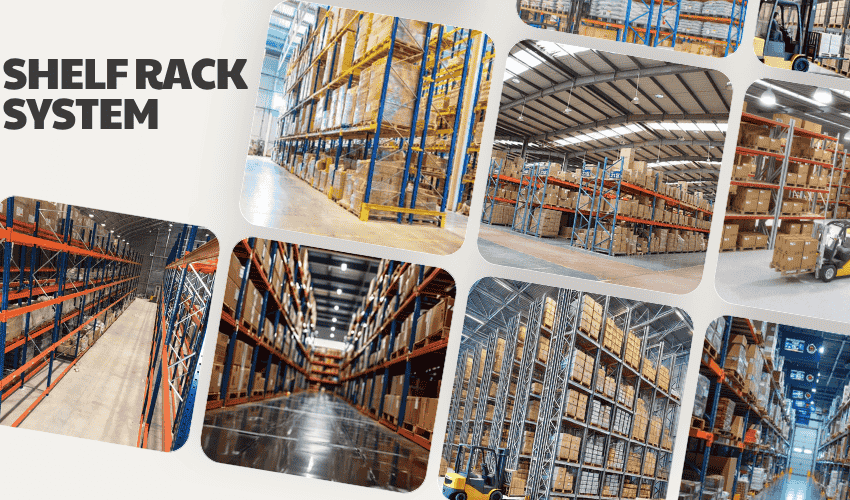
Sistema di scaffalatura a ripiani
2. The Three Dominant Racking Systems Used in Cold Storage
Although many racking variants exist, most cold storage warehouses rely on three core systems, each optimized for a different operational priority:
-
Double deep racking for balanced density and accessibility
-
Drive-in racking for maximum pallet density
-
Very narrow aisle (VNA) racking for high selectivity and automation readiness
Each system represents a different trade-off between storage density, SKU selectivity, throughput, and long-term flexibility.
Before analyzing each system in detail, the following table provides a high-level comparison framework that helps decision-makers quickly understand how these racking types differ in real cold storage operations.
3. Cold Storage Racking Systems — Comparison Overview
📊 Cold Storage Racking Systems Comparison
| Decision Dimension | Scaffalatura a doppia profondità | Drive-In Racking | Scaffalatura VNA |
|---|---|---|---|
| Densità di stoccaggio | Alto | Molto alto | Medium–High |
| SKU Selectivity | Medio | Basso | Molto alto |
| Typical Inventory Logic | FIFO / Controlled LIFO | LIFO | FIFO |
| Ideal SKU Profile | Medium SKU variety | Homogeneous SKUs | High SKU variety |
| Aisle Width Requirement | Medio | Minimo | Very Narrow |
| Forklift Compatibility | Reach trucks / cold electric forklifts | Counterbalanced forklifts | Guided VNA trucks |
| Throughput Potential | Medium–High | Medio | Alto |
| Automation Readiness | Medio | Basso | Alto |
| Expansion & Reconfiguration | Medio | Basso | Alto |
| Typical Cold Storage Use Case | Frozen food DCs | Bulk frozen storage | High-turnover cold warehouses |
This table provides a strategic overview. The optimal racking choice ultimately depends on how these systems interact with forklift selection, cold-room operating conditions, and long-term automation strategy.
4. How to Read This Table (Important)
The comparison above is not intended to declare a single “best” racking system. Instead, it highlights how each option prioritizes different operational goals:
-
Density-focused operations tend to favor drive-in or double deep racking
-
Throughput- and selectivity-driven warehouses lean toward VNA solutions
-
Facilities planning future automation should weigh flexibility more heavily than raw pallet count
With this framework in mind, the following sections analyze each racking system in detail, focusing on where it performs best, where it introduces risk, and how it interacts with forklift selection in cold storage environments.
5. VNA Racking: Selectivity and Automation Readiness
Very narrow aisle racking systems prioritize selectivity and vertical space utilization by minimizing aisle width and increasing storage height.
Key Characteristics
-
Narrow aisles with guided forklifts
-
High selectivity
-
Strong compatibility with automation
Where VNA Works Best
-
High SKU diversity
-
Frequent picking operations
-
Cold storage facilities planning future automation
VNA systems require specialized reach trucks and precise floor flatness, but they offer long-term flexibility for cold storage warehouses evolving toward higher automation levels.
6. Forklift and Racking Compatibility: A Non-Negotiable Factor
Racking systems cannot be evaluated independently of material handling equipment. In cold storage, this relationship becomes even more critical.
-
Double deep racking typically pairs with reach trucks designed for cold environments
-
Drive-in racking demands highly stable carrelli elevatori controbilanciati with excellent operator visibility
-
VNA racking relies on guided equipment and precise maneuvering
Ignoring forklift–racking compatibility is one of the most common causes of reduced throughput and safety incidents in frozen warehouses.
7. Automation and Future-Proofing Considerations
Cold storage warehouses increasingly move toward automation, but not all racking systems adapt equally well.
-
VNA racking offers the strongest foundation for future automation
-
Double deep racking can be partially automated with shuttle or hybrid solutions
-
Drive-in racking is difficult to automate without major structural changes
For this reason, racking selection should align with long-term automation strategies, including automated warehouse solutions and potential AGV integration.
8. Common Mistakes in Cold Storage Racking Selection
Even experienced operators repeat the same mistakes:
-
Selecting racking based solely on pallet count
-
Ignoring forklift operating conditions at -25°C
-
Prioritizing maximum density over operational resilience
-
Separating racking decisions from automation planning
In cold storage environments, these mistakes often lead to congestion, safety risks, and permanently constrained throughput.
9. How to Choose the Right Racking System for Your Cold Storage
A practical decision framework should consider:
-
SKU profile and turnover rate
-
Required storage density
-
Forklift type and aisle width
-
Automation roadmap
-
Expansion and reconfiguration flexibility
Warehouses that evaluate racking systems within an end-to-end cold storage warehouse solution consistently achieve better long-term ROI and operational stability.
10. Google Popular Topics (Contextual Answers)
Which racking system is best for cold storage warehouses?
The best system depends on SKU variety, throughput, and long-term automation plans.
Is drive-in racking suitable for high-turnover cold storage?
Generally no. Drive-in racking is better suited for homogeneous SKUs with low turnover.
Can VNA racking be used in frozen warehouses?
Yes, provided floor flatness, guided equipment, and cold-rated forklifts are properly specified.
Does double deep racking support FIFO operations?
Yes, with proper inventory management and operational discipline.
How does racking choice affect forklift selection in cold storage?
Racking geometry directly determines forklift type, reach capability, and safety requirements.