

 Russian
  English
  French
  Spanish
  German
  Italian
  Portuguese
  Korean
  Japanese
  Arabic
  Turkish
  Indonesian
  Dutch
Dutch 

Damage rarely happens because carton clamps are “too strong” or “too rough” in some abstract sense. Damage happens because clamp force, pad friction, carton strength, and driving dynamics are not matched to the load’s real limits. When these variables are managed with measurable targets, carton clamps can be one of the cleanest ways to reduce handling steps while maintaining product appearance standards that customers actually inspect.
This article is written for warehouse managers, safety leads, and procurement teams who want predictable, repeatable, damage-free carton clamping—especially for appliances, FMCG master cartons, furniture packs, and export cartons that must arrive with clean corners.
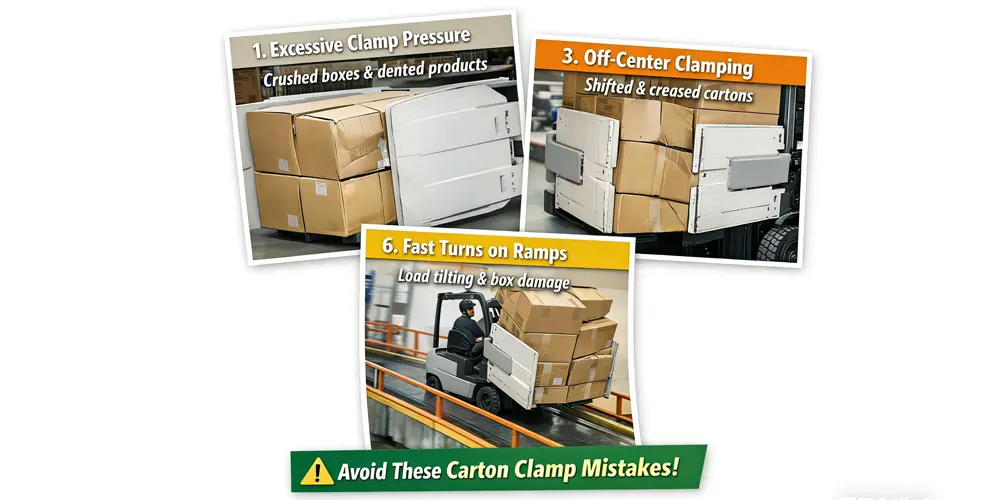
Why carton clamp damage happens in the real world
Cartons fail in three common ways during clamping:
First is panel compression: the clamp pads push harder than the carton’s panel can resist, leaving dents, crushed flutes, or “ghost marks” that show up after unpacking.
Second is edge collapse: the carton corners buckle because force is concentrated on edges or because the carton’s edge crush strength is too low for the chosen clamp pressure.
Third is slip and impact: the load slips inside the pads during acceleration, turning, or uneven floors, causing corner impacts or internal product movement.
Most teams respond by lowering clamp pressure until dents disappear. That usually creates a new problem: load slip increases, operators compensate with more tilt and more speed, and damage returns in a different form. The correct approach is to fix the root variables: correct clamp force window, correct pads, correct alignment, correct driving profile, and correct training routine.
Key material parameters that actually matter (and how to read them)
To prevent damage, carton clamp settings must match packaging strength and surface friction.
Carton strength: ECT and compression reality
Edge Crush Test (ECT) is a practical indicator of how well corrugated board resists edge compression. In many supply chains, cartons are stamped with values such as 32 ECT, 44 ECT, or 48 ECT. These numbers are not decoration; they correlate with how easily corners and edges buckle during clamp handling.
Two things complicate reality:
-
Carton strength drops with humidity. In humid dock areas, effective strength can decrease noticeably, especially for long-dwell storage.
-
Overhang and voids amplify damage. A carton with internal voids (air gaps) deforms earlier because the panel is unsupported.
Pad friction: the “hidden force multiplier”
Even if clamp pressure is set perfectly, pads with the wrong friction characteristics will cause slip. Slip leads to impact damage and forces operators to increase clamp pressure beyond what the carton can tolerate.
A simple way to think about it:
-
Higher pad friction = less clamp force required to prevent slip
-
Lower pad friction = more clamp force required (and more dent risk)
Load dynamics: the overlooked cause of dents
If an operator turns sharply with a clamped load, the load experiences lateral acceleration. Even a modest 0.2 g lateral event (≈ 1.96 m/s²) can shift the load against one pad, concentrating force on edges and increasing local compression. This is why “we set the pressure correctly” can still coexist with dents: the pressure may be correct for straight travel, but not for aggressive turning.
The seven mistakes that cause most carton clamp damage
 |
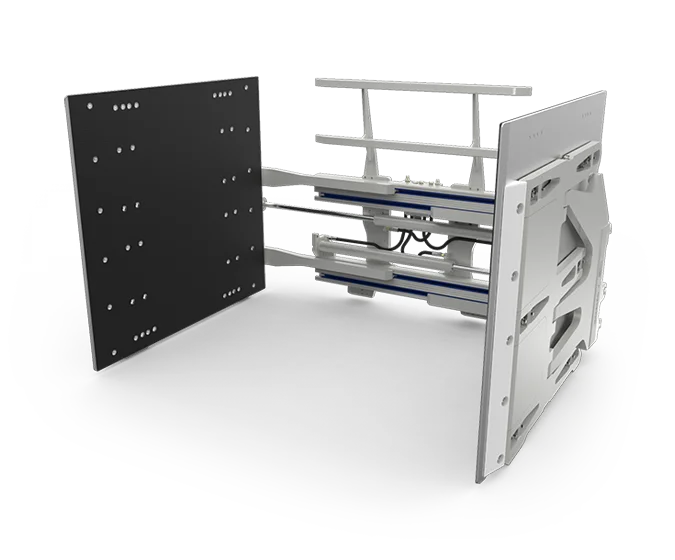 |
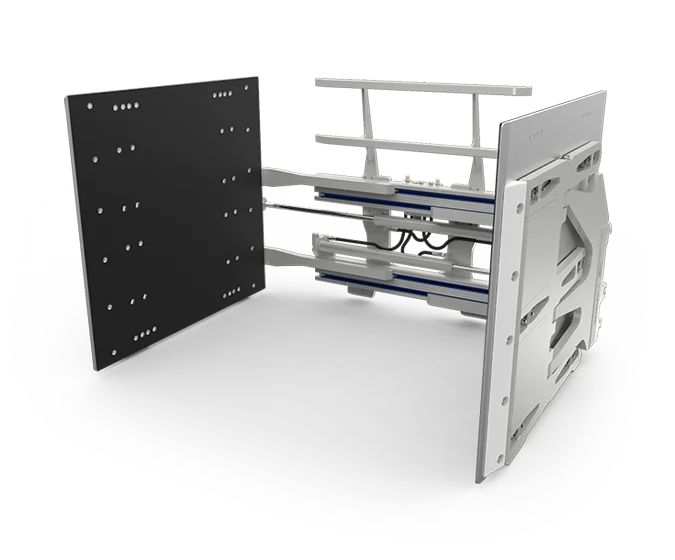
The following seven mistakes account for the bulk of real damage cases in mixed-load warehouses.
Mistake 1: Setting clamp pressure once and never validating it by load type
What happens
Many sites set clamp pressure based on a single product trial, then run everything through the same pressure. That’s how appliance cartons get crushed after a configuration optimized for rigid FMCG master cartons—or how FMCG loads start slipping because pressure was reduced to protect weaker packaging.
How to avoid it
Use a pressure validation method that finds the minimum pressure that prevents slip, then verifies it does not create damage across real operating conditions.
Practical target: establish a clamp-force “window,” not a single value. The window is the range where:
-
Slip rate is near zero under normal acceleration and turning
-
Visible carton deformation is zero or within acceptable cosmetic limits
A workable warehouse method is to adjust in small increments and test under representative conditions (ramps, turns, uneven floors, dock plates). Technical bulletins from major attachment makers commonly recommend incremental adjustments rather than large jumps, because the safe window can be narrower than teams expect.
Real scenario
A distribution center clamping mixed appliance cartons and flat-packed furniture set pressure based on furniture packs (which had rigid internal support). Appliance cartons began showing shallow dents at the pad contact zone. Lowering pressure reduced dents but introduced slip during dock plate transitions. The fix was not “lower pressure forever”; it was to introduce a second pressure profile and standardize a lower lateral-acceleration driving routine for appliances.
Measurement checklist
-
Record pressure setting (psi or bar) for each load family
-
Track monthly “damage per 1,000 moves” and “slip events per 1,000 moves”
-
Revalidate after packaging supplier change, seasonal humidity shift, or pad replacement
Mistake 2: Using the wrong pad material or pad geometry for the carton surface
What happens
Pad choice is often treated as an accessory detail. In reality, pads directly control contact pressure distribution and friction.
Common failure patterns:
-
Smooth pads on glossy cartons → slip increases → operators increase pressure → dents appear
-
Overly aggressive pads on thin cartons → friction is high but contact is uneven → corner crush and “hot spots” occur
-
Worn pads → friction drops and contact becomes patchy → slip + localized dents
How to avoid it
Select pad materials based on carton surface and the site’s cleanliness realities (dust, shrink film residue, condensation). Then inspect pad condition on a schedule.
Typical friction behavior (illustrative values; verify with pad supplier testing):
| Pad surface type | Typical friction vs corrugated (dry) | Slip risk | Dent risk |
|---|---|---|---|
| Smooth rubber | 0.35–0.55 | Средний | Средний |
| Textured rubber | 0.55–0.80 | Низкий | Medium (if uneven) |
| High-friction composite | 0.70–0.95 | Very low | Medium–High (needs distribution control) |
| Worn/contaminated pad | < 0.35 | Высокий | High (operators over-clamp) |
Operational rule: any pad change should trigger a pressure revalidation, because friction changes the minimum force needed to prevent slip.
Real scenario
A retailer’s cold-room operation saw slip spikes after condensation formed on cartons during dock-to-freezer transitions. The team raised pressure to stop slip. Dents increased. The better fix was to use pad surfaces designed to maintain friction in wet conditions and reduce turning acceleration inside the freezer aisle.
Mistake 3: Ignoring carton strength ratings and internal voids
What happens
Cartons are not “all the same.” Two cartons of the same outer size can behave completely differently if one is 44 ECT with internal partitions and the other is 32 ECT with void space.
Dents and crush often appear when:
-
carton ECT is lower than assumed
-
internal product does not support the panel at the pad contact zone
-
cartons were stored in humid conditions
-
packaging has been downgraded without communicating to operations
How to avoid it
Build a simple carton strength check into receiving or change-control:
-
Read carton stamps (ECT or burst rating) when available
-
Identify void-heavy products (air gaps) and treat them as “low panel support”
-
Consider humidity exposure at docks and staging areas
-
When packaging changes, revalidate clamp window
Practical engineering lens:
-
If the carton has low edge strength, reduce local edge loading by improving pad distribution and alignment, not by relying only on lower pressure.
-
If internal voids exist, reposition pad contact zones to areas with internal support when possible.
A quick internal guideline many teams use:
-
Low-support carton: treat as “higher dent sensitivity” and reduce dynamic events (turning/tilt speed) even if clamp force is within a safe range.
Mistake 4: Clamping off-center or accepting misalignment as “normal”
What happens
Misalignment is one of the fastest ways to concentrate force on one corner. When the load is not centered:
-
One pad takes more force
-
One edge becomes the “impact corner” during turning or floor transitions
-
Carton flutes collapse asymmetrically, leaving visible corner deformation
How to avoid it
Implement two alignment rules:
Rule A: approach square, then clamp. Do not clamp while still steering into position.
Rule B: verify centered contact before lifting or traveling.
A measurable practice: define a maximum allowable offset, such as ≤ 10 mm visible gap difference between left and right pad contact lines on the carton face (or another site-specific visual alignment reference). The exact number depends on load size and pad width, but the point is to define a limit and train to it.
Real scenario
A mixed-load cross-dock had recurring corner dents on export cartons. The pattern was inconsistent and hard to reproduce. Video review showed that operators often clamped while turning, creating a small misalignment that became a large force concentration during ramp entry. The fix was a “square-and-clamp” procedure plus a floor marking guide at common pick positions.
Mistake 5: Over-tilting and high-speed turns with a clamped load
What happens
Operators often tilt more “to feel safe.” With a carton clamp, excessive tilt can create:
-
increased edge compression at the top corners
-
internal product shift (especially for appliances)
-
higher risk of slip during turn initiation
High-speed turns amplify lateral acceleration. Even if clamp force is correct, dynamic events concentrate load on edges and corners.
How to avoid it
Define a driving profile for clamped loads:
-
Low acceleration starts
-
Wider turns
-
Reduced speed near dock plates, ramps, and uneven floors
-
Minimal tilt needed for stability (site policy should define “minimum safe tilt”)
If a site wants a measurable rule, a practical approach is to define a maximum speed for clamped travel in high-risk zones (for example, dock plates and ramp entries) and enforce it through training and supervision. The exact number varies by facility layout and equipment, but the method—setting limits—reduces damage.
Mistake 6: Treating operator training as optional when attachments change
What happens
Carton clamps are not forks. The risk profile changes:
-
capacity and stability considerations change
-
load engagement method changes
-
visibility changes
-
load damage risk becomes a quality KPI, not just safety
Regulatory frameworks for powered industrial trucks emphasize training and evaluation. When attachments and workplace conditions change, training must be aligned with the real tasks being performed.
How to avoid it
Create an attachment-specific training module:
-
clamp engagement method and alignment
-
pressure validation awareness (what to do when slip or dents appear)
-
turning and tilt restrictions
-
inspection routine: pads, hydraulics, leaks, and nameplate visibility
-
damage reporting workflow: stop, tag, investigate—not “keep going”
A strong training system also includes periodic evaluation, not only initial onboarding. That is where many sites regain consistency.
Mistake 7: Skipping compliance and nameplate/capacity verification
What happens
This mistake shows up as both a safety risk and a damage risk.
If nameplate capacity and attachment weight/center-of-load are not understood, operators may:
-
lift higher than intended with a load that’s less stable
-
compensate with more tilt and aggressive movements
-
increase clamp pressure to “feel secure,” risking carton deformation
OSHA guidance and industry standards emphasize understanding truck nameplate information and compliance with powered industrial truck standards.
How to avoid it
-
Ensure the truck/attachment combination is properly identified and understood by supervisors and operators
-
Confirm capacity changes with attachments are documented
-
Include nameplate reading as part of operator training
-
Make sure maintenance modifications do not remove or obscure critical labels
This compliance discipline is not bureaucracy; it reduces the operational behaviors that create dents.
A practical prevention system: how to run carton clamps with low damage and high throughput
A “no-damage” carton clamp program usually has five layers. Sites that implement all five see a step change in consistency.
Layer 1: Load family classification
Group products into load families based on:
-
carton strength (ECT or packaging spec)
-
internal support (void vs partitioned)
-
surface condition (glossy, film-wrapped, damp exposure)
-
weight range (kg) and center-of-load behavior
-
damage sensitivity (cosmetic critical vs tolerant)
This classification enables pressure profiles and pad choices to be standardized rather than debated daily.
Layer 2: Pressure window validation and documentation
Instead of a single setting, document a window and a target:
-
Target setting: the midpoint where slip is eliminated and dents are absent
-
Lower bound: the minimum that prevents slip during representative moves
-
Upper bound: the maximum before visible deformation begins
Then train supervisors to revalidate when any of these change:
-
new carton supplier
-
new pad material
-
seasonal humidity change
-
new product mix
-
change in dock plate/ramp condition
Layer 3: Pad condition management
Pad checks should be treated like tire checks:
-
daily visual inspection for contamination and uneven wear
-
weekly cleaning routine aligned to facility conditions
-
replacement trigger when friction behavior changes (slip rises) or contact becomes uneven
This is one of the simplest ways to prevent the “we lowered pressure and still got dents” cycle.
Layer 4: Driving profile standardization
Damage reduction is not only about force; it is about dynamic events.
Standardize:
-
approach path and squaring procedure
-
clamp sequence (stop → align → clamp → verify → move)
-
speed limits in ramps/docks/freezer zones
-
turning radius discipline
-
tilt discipline
Warehouse teams often underestimate how much damage is prevented simply by removing high-lateral-acceleration turns.
Layer 5: Data feedback loop
A damage-prevention program must measure outcomes.
Recommended KPIs:
-
Damage incidents per 1,000 clamp moves
-
Rework rate (%) for repacking/reboxing
-
Slip events per 1,000 clamp moves
-
Operator variance (damage distribution by shift/team)
-
Seasonal variance (humidity-related spikes)
When damage metrics are tracked, procurement decisions (pads, attachment style, training hours) become justified and repeatable.
A technical table you can use in internal discussions
This table helps teams connect carton strength and operating risk. It is not a substitute for engineering testing, but it creates a shared language.
| Packaging factor | Higher risk indicator | Damage tendency | Prevention focus |
|---|---|---|---|
| ECT / edge strength | Lower ECT (e.g., 32 ECT) | Corner collapse, flute crush | Improve pad distribution, reduce dynamics, revalidate pressure window |
| Internal support | Large voids, no partitions | Panel dents, “ghost marks” | Adjust pad contact zone, reduce pressure, reduce turning/tilt |
| Surface friction | Glossy film, condensation | Slip → impacts | Select higher-friction pads, tighten driving profile, revalidate pressure |
| Environment | High humidity staging | Reduced strength | Reduce dwell time, add seasonal validation, improve ventilation |
| Floor transitions | Dock plates, ramps | Impact corners | Slow zones, smoother approach, reduce turning during transitions |
Industry trend: carton clamps are moving from “attachment” to “quality tool”
In many sectors, carton appearance is now part of the product promise. That shifts clamp handling into the quality domain, not just operations.
Three trend lines are pushing this:
-
More direct-to-consumer shipping: returns increase if cartons arrive visibly damaged.
-
Higher cosmetic standards for appliances and premium goods: small dents become “brand damage.”
-
Automation and tighter KPIs: warehouses want predictable throughput with predictable damage rates, not operator-dependent outcomes.
This is why procurement teams increasingly ask carton clamp suppliers and carton clamp manufacturers to provide not only hardware, but also setup guidance, pad options, and validation methods. For teams sourcing through akuros, aligning attachment selection with packaging reality is now a competitive advantage, not a “nice to have.”
Regulatory direction: why compliance supports damage reduction
When regulators and standards bodies focus on powered industrial truck training, evaluation, and safe operation practices, the effect is not limited to injury prevention. These requirements also reduce the risky behaviors that cause product damage—over-tilting, high-speed turns, and operating beyond the understood capacity profile.
A mature clamp program ties damage prevention to:
-
operator training and evaluation discipline
-
clear operating limits
-
consistent nameplate understanding
-
maintenance routines that keep hydraulics and pads stable
Facilities that treat compliance as a foundation typically see fewer “mystery dents” because operational variability is reduced.
ЧАСТО ЗАДАВАЕМЫЕ ВОПРОСЫ
1. What clamp pressure should I use for a carton clamp to avoid dents?
The safest approach is not to aim for a single universal pressure, but to validate the minimum pressure that prevents slip for each load family, then confirm it does not deform cartons in real operating conditions. Start with a conservative setting, test on ramps and turns, and adjust in small increments until slip disappears. Then inspect cartons under bright lighting for panel dents, corner crush, and “ghost marks.” If dents appear before slip is eliminated, the solution is usually pad selection and load alignment—not simply lowering pressure—because low friction pads force higher pressure to prevent slip.
2. Why do carton clamps damage corners more than the center panels?
Corners are the structural “columns” of a carton, but they are also the easiest place to concentrate force when the load is misaligned or when the operator turns sharply. In a turn, the load shifts laterally, and one pad can become the dominant contact point, pressing into an edge. If the carton has lower edge strength (lower ECT) or has been weakened by humidity, the corner collapses earlier. Keeping loads centered, minimizing high-speed turns, and ensuring pads contact evenly across the surface are the most effective fixes.
3. How can I stop a carton load from slipping without increasing clamp pressure?
Slipping is often a friction problem, not a force problem. Improve pad friction compatibility with the carton surface, keep pads clean, and replace worn pads before friction drops. Also reduce dynamic events that “pull” the load: avoid aggressive acceleration, reduce turning speed, and slow down over dock plates and uneven floors. In many warehouses, tightening the driving profile and upgrading pad material reduces slip without increasing pressure, which protects cartons and improves control.
4. Do carton strength ratings like ECT really matter for clamp handling?
Yes. ECT is a practical signal of how much edge compression a corrugated board can resist, and carton clamp handling directly loads edges and panels. A lower ECT carton is more likely to buckle at corners and show flute crush when clamped, especially if the carton has internal voids that leave panels unsupported. Even when cartons have the same outer dimensions, different ECT ratings can behave very differently under the same clamp pressure. When packaging changes, clamp settings should be revalidated.
5. What daily checks reduce carton clamp damage the most?
The highest-impact daily checks are pad condition and cleanliness, visible hydraulic leaks, and a quick alignment discipline review. If pads are contaminated or worn, operators will over-clamp to stop slip, which increases dents. If the attachment movement feels uneven, it can create force hot spots. A short pre-shift routine that confirms pad surfaces are clean, arms move smoothly, and operators follow a square-and-clamp approach prevents most repeat damage patterns.
Ссылки
-
Occupational Safety and Health Administration (OSHA). “29 CFR 1910.178 Powered Industrial Trucks.” U.S. Department of Labor.
-
OSHA. “Powered Industrial Trucks (Forklift) eTool: Training Assistance.” U.S. Department of Labor.
-
ANSI/ITSDF. “B56.1 Safety Standard for Low Lift and High Lift Trucks.” Industrial Truck Standards Development Foundation.
-
Cascade Corporation. “Technical Bulletin: Establishing Carton Clamp Force (TB340).” Cascade Product Support Publication.
-
ISO. “ISO 3037: Corrugated fibreboard—Determination of edgewise crush resistance (Edge Crush Test).” International Organization for Standardization.
-
ASTM International. “ASTM D642: Standard Test Method for Determining Compressive Resistance of Shipping Containers.” ASTM.
-
Industrial Physics. “Edge Crush Testing (ECT) Conversion and Interpretation Notes.” Industrial Physics Knowledgebase.
-
Packaging engineering reference. “Corrugated Board Performance: ECT, Humidity Effects, and Box Compression Behavior.” Industry technical overview.