

 Japanese
  English
  Russian
  French
  Spanish
  German
  Italian
  Portuguese
  Korean
  Arabic
  Turkish
  Indonesian
  Dutch
Dutch 

Before vs After: From Bottlenecks to Stable Throughput at -25°C
This benchmark case compares two operational states of the same -25°C frozen warehouse before and after forklift system optimization. Without expanding space or adding automation, the project achieved measurable gains in uptime, safety, and throughput by rethinking forklift selection, battery strategy, and attachments as a unified system.
1. Project Context (Anonymized, Same Warehouse)
-
Facility type: Export-oriented frozen food distribution center
-
Operating temperature: -25°C
-
Racking: Selective + double deep racking
-
Peak challenge: Seasonal volume surge with fixed shipping cut-offs
The warehouse footprint, storage system, and staffing level did not change during the benchmark period.
Only the フォークリフト system strategy was adjusted.
 2. BEFORE: Original Forklift Setup & Operational Reality
Forklift Strategy (Before)
-
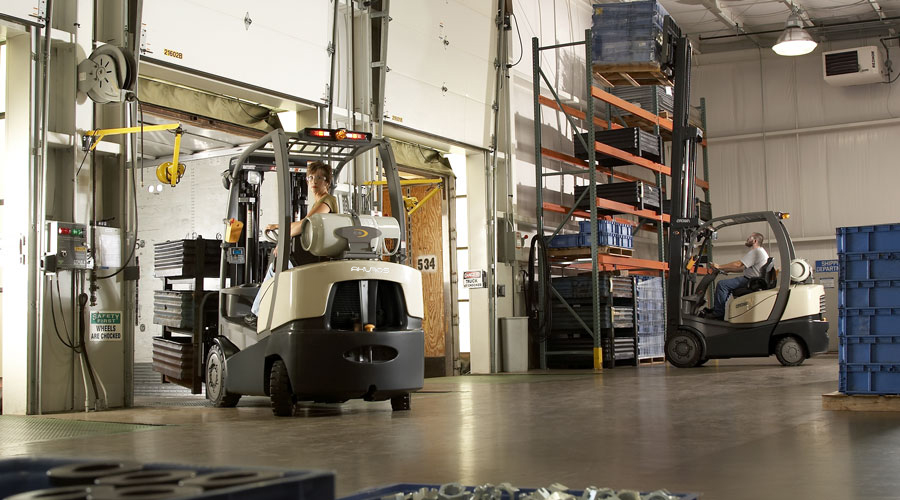
Mixed standard electric forklifts used across all zones
-
No differentiation between frozen and non-frozen tasks
-
Standard batteries with frequent mid-shift charging
-
Minimal use of attachments
What Looked Fine on Paper
-
Adequate forklift quantity
-
Acceptable average throughput
-
No obvious safety violations
What Happened in Reality
-
Forklift availability dropped sharply during peak shifts
-
Battery voltage instability caused unplanned stoppages
-
Operators spent extra time repositioning pallets
-
Congestion increased at aisle intersections
3. BEFORE: Performance Snapshot
📊 Operational Metrics — Before Optimization
| Indicator | Observed Situation |
|---|---|
| Forklift uptime | Unstable during peak hours |
| Battery interruptions | Frequent mid-shift |
| Pallet positioning accuracy | Inconsistent |
| Peak-hour congestion | 高い |
| Operator fatigue | Increasing |
| Safety incidents | Trending upward |
The warehouse had enough equipment, but insufficient effective capacity.
4. AFTER: Optimized Forklift System Strategy
Instead of adding forklifts, the project applied a system-level adjustment focused on three levers:
1️⃣ Forklift Assignment by Zone & Task
-
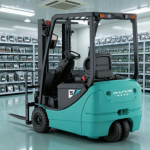
Dedicated cold-storage electric forklifts for frozen aisles
-
Ambient-zone forklifts removed from frozen operations
2️⃣ Battery Strategy Upgrade
-
Standard batteries replaced with cold-rated battery systems
-
Charging strategy aligned with shift patterns
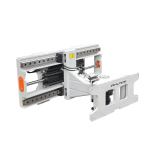
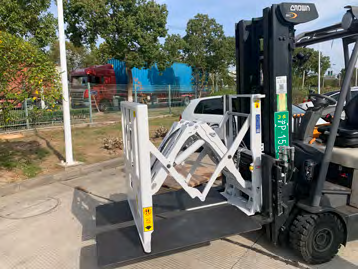
3️⃣ Targeted アタッチメント 配備
-
Side shifters added to narrow-aisle forklifts
-
Fork positioners used in mixed-pallet staging zones
No racking changes. No automation. No additional headcount.
 5. AFTER: Performance Snapshot
📊 Operational Metrics — After Optimization
| Indicator | Observed Situation |
|---|---|
| Forklift uptime | Stable across peak shifts |
| Battery interruptions | Rare |
| Pallet positioning accuracy | Consistent |
| Peak-hour congestion | Controlled |
| Operator fatigue | Reduced |
| Safety incidents | Decreased |
6. BEFORE vs AFTER — Direct Benchmark Comparison
📊 Forklift System Benchmark
| Dimension | BEFORE | AFTER |
|---|---|---|
| Forklift utilization | Theoretical | Effective |
| Battery reliability | Unpredictable | Stable |
| Handling precision | Operator-dependent | System-assisted |
| Peak throughput | Bottlenecked | Predictable |
| Maintenance pressure | Reactive | Preventive |
| Expansion need | Considered | Deferred |
The same warehouse delivered more output simply by removing hidden friction.
7. Financial & ROI Implications
Avoided Costs
-
Additional forklift purchases
-
Emergency battery replacements
-
Overtime during peak periods
Value Created
-
Higher shipment reliability
-
Lower maintenance disruption
-
Improved safety and operator confidence
The project achieved a short payback period primarily by converting existing capacity into usable capacity.
8. Key Differences That Made the Outcome Change
This benchmark highlights several decisive shifts:
-
より equipment quantity → equipment effectiveness
-
より average performance → peak reliability
-
より reactive fixes → system design
These shifts are particularly impactful in frozen environments where small inefficiencies are amplified.
9. Who Should Use This Benchmark as Reference
This benchmark case is especially relevant for:
-
Frozen warehouses operating below -18°C
-
Facilities facing unexplained forklift downtime
-
Operations considering fleet expansion
-
Export-oriented cold storage with fixed deadlines
If your warehouse experiences peak-period instability, the BEFORE state will likely feel familiar.
10. Google Popular Topics (Contextual Answers)
Why didn’t adding forklifts solve the problem initially?
Because battery reliability and task misalignment limited effective capacity.
What delivered the biggest improvement?
Battery stability combined with better task assignment and attachments.
Was automation required?
No. The benchmark improvement was achieved without automation.
Is this approach scalable?
Yes. The same logic applies to larger and more complex facilities.
Can this be applied to other cold storage types?
Yes, particularly seafood, export, and multi-temperature warehouses.