

 Arabic
  English
  Russian
  French
  Spanish
  German
  Italian
  Portuguese
  Korean
  Japanese
  Turkish
  Indonesian
  Dutch
Dutch 

A cold-chain scene you’ll recognize in five seconds
“Why are we out of space again?” the cold-room supervisor asked, staring at a freezer map that looked fine on paper.
“Because cold-chain doesn’t punish you slowly,” the ops analyst replied. “Every extra aisle is expensive air. Every extra touch is frost, dwell time, and risk.”
“So we just go denser?”
“Only if we don’t create bottlenecks. Cold-chain density without flow discipline is how you get more pallets و less throughput.”
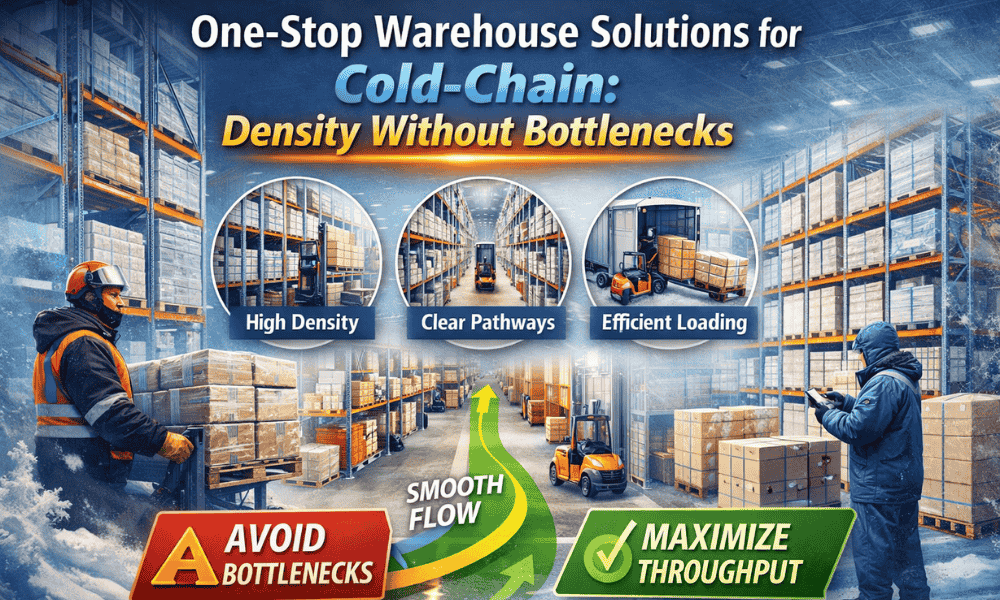
That’s exactly why حلول المستودعات الشاملة are gaining traction in cold storage: not as a buzzword, but as a way to design racking + travel paths + handling routines + safety rules as one operating model. When everything is temperature-controlled, mistakes cost more—energy, time, product integrity, and compliance pressure stack up fast.
To understand how a system approach works end-to-end, start at أكوروس and treat the project like an operating system upgrade, not a single piece of hardware.
حلول المستودعات المتكاملة
Why cold-chain makes “density without bottlenecks” a real engineering problem
Cold storage typically operates under constraints that ambient warehouses can “get away with” ignoring:
-
Energy penalty: every cubic meter you cool is money, 24/7.
-
Time sensitivity: door-open time and dwell time impact product stability and work pace.
-
Safety complexity: low traction, reduced visibility, condensation/ice, and cold fatigue.
-
Process fragility: congestion increases waiting time, which increases door cycles, which increases frost load and maintenance interruptions.
Industry benchmarks frequently show that travel time and picking/handling labor dominate warehouse operating costs, and in cold-chain that cost pressure is amplified because movement is slower, breaks are more frequent, and equipment performance is more sensitive to environment. The goal is not “maximum density.” The goal is maximum usable density—density that still ships on time.
If you want to see how the people behind the solution think and how they frame projects, check Akuros About and look for the operational logic: layout, safety, and execution—not just product catalog talk.
What “one-stop warehouse solutions” really means in cold-chain
In practice, حلول المستودعات الشاملة for cold storage typically combine four layers:
1) Storage architecture (where pallets live)
-
Rack type selection (selective vs higher-density zones)
-
Height and bay planning based on handling stability and aisle rules
-
Zone design (fast movers near shipping, bulk/deep storage in density zones)
2) Flow architecture (how pallets move)
-
Dedicated travel lanes, cross-aisle logic, and staging rules
-
Separation of replenishment flow from picking flow where possible
-
Traffic control and “no-blocking” standards at doors and buffer zones
3) Equipment fit (how work is executed)
-
Cold-rated trucks, batteries, tires, and attachments
-
Turning radius and visibility planning for icy, narrow conditions
-
Cycle-time stability at height, not just rated capacity
4) Rules and discipline (how reality stays predictable)
-
Slotting rules for depth SKUs vs single-pallet SKUs
-
Exception handling (what happens when the front pallet leaves)
-
Inspection routines and impact prevention
If you’re evaluating partners, the fastest way to filter serious providers is simple: ask them to explain the trade-offs and the rules. If the answer is only “more capacity,” you’re about to buy congestion.
When you’re ready to translate the above into a tailored plan, route the discussion through Akuros Contact Us so the recommendation aligns with your SKU profile, temperature zone, door strategy, and throughput targets—not just a generic racking quote.
Bottlenecks cold-chain warehouses create by accident
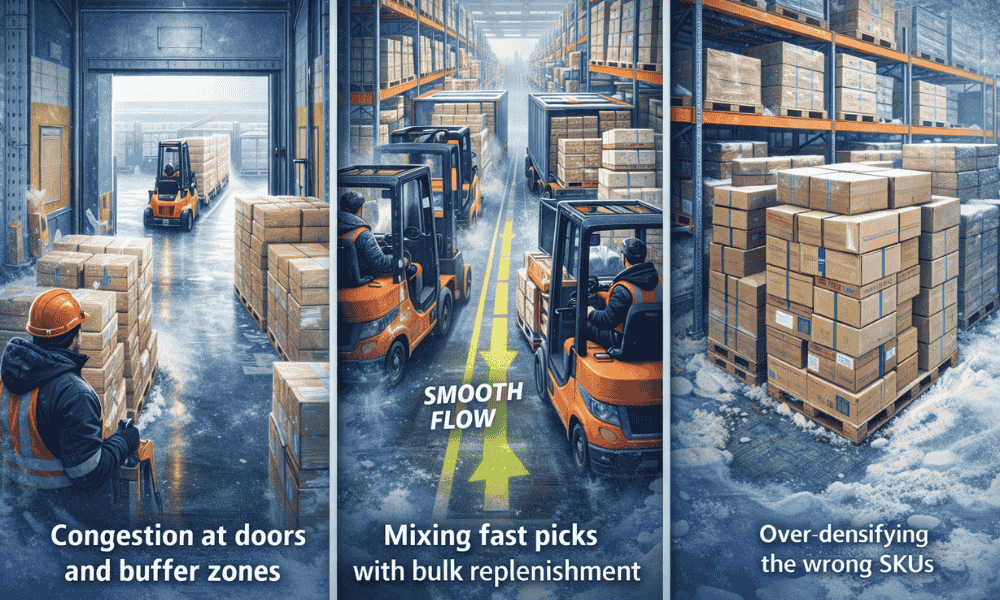
Cold-chain bottlenecks usually come from “small” decisions that compound:
Congestion at doors and buffer zones
The cold room is not the place to improvise staging. If pallets “temporarily” accumulate near doors, you get:
-
longer door-open times
-
longer forklift waiting times
-
more frost/ice load
-
more near-miss safety events
Mixing fast picks with bulk replenishment
If your fast-mover picking lanes share the same travel corridor with replenishment from deep storage, peak windows collapse. Cold-chain needs flow separation more than ambient warehouses because recovery time is slower.
Over-densifying the wrong SKUs
High density is a weapon—if used on SKUs that actually have depth. If you use dense storage on “one pallet of everything,” you create reshuffles and double-handling.
One-Stop Warehouse Solutions cold-chain
The cold-chain playbook: how to get dense without getting stuck
Here’s a practical framework you can apply before choosing any system.
Step 1: Build a cold-chain SKU map (the “truth table”)
Create a profile with:
-
Velocity bands (A/B/C) by temperature zone
-
Average pallet depth per SKU (how often you have 2+ pallets of the same SKU)
-
Order profile (full pallet vs case pick vs mixed pallet)
-
Peak stress test (what breaks first during promotions/seasonality)
A rule-of-thumb that usually holds: density systems love consistent depth. If the SKU rarely has two pallets, don’t trap it behind another pallet.
Step 2: Design zones before you design racks
Cold-chain works best with clear zones:
-
Fast movers: easier access, shortest travel, highest pick stability
-
Medium movers: balanced access + moderate density
-
Bulk/slow movers: higher density, deeper lanes, stricter rules
-
Quarantine/hold: compliance-driven separation (returns, QA holds, batch issues)
Step 3: Enforce “door discipline” like it’s a KPI
Door areas should have explicit rules:
-
maximum staging time
-
max pallet count in buffer
-
clear turning-radius and “no parking” boundaries
-
scheduled replenishment windows during peak pick times
Step 4: Match racking choice to execution reality
High-density is valuable, but only if the operating model supports it. A one-stop approach evaluates racking together with workflow, equipment, and safety. This is the point where Akuros Warehouse Solution becomes the core reference: density, flow, equipment fit, and implementation discipline should be presented as one integrated recommendation.
Why ordinary beam racks still matter in cold-chain (yes, really)
Here’s the trap: many teams assume cold-chain must always go “most dense possible.” In reality, a well-planned cold facility often uses a hybrid:
-
Ordinary beam racks for high-access or mixed SKU zones
-
Denser systems for bulk depth SKUs
-
Dedicated buffers and door controls to protect flow
Why beam racks stay relevant:
-
They provide direct access (fewer reshuffles)
-
They reduce “rear pallet surprises”
-
They simplify inspection and training routines
-
They can be reconfigured as SKU mix changes
In other words, beam racks can be the throughput stabilizer in a cold-chain system. If you want a practical lens on long-term storage logic, read Top 10 Benefits of Using Ordinary Beam Racks for Long-Term Storage Solutions and treat it as the “access-first” counterpart to density-first zones.
(And yes: the best cold-chain designs often keep a portion of the warehouse intentionally “less dense” so the whole operation stays fast.)
Mini case patterns: what “density without bottlenecks” looks like in practice
Pattern 1: Frozen bulk + stable rotation
Problem: aisle space is expensive; bulk SKUs overwhelm selective racks.
System move: bulk SKUs assigned to density zones with strict lane rules; fast movers kept accessible near outbound.
Result pattern: higher cubic utilization without blocking doors during peaks.
Pattern 2: Chilled distribution with mixed orders
Problem: mixed picking creates congestion and dwell time at the dock.
System move: clear separation between replenishment corridors and pick corridors; disciplined staging windows.
Result pattern: fewer traffic conflicts and more predictable wave execution.
Pattern 3: Cold-chain with batch logic and QA holds
Problem: compliance holds and batch separation destroy “simple FIFO.”
System move: zone by batch/date logic; ensure access zones stay clean; density zones handled by replenishment timing and rules.
Result pattern: better control without turning retrieval into a puzzle.
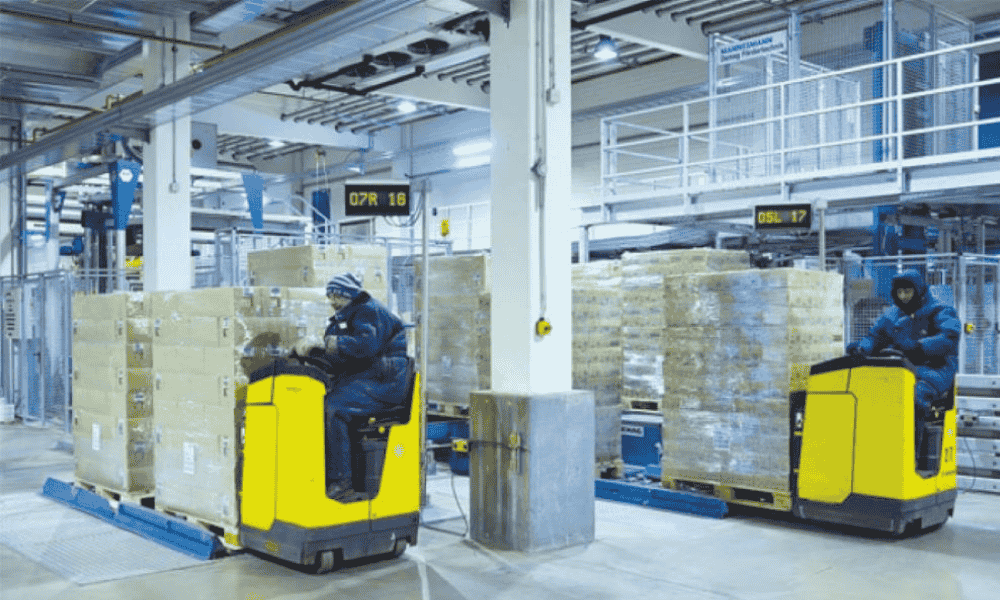
One-Stop Warehouse Solutions cold-chain-
Frequently Asked Questions (FAQs)
1) What does “one-stop warehouse solutions” mean for cold-chain facilities?
It means designing storage density, travel paths, handling equipment, and operating rules as one integrated system—so the warehouse stays fast even under temperature constraints and peak volume.
2) What’s the biggest bottleneck risk when increasing cold storage density?
Congestion near doors and buffer zones. If staging rules are weak, density increases touches and waiting time, which increases door-open time and operational drift.
3) Do cold-chain warehouses always need high-density racking?
Not always. Many top-performing operations use a hybrid: density zones for depth SKUs and high-access zones (often beam racks) for fast movers or mixed SKUs that need direct access.
4) How do you protect throughput in a dense cold-chain warehouse?
Use zoning (fast vs medium vs bulk), separate replenishment travel from picking travel, enforce door discipline, and standardize exception handling rules—especially when front pallets are removed.
5) What’s the fastest “first step” to choose the right solution?
Build a SKU truth table: velocity bands, pallet depth per SKU, order profile, and peak stress test. That data tells you where density will help—and where it will create bottlenecks.
Cold-chain density only works when the system behaves
حلول المستودعات الشاملة are the cleanest way to get cold-chain density without choking flow—because cold storage punishes fragmentation. The winning approach is usually hybrid: protect fast movers with access, push depth SKUs into density zones, and enforce door and traffic discipline like it’s a KPI. When racking, travel paths, equipment, and rules align, you don’t just “add pallet positions.” You add pallet positions that still ship on time—even when the freezer is unforgiving.
If your cold facility is chasing capacity while fighting congestion, the fix isn’t another patch. It’s a system.