

 Dutch
Dutch  English
  Russian
  French
  Spanish
  German
  Italian
  Portuguese
  Korean
  Japanese
  Arabic
  Turkish
  Indonesian

Een cold-chain-scène die u binnen vijf seconden herkent
“Waarom hebben we weer geen ruimte meer?” vroeg de koude-kamer supervisor, starend naar een vriezerkaart die eruitzag goed op papier.
“Omdat de cold-chain je niet langzaam straft,” antwoordde de operatieanalist. “Elke extra gangpad is dure lucht. Elke extra aanraking is vorst, verblijftijd en risico.”
“Dus gaan we gewoon dichter?”
“Alleen als we geen knelpunten creëren. Cold-chain-dichtheid zonder flowdiscipline is hoe je meer pallets en minder doorvoer.”
Dat is precies waarom one-stop magazijnoplossingen aan populariteit winnen in koude opslag: niet als modewoord, maar als een manier om rekken + reisroutes + handlingroutines + veiligheidsregels als één operationeel model te ontwerpen. Wanneer alles temperatuurgecontroleerd is, kosten fouten meer—energie, tijd, productintegriteit en compliance-druk stapelen zich snel op.
Om te begrijpen hoe een systeembenadering end-to-end werkt, begin dan bij Akuros en behandel het project als een besturingssysteemupgrade, niet als één stuk hardware.
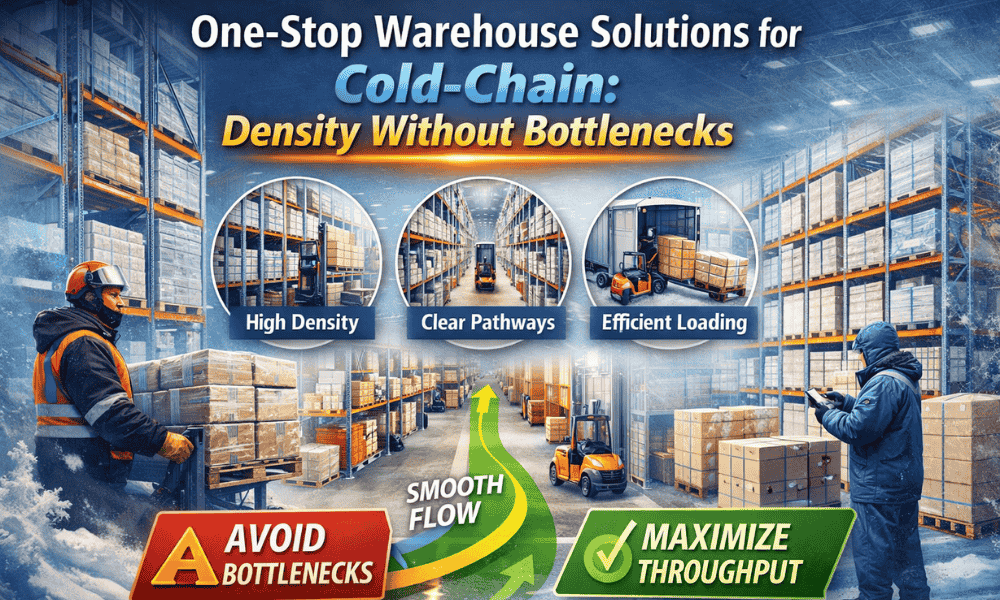
One-stop magazijnoplossingen
Waarom cold-chain ‘dichtheid zonder knelpunten’ tot een echt ingenieursprobleem maakt
Koude opslag functioneert meestal onder beperkingen die ambient warehouses kunnen ‘wegmaken’ door te negeren:
-
Energieboete: elke kubieke meter die je koelt is geld, 24/7.
-
Tijdsgevoeligheid: deur-open tijd en verblijftijd beïnvloeden de productstabiliteit en het werktempo.
-
Veiligheidscomplexiteit: lage tractie, verminderde zichtbaarheid, condensatie/ijs en koudevermoeidheid.
-
Procesfragiliteit: congestie verhoogt de wachttijd, wat de deurcycli verhoogt, wat de vorstbelasting en onderhoudsonderbrekingen verhoogt.
Industriebenchmarks tonen vaak aan dat reistijd en picking/handlingarbeid de grootste kostenposten zijn in magazijnoperaties, en in de cold-chain wordt die kostendruk versterkt omdat beweging trager is, pauzes vaker voorkomen en de prestaties van apparatuur gevoeliger zijn voor de omgeving. Het doel is niet ‘maximale dichtheid’. Het doel is maximale bruikbare dichtheid—dichtheid die nog steeds op tijd wordt verzonden.
Als u wilt zien hoe de mensen achter de oplossing denken en hoe ze projecten formuleren, bekijk dan Akuros Over en zoek naar de operationele logica: indeling, veiligheid en uitvoering—niet alleen productcataloguspraat.
Wat ‘one-stop magazijnoplossingen’ echt betekent in de cold-chain
In de praktijk, one-stop magazijnoplossingen voor koude opslag combineren we meestal vier lagen:
1) Opslagarchitectuur (waar pallets leven)
-
Selectie van rektype (selectief vs zones met hogere dichtheid)
-
Hoogte- en baanplanning gebaseerd op handlingstabiliteit en gangpadregels
-
Zoneontwerp (snelle goederen bij verzending, bulk/diepe opslag in dichtheidszones)
2) Flowarchitectuur (hoe pallets bewegen)
-
Speciale reisbanen, cross-aisle-logica en stagingregels
-
Scheiding van vulflow van pickingflow waar mogelijk
-
Verkeerscontrole en ‘no-blocking’-normen bij deuren en bufferzones
3) Apparatuurfit (hoe het werk wordt uitgevoerd)
-
Koude-geclassificeerde vrachtwagens, batterijen, banden en accessoires
-
Plannen van draaicirkel en zichtbaarheid voor ijzige, smalle omstandigheden
-
Cycle-time stabiliteit op hoogte, niet alleen rated capacity
4) Regels en discipline (hoe de realiteit voorspelbaar blijft)
-
Slottingregels voor diepte-SKUs versus single-pallet-SKUs
-
Uitzonderingsafhandeling (wat gebeurt er wanneer de voorste pallet vertrekt)
-
Inspectieroutines en impactpreventie
Als u partners evalueert, is de snelste manier om serieuze leveranciers te filteren eenvoudig: vraag hen om de trade-offs en de regels. Als het antwoord alleen ‘meer capaciteit’ is, staat u op het punt om congestie te kopen.
Wanneer u klaar bent om het bovenstaande om te zetten in een op maat gemaakt plan, leid de discussie via Akuros Neem contact met ons op zodat de aanbeveling aansluit bij uw SKU-profiel, temperatuurzone, deurstrategie en doorvoerdoelen—niet alleen een generieke rekofferte.
Knelpunten die cold-chain-magazijnen per ongeluk creëren
Cold-chain bottlenecks usually come from “small” decisions that compound:
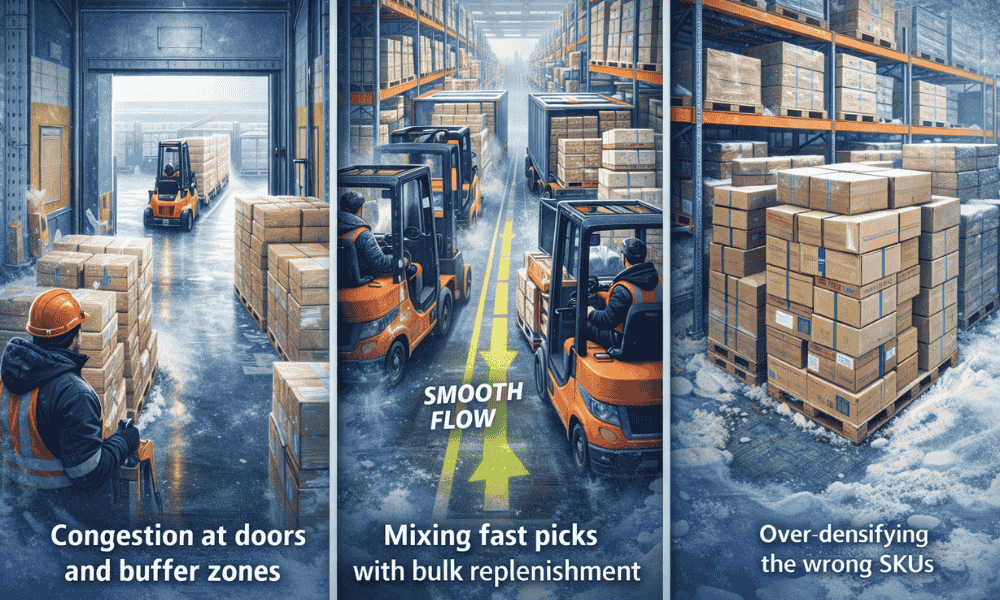
Congestion at doors and buffer zones
The cold room is not the place to improvise staging. If pallets “temporarily” accumulate near doors, you get:
-
longer door-open times
-
longer forklift waiting times
-
more frost/ice load
-
more near-miss safety events
Mixing fast picks with bulk replenishment
If your fast-mover picking lanes share the same travel corridor with replenishment from deep storage, peak windows collapse. Cold-chain needs flow separation more than ambient warehouses because recovery time is slower.
Over-densifying the wrong SKUs
High density is a weapon—if used on SKUs that actually have depth. If you use dense storage on “one pallet of everything,” you create reshuffles and double-handling.
One-Stop Magazijnoplossingen koelketen
The cold-chain playbook: how to get dense without getting stuck
Here’s a practical framework you can apply before choosing any system.
Step 1: Build a cold-chain SKU map (the “truth table”)
Create a profile with:
-
Velocity bands (A/B/C) by temperature zone
-
Average pallet depth per SKU (how often you have 2+ pallets of the same SKU)
-
Order profile (full pallet vs case pick vs mixed pallet)
-
Peak stress test (what breaks first during promotions/seasonality)
A rule-of-thumb that usually holds: density systems love consistent depth. If the SKU rarely has two pallets, don’t trap it behind another pallet.
Step 2: Design zones before you design racks
Cold-chain works best with clear zones:
-
Fast movers: easier access, shortest travel, highest pick stability
-
Medium movers: balanced access + moderate density
-
Bulk/slow movers: higher density, deeper lanes, stricter rules
-
Quarantine/hold: compliance-driven separation (returns, QA holds, batch issues)
Step 3: Enforce “door discipline” like it’s a KPI
Door areas should have explicit rules:
-
maximum staging time
-
max pallet count in buffer
-
clear turning-radius and “no parking” boundaries
-
scheduled replenishment windows during peak pick times
Step 4: Match racking choice to execution reality
High-density is valuable, but only if the operating model supports it. A one-stop approach evaluates racking together with workflow, equipment, and safety. This is the point where Akuros Warehouse Solution becomes the core reference: density, flow, equipment fit, and implementation discipline should be presented as one integrated recommendation.
Why ordinary beam racks still matter in cold-chain (yes, really)
Here’s the trap: many teams assume cold-chain must always go “most dense possible.” In reality, a well-planned cold facility often uses a hybrid:
-
Ordinary beam racks for high-access or mixed SKU zones
-
Denser systems for bulk depth SKUs
-
Dedicated buffers and door controls to protect flow
Why beam racks stay relevant:
-
They provide direct access (fewer reshuffles)
-
They reduce “rear pallet surprises”
-
They simplify inspection and training routines
-
They can be reconfigured as SKU mix changes
In other words, beam racks can be the throughput stabilizer in a cold-chain system. If you want a practical lens on long-term storage logic, read Top 10 Benefits of Using Ordinary Beam Racks for Long-Term Storage Solutions and treat it as the “access-first” counterpart to density-first zones.
(And yes: the best cold-chain designs often keep a portion of the warehouse intentionally “less dense” so the whole operation stays fast.)
Mini case patterns: what “density without bottlenecks” looks like in practice
Pattern 1: Frozen bulk + stable rotation
Problem: aisle space is expensive; bulk SKUs overwhelm selective racks.
System move: bulk SKUs assigned to density zones with strict lane rules; fast movers kept accessible near outbound.
Result pattern: higher cubic utilization without blocking doors during peaks.
Pattern 2: Chilled distribution with mixed orders
Problem: mixed picking creates congestion and dwell time at the dock.
System move: clear separation between replenishment corridors and pick corridors; disciplined staging windows.
Result pattern: fewer traffic conflicts and more predictable wave execution.
Pattern 3: Cold-chain with batch logic and QA holds
Problem: compliance holds and batch separation destroy “simple FIFO.”
System move: zone by batch/date logic; ensure access zones stay clean; density zones handled by replenishment timing and rules.
Result pattern: better control without turning retrieval into a puzzle.
One-Stop Warehouse Solutions cold-chain-
Veelgestelde vragen (FAQ’s)
1) What does “one-stop warehouse solutions” mean for cold-chain facilities?
It means designing storage density, travel paths, handling equipment, and operating rules as one integrated system—so the warehouse stays fast even under temperature constraints and peak volume.
2) What’s the biggest bottleneck risk when increasing cold storage density?
Drukte in de buurt van deuren en bufferzones. Als de regels voor het opstellen van de rijen zwak zijn, neemt de dichtheid toe, wat leidt tot meer aanrakingen en langere wachttijden, waardoor de tijd dat de deuren open blijven toeneemt en de operationele afwijking groter wordt.
3) Do cold-chain warehouses always need high-density racking?
Not always. Many top-performing operations use a hybrid: density zones for depth SKUs and high-access zones (often beam racks) for fast movers or mixed SKUs that need direct access.
4) How do you protect throughput in a dense cold-chain warehouse?
Gebruik zone-indeling (snel vs. gemiddeld vs. bulk), scheid het bevoorradingstraject van het picktraject, handhaaf deurdiscipline en standaardiseer de regels voor het afhandelen van uitzonderingen—met name wanneer de voorste pallets worden verwijderd.
5) What’s the fastest “first step” to choose the right solution?
Stel een SKU-waarheidstabel op: snelheidsbanden, palletdiepte per SKU, bestelprofiel en piekbelastingstest. Die gegevens vertellen u waar dichtheid zal helpen – en waar het knelpunten zal veroorzaken.
Cold-chain density only works when the system behaves
One-stop magazijnoplossingen are the cleanest way to get cold-chain density without choking flow—because cold storage punishes fragmentation. The winning approach is usually hybrid: protect fast movers with access, push depth SKUs into density zones, and enforce door and traffic discipline like it’s a KPI. When racking, travel paths, equipment, and rules align, you don’t just “add pallet positions.” You add pallet positions that still ship on time—even when the freezer is unforgiving.
If your cold facility is chasing capacity while fighting congestion, the fix isn’t another patch. It’s a system.