

 Russian
  English
  French
  Spanish
  German
  Italian
  Portuguese
  Korean
  Japanese
  Arabic
  Turkish
  Indonesian
  Dutch
Dutch 

Handling, Hygiene & Throughput Challenges
Seafood cold storage warehouses operate under some of the harshest conditions in the cold chain industry. High humidity, salt corrosion, slippery floors, and rapid throughput create unique challenges that standard cold storage designs often fail to address. This article explains how seafood warehouses should be designed, equipped, and operated to maintain hygiene, safety, and efficiency.
1. Why Seafood Cold Storage Is Fundamentally Different
Seafood cold storage warehouses are not simply “colder” versions of standard facilities. They combine multiple high-risk factors:
-
Constant moisture and wash down operations
-
Salt and organic residue accelerating corrosion
-
Slippery floors and reduced traction
-
High inbound–outbound frequency under tight freshness windows
These conditions dramatically shorten the lifespan of standard warehouse equipment and expose design flaws much faster than in dry frozen food environments.
This is why seafood projects require a dedicated cold storage solution, not a generic freezer layout.
 2. Seafood Cold Storage Challenges — Overview Table
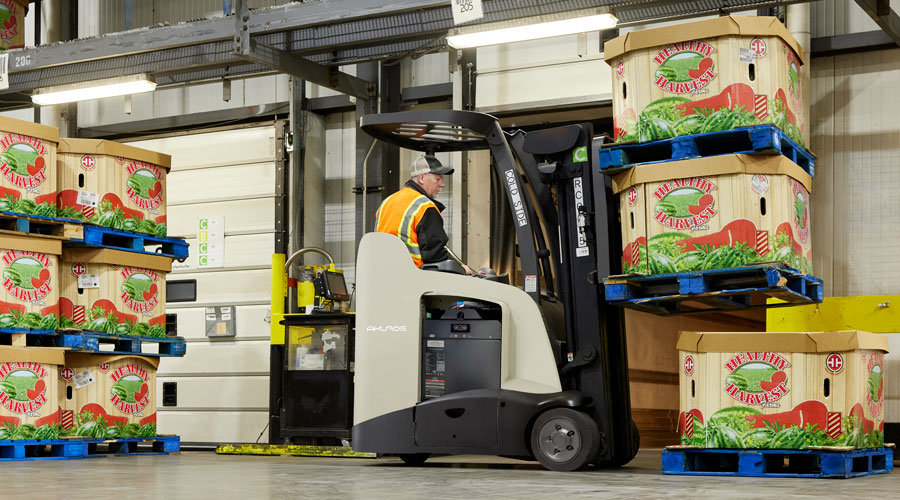
Before diving into specific systems, the table below summarizes the most common challenges faced by seafood cold storage warehouses and their operational impact.
📊 Seafood Cold Storage Challenges & Design Priorities
| Challenge | Operational Impact | Design & Equipment Priority |
|---|---|---|
| High humidity & washdown | Corrosion, electronics failure | Sealed components, corrosion resistance |
| Slippery floors | Safety incidents, collisions | High-traction tires, stable braking |
| Salt exposure | Accelerated wear | Stainless or protected materials |
| Rapid throughput | Congestion, delays | Efficient traffic flow |
| Mixed SKU profiles | Handling inefficiency | Flexible racking & equipment |
Seafood cold storage magnifies weaknesses that may remain hidden in other frozen environments.
3. Layout Design for Seafood Cold Storage Warehouses
Layout design in seafood cold storage must prioritize flow separation and hygiene. Inbound raw seafood, processing areas, and outbound finished goods should follow clearly defined paths to reduce cross-contamination and congestion.
Aisle width and turning radii must account for wet floors and reduced braking performance. Layouts copied from dry cold storage facilities often become unsafe when exposed to seafood operating conditions.
Designing layout as part of an integrated складское решение allows hygiene, safety, and throughput to be addressed simultaneously.
 4. Racking Systems Suitable for Seafood Cold Storage
Racking systems in seafood warehouses must balance density with accessibility and cleaning requirements.
-
Double deep racking systems are commonly used to balance space utilization with manageable access in mixed SKU seafood operations.
-
Drive-in racking systems may be suitable for bulk frozen seafood with homogeneous SKUs, but require strict forklift control and protective measures.
Racking systems that are difficult to clean or inspect often become long-term hygiene risks in seafood facilities.
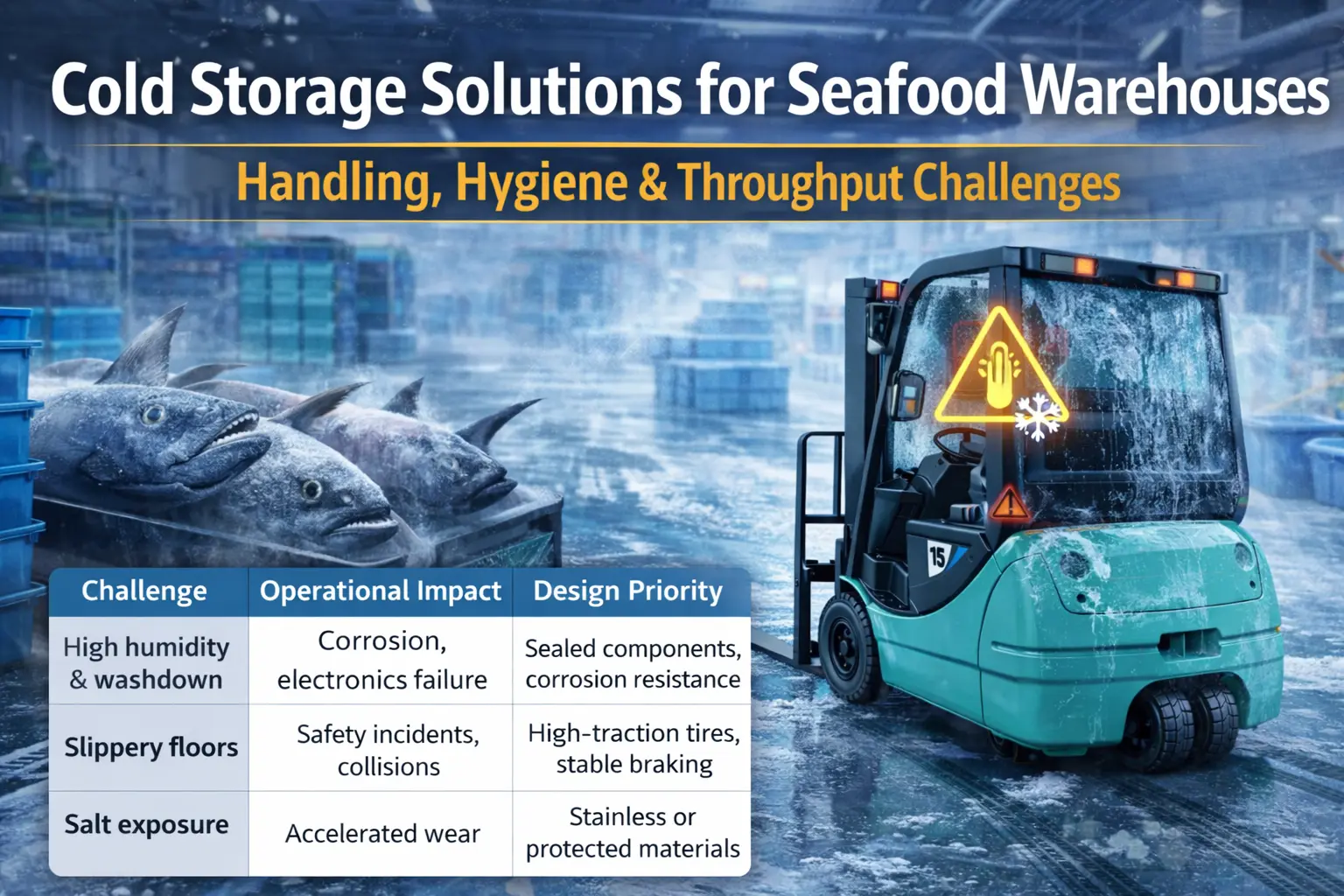
5. Forklifts Designed for Wet and Corrosive Cold Environments
Forklifts in seafood cold storage face constant exposure to moisture, salt, and organic residue. Standard electric forklifts often experience premature failure of electronics, bearings, and structural components.
Seafood facilities typically rely on electric forklifts engineered for cold storage, with enhanced sealing, corrosion protection, and stable low-temperature performance. Forklift selection must align with racking geometry and wet-floor operating conditions to avoid safety incidents and downtime.
6. Tires, Traction, and Safety on Wet Frozen Floors
Slippery floors are one of the most underestimated risks in seafood cold storage. Braking distance increases significantly, and minor handling errors can lead to collisions or product damage.
Using cold-rated polyurethane tire solutions is critical to maintaining traction and predictable braking behavior in wet and frozen environments. Tire selection should be considered a safety decision, not a consumable afterthought.
7. Automation in Seafood Cold Storage: Where It Works—and Where It Doesn’t
Automation can deliver value in seafood cold storage, but only in carefully selected areas. Stable, repetitive pallet transport between fixed zones is well suited for AGV-based automation systems, particularly when integrated into broader automated warehouse solutions.
However, highly variable handling tasks, irregular pallet conditions, and frequent washdown zones often require manual flexibility. A hybrid automation model is typically the most practical approach for seafood operations.
8. Hygiene, Maintenance, and Lifecycle Considerations
In seafood cold storage, maintenance is inseparable from hygiene. Equipment downtime often coincides with sanitation cycles, making reliability critical.
Designing equipment selection, layout, and maintenance access within an end-to-end warehouse solution framework reduces long-term risk and ensures compliance with food safety standards.
9. Common Mistakes in Seafood Cold Storage Projects
Recurring issues include:
-
Using dry cold storage layouts for seafood operations
-
Underestimating corrosion and moisture impact
-
Prioritizing pallet density over cleanability
-
Introducing automation without considering washdown requirements
These mistakes often surface only after commissioning, when correction costs are highest.
10. Google Popular Topics (Contextual Answers)
Why is seafood cold storage more challenging than other frozen warehouses?
Because moisture, salt, and hygiene requirements accelerate equipment wear and safety risks.
What racking systems work best for seafood cold storage?
Double deep racking is common for mixed SKUs, while drive-in racking suits homogeneous bulk storage.
Are electric forklifts suitable for seafood cold storage?
Yes, if they are engineered for wet, corrosive, and low-temperature environments.
Can automation be used in seafood cold storage?
Yes, in stable transport zones, but manual flexibility remains essential.
How can seafood cold storage reduce long-term maintenance cost?
By selecting corrosion-resistant equipment and planning layout, equipment, and sanitation as one system.