

 Portuguese
  English
  Russian
  French
  Spanish
  German
  Italian
  Korean
  Japanese
  Arabic
  Turkish
  Indonesian
  Dutch
Dutch 

How to Choose the Best Forklift for Cold Storage Warehouses
Choosing the best forklift for cold storage warehouses is not simply about tonnage or price. Low temperatures affect battery efficiency, hydraulic response, traction, and long-term reliability. This guide explains how to evaluate cold storage forklifts based on temperature, lifting height, aisle width, pallet weight, and operating frequency, so buyers can choose equipment that actually matches freezer warehouse conditions.
In many cold storage projects, the first major focus is usually on insulation panels, refrigeration systems, racking layout, and storage capacity. Forklift selection often comes later. But once the warehouse begins operating, many companies quickly realize that the wrong forklift can become a daily operational problem.
Battery performance drops faster in low temperatures. Hydraulic response becomes slower. Condensation affects visibility and electrical reliability. Aisles that looked acceptable on paper suddenly feel too narrow in real operation. A truck that seems powerful enough at ground level may no longer handle the same load safely at height. In some warehouses, the forklift works, but handling efficiency is too low to support the actual throughput requirement.
That is why choosing the best forklift for cold storage warehouses is not simply about comparing nominal capacity or purchase price. The real question is whether the truck matches the full working condition of the warehouse. For cold rooms and freezer warehouses, forklift selection must be based on temperature, lifting height, aisle width, cargo weight, pallet dimensions, and operating frequency. Only when these factors are analyzed together can a project identify the right cold storage material handling solution.
Why Cold Storage Forklift Selection Is More Difficult
Many buyers assume that forklift selection for a cold storage warehouse follows the same logic as a standard indoor warehouse. In practice, this is where many mistakes begin.
A normal electric forklift may work well in ambient conditions, but cold environments create a completely different set of challenges. Low temperature affects battery efficiency, lubrication, seals, tires, electronics, and operator comfort. At the same time, cold storage warehouses are usually designed to maximize storage density, which means higher racking, tighter aisles, and stricter handling requirements.
That combination makes forklift selection far more technical than many operators expect.
Cold Storage Forklift Selection Overview
| Fator | Why It Matters | Typical Risk If Ignored |
|---|---|---|
| Temperature | Affects battery, lubrication, electronics, and condensation resistance | Fast battery loss, electrical faults, unstable operation |
| Altura de elevação | Determines whether the truck can safely lift the real load to the target beam level | Residual capacity too low at height |
| Largura do corredor | Directly affects turning radius, truck type, and storage density | Congestion and inefficient handling |
| Cargo Weight & Pallet Size | Influences load center, stability, and real capacity | Truck appears sufficient on paper but fails in real operation |
| Operating Frequency | Determines battery demand, service pressure, and equipment uptime | Poor shift coverage and rising lifecycle cost |
This table provides a quick decision framework. The correct forklift choice comes from evaluating all five factors together, not separately.
1. Choose Based on Temperature
Temperature is always the first filter.
Not every cold storage warehouse has the same working environment. A chilled warehouse operating at 0°C to 5°C is very different from a freezer room operating at -18°C or lower. Some facilities also have frequent traffic between ambient areas, refrigerated zones, and deep-freeze rooms, which creates additional condensation and performance issues.
For chilled storage, many electric forklifts can be adapted with the right configuration. That may include suitable tires, cold-resistant lubricants, and a certain level of anti-condensation protection.
For freezer applications, however, the forklift usually needs a more dedicated cold-storage configuration. That can include:
- óleo hidráulico de baixa temperatura
- cold-resistant seals and hoses
- anti-condensation protection for electrical components
- suitable battery configuration for freezer work
- anti-slip tires or cold-environment tire options
- optional enclosed or heated cabin in some projects
If the truck will work inside a deep-freeze room for long periods every day, choosing a properly configured freezer warehouse forklift is usually a better decision than trying to use a standard indoor model with minimal modification.
A useful rule is simple: the lower the temperature and the longer the working time, the more important dedicated cold-storage protection becomes.
2. Choose Based on Lifting Height
Lifting height is one of the most important technical factors, but it must be interpreted correctly.
Many buyers focus on the maximum lifting height listed in a catalog. In reality, the more important question is whether the forklift can lift the actual pallet load to that height safely and efficiently.
This is especially important in cold storage because many warehouses use selective racking, drive-in systems, or high-bay layouts to maximize storage density. Once the racking goes higher, the forklift must not only reach the beam level, but also maintain enough residual capacity to handle the real product load.
For lower storage applications, standard pallet trucks, stackers, or electric counterbalance forklifts may be enough. For medium-height racking, such as around 4 to 6 meters, reach trucks often become more attractive because they combine good lift height with better aisle efficiency. For higher storage levels, forklift selection becomes more sensitive. Mast type, load center, and actual pallet weight all become critical.
The right selection logic is not:
Can this forklift lift to 6 meters?
It is:
Can this forklift lift my real pallet weight, with my real pallet dimensions, to 6 meters under freezer warehouse conditions?
That is the question that matters.
3. Choose Based on Aisle Width
In many cold storage projects, aisle width is the factor that most directly determines forklift type.
Because cold room space is expensive, many operators try to reduce aisle width and increase rack density. This can improve storage capacity, but it also narrows the equipment options.
In wider aisles, an electric counterbalance forklift offers flexibility. It is suitable for loading and unloading, staging, and general movement. It is also easier to use in warehouses where the same truck must support different handling tasks.
In medium-width aisles, a reach truck is often the more efficient solution. It improves storage density while still offering strong indoor lift performance. This is why reach trucks are commonly used in indoor cold storage applications.
In very narrow aisles, articulated forklifts, turret trucks, or other narrow-aisle solutions may become necessary. However, these options are not automatically the best choice. They require the rack system, pallet design, floor condition, and workflow to be aligned. If the operation also includes frequent dock-side handling or heavy mixed-use movement, narrow-aisle equipment may reduce overall flexibility.
Aisle width should never be evaluated alone. It must be assessed together with pallet size, turning radius, fork entry direction, and rack layout. This is where many cold storage buyers underestimate the complexity of the project.
4. Choose Based on Cargo Weight and Pallet Dimensions
Cargo weight is obvious, but pallet size and load center are just as important.
A common mistake is to say, “Our pallet weighs 1,200 kg, so a 1.5-ton forklift is enough.” In many real cases, that conclusion is too simplistic. The true working condition depends on more than just total weight.
You also need to consider:
- pallet length and width
- fork entry direction
- actual load center
- load height and product stability
- whether the load is dense, loose, or top-heavy
- whether the truck will handle the pallet at ground level only or at height
A longer pallet can increase the load center. A heavier or unstable product can reduce safe operating margins. If the pallet enters from the long side instead of the short side, the effective handling condition may change significantly.
For any forklift for cold room application, forklift capacity should always be checked against real pallet conditions, not just brochure figures.
In practice, many cold storage warehouses handle food, beverages, frozen meat, seafood, dairy, or pharmaceutical products. These goods may look similar as palletized loads, but their packaging, center of gravity, and handling sensitivity can be very different. A technically correct selection must reflect those differences.
5. Choose Based on Operating Frequency
A forklift used two hours a day is not the same as one running through multiple shifts.
This is why operating frequency must be part of the selection logic.
For low-frequency work, such as occasional movement or backup handling, a more basic configuration may be acceptable. In this case, the focus may be on essential functionality and cost control.
For medium- to high-frequency work, the decision becomes more demanding. Battery performance, charging time, opportunity charging strategy, ergonomics, maintenance access, and parts support all matter more. If the forklift spends long hours in freezer operation every day, those factors directly affect long-term operating cost and uptime.
This is particularly important in high-throughput cold storage material handling environments, such as third-party cold chain logistics, food distribution centers, and large freezer warehouses. In these operations, even small inefficiencies get multiplied every day.
Which Forklift Type Fits Which Cold Storage Situation?
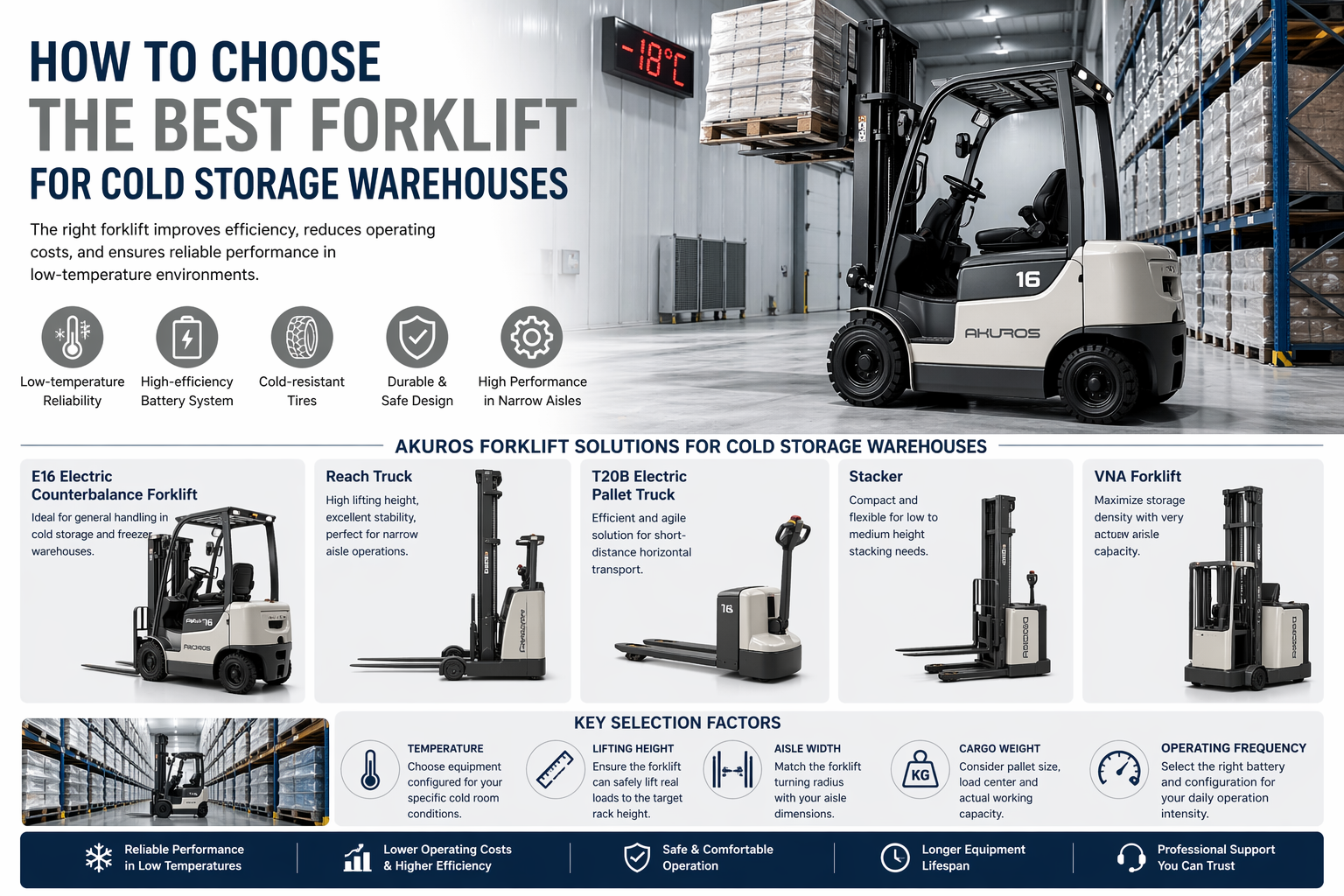
Empilhadeira elétrica de contrapeso
This type is suitable for wider aisles, loading zones, staging areas, and warehouses that need more operational flexibility. It is often a good choice when one truck must handle mixed tasks.
Its advantage is versatility. Its limitation is that it usually needs more aisle space than a reach truck.
Camião retrátil
This is often the preferred option for indoor cold storage warehouses with medium to high racking and narrower aisles. It supports better space utilization and is widely used where storage density matters.
Its strength is rack handling efficiency. Its limitation is that it is generally less suitable for rough transitions, outdoor work, or highly mixed environments.
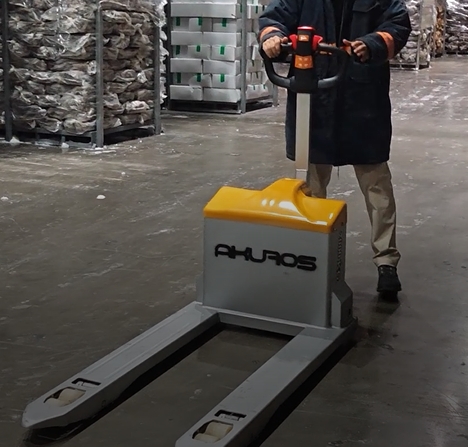
Pallet Truck and Stacker
These are suitable for short-distance horizontal movement and low-level storage work. They are economical and efficient for simple tasks, but they are not the right solution for higher racking.
Articulated or Narrow-Aisle Forklift
These are suitable for projects pursuing maximum storage density. They can reduce aisle width significantly, but only when the full warehouse design supports that solution. They are not automatically the best answer for every cold storage warehouse.
Which Projects Are Suitable — and Which Are Not?
A well-chosen cold storage forklift solution is often suitable for:
- food cold chain warehouses
- frozen meat and seafood facilities
- dairy and beverage cold rooms
- pharmaceutical temperature-controlled warehouses
- third-party cold logistics centers
- high-density pallet storage warehouses
However, not every truck type fits every project. Some forklift solutions become inefficient when:
- aisles are too narrow for the selected truck
- pallet loads are too heavy for the target height
- the warehouse expects one truck to handle both dock work and dense high-rack storage
- the floor condition is not ideal
- the racking system is fixed first, and forklift selection is considered too late
In many cases, the real issue is not that the forklift is poor. It is that the warehouse design and the forklift solution were never properly matched.
Percepções de especialistas
Expert Insight 1: In cold storage projects, buyers often compare forklift tonnage first. In reality, turning radius, battery behavior, and residual capacity at height usually affect daily efficiency much more.
Expert Insight 2: A forklift that looks cheaper at purchase stage can become more expensive over time if its battery platform, charging cycle, or freezer configuration does not match the warehouse workflow.
Final Recommendation
For most projects, the best way to choose a forklift is to follow a simple decision sequence.
First, confirm the temperature requirement. Second, verify the real pallet weight and required lifting height. Third, check aisle width together with pallet dimensions and rack layout. Finally, choose the truck type and battery configuration based on operating frequency.
If the warehouse focuses on higher racking and better storage density, a reach truck is often the better fit. If the aisles are wider and the operation needs more flexibility between loading, unloading, and internal transfer, an electric counterbalance forklift is often the more practical option. If the task is mainly short-distance transfer, pallet trucks may offer the most economical solution.
There is no universal answer for every warehouse. The best forklift is the one that matches the real operating condition.
Send Us These 6 Details
If you are planning a new cold storage warehouse or upgrading an existing one, the fastest way to identify the right solution is to start with the actual project data.
Please send us:
- pallet dimensions
- cargo weight
- lifting height
- largura dos corredores
- temperature requirement
- target storage capacity
With these six details, it becomes much easier to recommend the right freezer warehouse forklift, the right forklift for cold room use, and a more efficient cold storage material handling solution for your project.
FAQ
What is the best forklift for cold storage warehouses?
The best forklift depends on your temperature range, lifting height, aisle width, pallet size, and operating frequency. There is no single forklift that fits every freezer warehouse.
Um empilhador elétrico padrão pode ser utilizado em um armazém congelado?
Sometimes for short periods, but in long-term freezer use, standard forklifts often face battery loss, condensation problems, and reduced reliability.
Is a reach truck better than a counterbalance forklift in cold storage?
It depends on the layout. Reach trucks are often better for higher racking and narrower aisles, while counterbalance forklifts are more flexible in wider aisles and mixed-use zones.
Why does forklift capacity change at height?
Because actual lifting performance depends on load center, mast configuration, and residual capacity—not only the nominal tonnage shown in the catalog.
What information should I prepare before requesting a cold storage forklift quotation?
You should prepare pallet dimensions, cargo weight, lifting height, aisle width, temperature requirement, and target storage capacity.