

 Portuguese
  English
  Russian
  French
  Spanish
  German
  Italian
  Korean
  Japanese
  Arabic
  Turkish
  Indonesian
  Dutch
Dutch 

From Chaos to Control: The Turning Point in Modern Warehousing
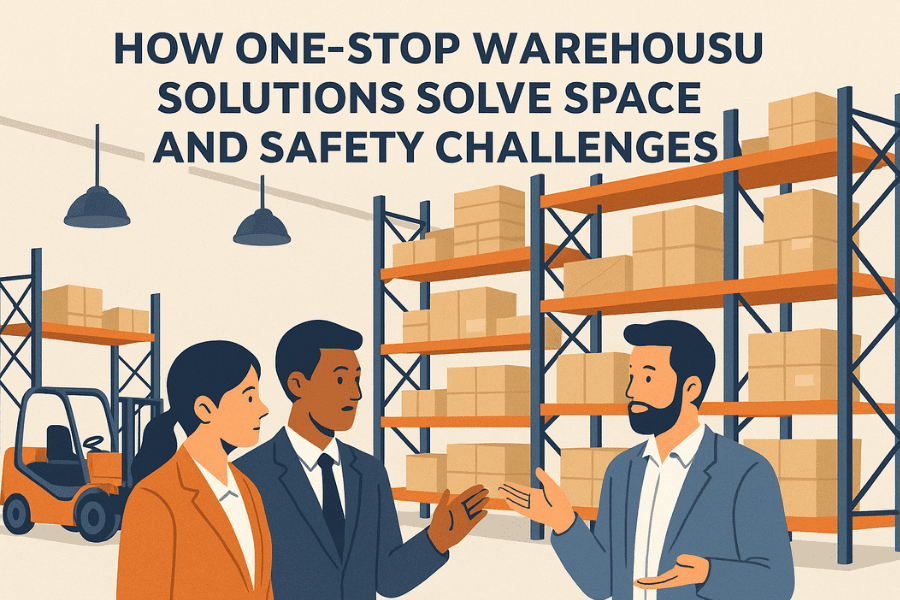
Elena (Operations Director, Logistics Firm):
“Our warehouse aisles are packed, forklifts barely move safely, and we’ve had two minor accidents in the past quarter. We can’t just expand — land costs are insane.”
Thomas (Warehouse Safety Consultant):
“That’s what happens when systems grow without integration. Each vendor adds racks, conveyors, or labeling lines without spatial harmony. You need a one-stop warehouse design — engineered from the ground up.”
David (CEO, Akuros – Supply Chain Solutions Buyer):
“At Akuros, we’ve helped global clients redesign their logistics using one-stop warehouse solutions. Once space planning, racking, and safety systems are unified, accidents drop and capacity increases — without building new facilities.”
One-Stop Warehouse Solutions Supplier
1. The Growing Space and Safety Dilemma
A. The Modern Warehouse Crunch
Global e-commerce has grown by 23% year-on-year, but warehouse footprints in major logistics hubs (Rotterdam, Dubai, Los Angeles) remain nearly static.
This mismatch has led to:
-
Overcrowded aisles reducing operational efficiency.
-
Stacking beyond safety limits, raising structural risk.
-
Fragmented vendor setups that complicate workflow management.
A 2024 McKinsey report found that 48% of warehouse accidents occur due to poor spatial planning — not human error.
This statistic alone underscores the importance of integrated, one-stop warehouse design.
2. What Makes One-Stop Warehouse Solutions Different
A. Material Engineering for Durability and Safety
Unlike piecemeal warehouse systems, soluções de armazém num só local use standardized materials and modular designs across all functions — from racking to flooring to automated gates.
Material Advantages:
-
Cold-rolled steel beams with anti-corrosion coating
-
Reinforced uprights with seismic compliance certification
-
Fire-rated insulation and anti-slip flooring for operator safety
-
Load-tested racking: 3,000 kg per level
These materials exceed standard warehouse rack requirements, significantly reducing maintenance costs and structural fatigue over time.
B. Smart Design and Space Optimization
One-stop solutions optimize every cubic meter.
Instead of traditional static shelving, Akuros integrates advanced systems such as:
-
Adjustable beam racks for variable load profiles
-
Narrow-aisle pallet storage to increase capacity by 35–45%
-
Mezzanine platforms for vertical utilization
-
AI-driven warehouse management (WMS) for dynamic slot allocation
Comparison Table:
| Caraterística | Armazém único Solução | Traditional Vendor Model |
|---|---|---|
| Space Utilization | Up to +45% vertical capacity | Static, underused space |
| Safety Incidents | Reduced by 30–40% | Higher due to poor coordination |
| Eficiência energética | Centralized lighting & sensors | Fragmented energy control |
| Eficiência de custos | Single integrated invoice | Multiple vendor overhead |
| Maintenance | Predictive, automated | Manual, inconsistent |
3. How Akuros Implements One-Stop Warehouse Optimization
Step 1: Space Mapping & 3D Simulation
Akuros begins by conducting a 3D digital twin analysis to identify dead zones, collision points, and unused vertical volume.
Step 2: Integrated System Design
Based on load patterns, the system merges estantes de vigas normais, safety barriers, and real-time sensors into a unified model.
Step 3: Deployment & Training
Akuros trains warehouse teams on load balancing, traffic zoning, and safety audits, ensuring compliance from day one.
Step 4: Monitoring & Continuous Improvement
Through integrated dashboards, buyers can track warehouse KPIs such as energy use, incident frequency, and capacity utilization — all in real time.
4. Expert Insights & Industry Data
“Integrated warehousing is no longer a luxury — it’s a safety imperative. Companies that consolidate under one system report 35% fewer handling accidents.”
- Dr. Alan Smith, Supply Chain Safety Journal, 2024
Supporting Data
-
Instituto Fraunhofer (2024): Integrated warehouses reduce spatial waste by 28%.
-
PwC Logistics Outlook (2024): One-stop warehouses cut insurance premiums by 12–18% due to lower accident risk.
-
MIT Center for Logistics (2023): Optimized vertical storage can delay facility expansion by 5–8 years on average.
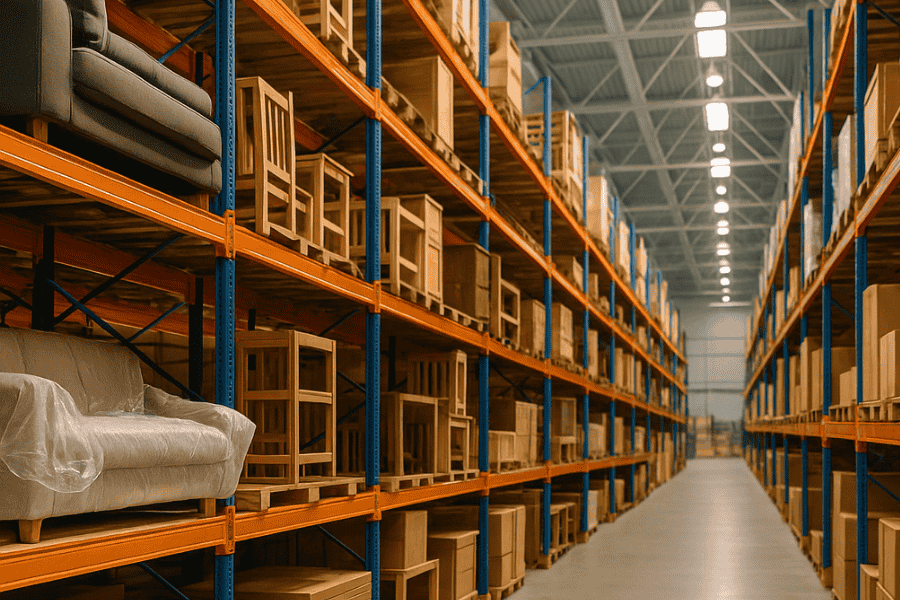
High-quality One-Stop Warehouse Solutions
5. Real-World Case Studies
Case 1: European Furniture Distributor
After adopting a one-stop system integrating adjustable racks and narrow aisles, the distributor increased capacity by 38% without facility expansion.
Case 2: Middle East Electronics Importer
By using fire-rated flooring and seismic rack structures, workplace incidents dropped 60% year-over-year.
Case 3: North American Exporter
Integrated Akuros dashboards improved safety audit accuracy by 45% and reduced forklift congestion zones by 50%.
6. Customer Feedback
Sofia, Logistics Head (Germany):
“We avoided a $50,000 expansion by redesigning storage vertically. The one-stop warehouse model changed our cost perspective completely.”
Raj, Operations Manager (UAE):
“Before integration, we had weekly forklift accidents. Now, with clear zoning and anti-collision sensors, it’s been four months accident-free.”
Noah, Procurement Specialist (USA):
“The unified dashboard is game-changing. Space utilization and safety metrics finally make sense together.”
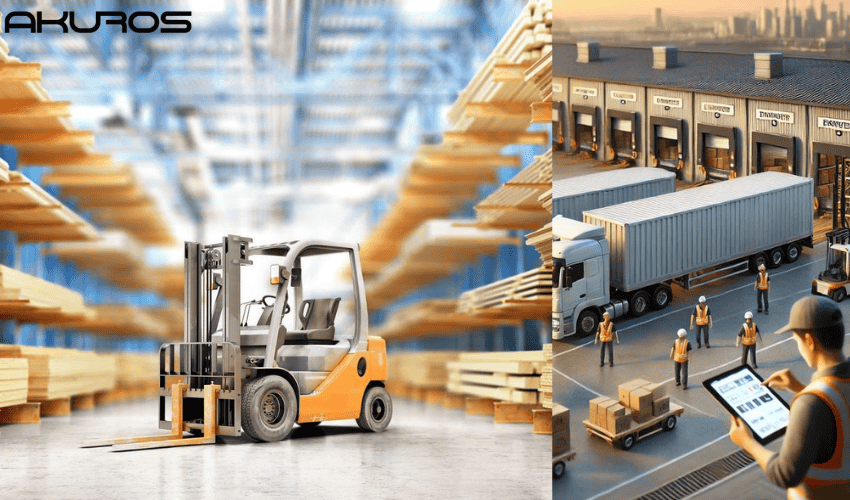
armazém único
7. FAQ
1. What does a solução de armazém único include?
It includes layout design, racking systems, automation integration, safety zoning, and unified monitoring dashboards.
2. How does it solve space challenges?
By maximizing vertical height, reducing aisle width, and combining smart inventory systems with modular racks.
3. Is it suitable for existing warehouses?
Yes — one-stop systems can retrofit existing infrastructure without disrupting daily operations.
4. How does it improve safety?
Integrated barriers, sensors, and AI systems prevent overloading and collisions.
5. How long before ROI is achieved?
Typically within 12–18 months through efficiency gains, reduced damage, and insurance savings.
📚 Referências
-
McKinsey & Company (2025). The Future of Integrated Warehousing: Safety, Space, and Smart Systems.
-
Fraunhofer Institute for Material Flow and Logistics (2024). Spatial Efficiency and Safety in Multi-Tier Warehousing.
-
PwC (2024). Global Warehouse Modernization Outlook: Risk Reduction Through Integration.
-
MIT Center for Transportation & Logistics (2023). The Impact of Smart Racking Systems on Warehouse Lifecycle and Safety.
-
Fórum Económico Mundial (2024). Automation and Resilience in Global Supply Chains.
-
OSHA (Occupational Safety and Health Administration, 2024). Warehouse Safety Guidelines and Best Practices.
-
European Committee for Standardization (CEN, 2023). EN 15512: Steel Static Storage Systems – Design and Safety Requirements.
-
Journal of Global Logistics (2024). Rossi, E. Why Integration Outperforms Expansion in Modern Warehousing.
-
Deloitte Insights (2024). Warehouse Transformation Report: Leveraging Digital Twins for Safety and Efficiency.
-
ISO (International Organization for Standardization, 2023). ISO 45001: Occupational Health and Safety Management Systems.
Fragmented warehouse structures create hidden inefficiencies: aisles that are too narrow, racks that exceed safe loads, and uncoordinated safety zones. Integrated one-stop warehouse solutions change this dynamic by connecting layout, materials, and digital monitoring into one ecosystem.
According to a 2025 McKinsey Supply Chain Safety Report, companies that adopted integrated warehouse models reduced injury rates by 35% and improved space efficiency by 40% within 18 months.In the end, space and safety challenges are not signs of poor management — they’re the natural result of fragmented systems. One-stop warehouse solutions solve this by bringing every layer of logistics under a single intelligent framework. From structural design to real-time monitoring, they turn cluttered spaces into optimized, compliant, and scalable environments.
For global buyers, this isn’t just an upgrade — it’s a strategic shift toward efficiency, predictability, and resilience. Warehousing in 2025 and beyond isn’t about expansion; it’s about smart integration.