

 Portuguese
  English
  Russian
  French
  Spanish
  German
  Italian
  Korean
  Japanese
  Arabic
  Turkish
  Indonesian
  Dutch
Dutch 

The E16 electric forklift is purpose-built for cold storage environments where standard forklifts struggle to deliver stable performance. This article analyzes how the E16 performs in -25°C cold rooms, which warehouse scenarios it fits best, and why lifecycle cost—rather than purchase price—should be the primary decision metric for cold chain operators.
1. Why Cold Storage Requires a Different Class of Electric Forklift
Cold storage warehouses impose operational conditions that fundamentally differ from ambient-temperature facilities. Low temperatures, condensation during door transitions, and high utilization intensity create compound stress on batteries, electronics, and mechanical systems.
Standard electric forklifts—designed primarily for room-temperature operation—often experience rapid battery degradation, electronic instability, and increased downtime in frozen environments. These issues are amplified in high-throughput cold chain facilities, where equipment reliability directly impacts order fulfillment and food safety compliance.
This is why cold storage operators increasingly evaluate forklifts as part of an integrado solução de armazém, rather than treating them as standalone handling tools.
 2. What Defines the E16 Electric Forklift for Cold Storage Applications
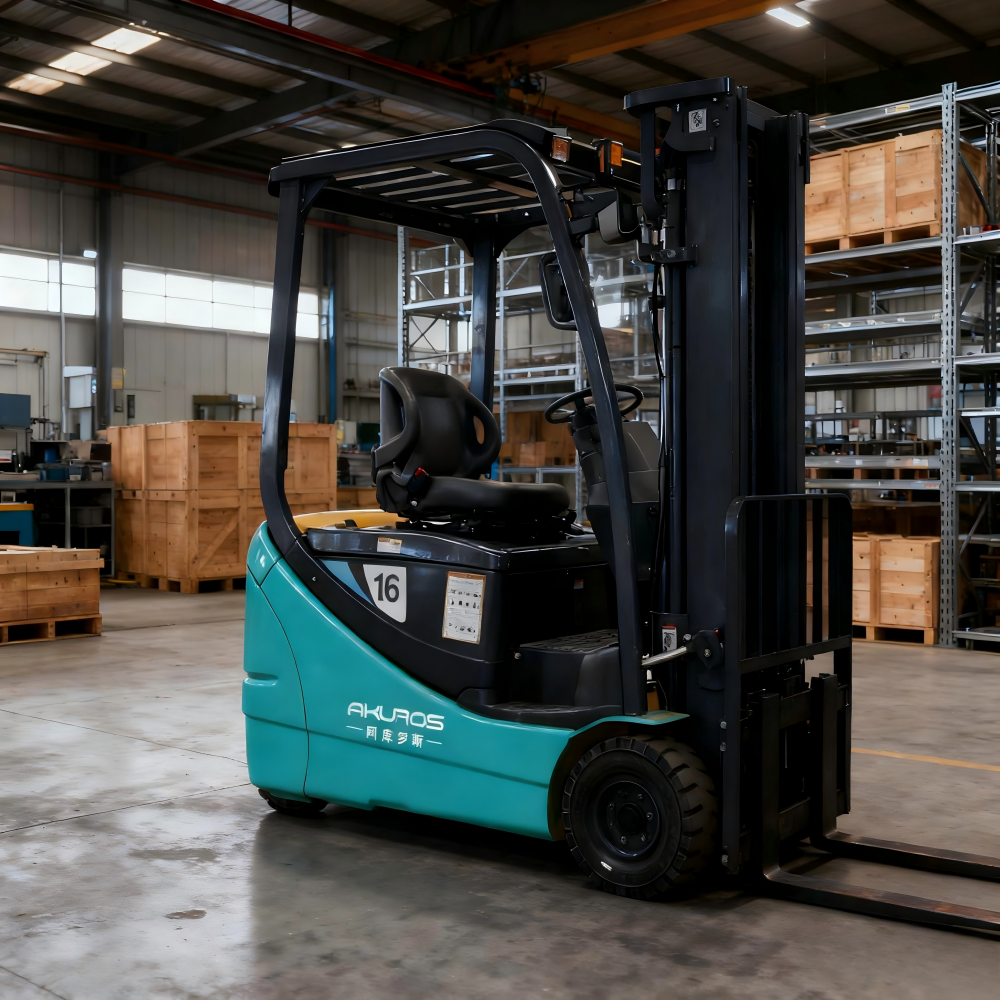
The E16 electric forklift is engineered to address the specific failure points commonly observed in frozen warehouses. Its design priorities focus on stability, durability, and system compatibility rather than headline specifications alone.
2.1 Cold-Adapted Power and Battery System
In sub-zero environments, battery performance becomes the single most critical determinant of forklift uptime. The E16 is designed to operate reliably at temperatures down to -25°C through cold-resistant battery configurations and optimized power management strategies.
When paired with properly specified forklift battery systems, the E16 maintains stable discharge behavior during extended cold-room shifts, reducing unexpected shutdowns and productivity loss.
2.2 Electronics Protection and Condensation Control
Condensation is one of the most underestimated risks in cold storage operations, particularly in facilities with frequent in–out movement between frozen and ambient zones. The E16 addresses this through enhanced sealing of electronic components and control systems, minimizing moisture ingress and electronic failure.
This design approach significantly improves reliability in cold chain environments where standard electric forklifts often fail prematurely.
2.3 Tires, Traction, and Cold Floor Stability
Frozen and damp floors reduce traction and increase braking distance. The E16 is compatible with cold-rated polyurethane tire solutions, providing consistent grip and reduced rolling resistance in low-temperature environments.
Stable ground contact is especially important in narrow aisles and high-density storage configurations, where maneuvering precision directly affects safety and throughput.
3. Expert Insights from Cold Chain Operations
Expert Insight — Cold Storage Operations Manager (North America)
“Forklift downtime in a frozen warehouse doesn’t just slow work—it disrupts the entire cold chain flow. Reliability matters more than peak speed.”
Expert Insight — Warehouse Engineering Consultant (Europe)
“Many cold storage projects underestimate how much battery and electronics stability affects long-term operating cost. The cheapest forklift is rarely the cheapest to operate.”
These insights reinforce a recurring theme in cold chain projects: equipment stability is a strategic asset, not a technical detail.
4. Where the E16 Performs Best: Application Scenarios
The E16 electric forklift is particularly well-suited for cold storage environments that combine operational intensity with space constraints.
4.1 High-Density Racking Environments
In facilities using double deep racking systems ou drive-in racking systems, forklift stability, reach accuracy, and predictable handling behavior become critical. The E16’s controlled performance profile supports consistent operation in these environments, reducing collision risk and improving pallet handling efficiency.
4.2 Hybrid Automation Warehouses
Many modern cold storage facilities adopt a hybrid automation model, where AGVs handle repetitive transport while forklifts manage flexible tasks. In such setups, the E16 integrates naturally with warehouse automation and AGV systems, supporting exception handling, mixed SKUs, and peak-period intervention.
This hybrid role allows operators to maintain flexibility without sacrificing the efficiency gains delivered by automation.
4.3 3PL and Multi-Client Cold Storage Facilities
Third-party logistics providers often operate under variable demand patterns and strict service-level agreements. The E16’s adaptability makes it suitable for multi-client cold storage operations where equipment must perform reliably across changing workflows.
5. Lifecycle Cost: Why Purchase Price Is the Wrong Metric
Cold storage forklift decisions based solely on purchase price often lead to higher total cost of ownership. A meaningful evaluation should consider lifecycle cost across several dimensions:
Direct Lifecycle Factors
-
Battery replacement cycles
-
Maintenance frequency
-
Downtime impact on throughput
Indirect Lifecycle Factors
-
Safety incidents and damage risk
-
Energy efficiency under low temperatures
-
Compatibility with future automation upgrades
When evaluated through a lifecycle cost lens, forklifts designed specifically for cold storage environments consistently outperform general-purpose alternatives.
6. Common Mistakes When Selecting Forklifts for Cold Storage
Even experienced operators make recurring mistakes in cold storage forklift procurement:
-
Applying ambient-warehouse selection logic to frozen environments
-
Ignoring future automation compatibility
-
Separating forklift procurement from racking and layout planning
In high-density cold storage layouts, these mistakes often become structural inefficiencies that cannot be corrected without significant operational disruption.
7. Why Forklift Selection Must Align with End-to-End Planning
Forklifts are not isolated assets in cold chain warehouses. Their performance is inseparable from layout design, storage density, automation strategy, and long-term service planning.
Selecting the E16 as part of a one-stop cold storage warehouse solution ensures that equipment capability, racking configuration, and automation logic are aligned from the outset, reducing integration risk and improving long-term ROI.
8. Google Popular Topics (Contextual Answers)
Is the E16 electric forklift suitable for -25°C cold storage?
Yes. When properly configured, the E16 is designed for stable operation in cold rooms down to -25°C.
What type of racking works best with the E16 in cold storage?
The E16 performs well in high-density configurations such as double deep and drive-in racking, provided aisle geometry is properly planned.
How does the E16 compare to diesel forklifts in frozen warehouses?
Electric forklifts like the E16 offer zero emissions, lower noise, and improved indoor safety compared to diesel alternatives.
Can the E16 work alongside AGV systems?
Yes. The E16 is commonly deployed in hybrid automation environments where forklifts handle flexible or exception tasks.
What is the typical lifespan of an electric forklift in cold storage?
Lifespan depends on operating conditions and maintenance, but cold-adapted forklifts generally deliver longer service life and lower downtime.