

 Korean
  English
  Russian
  French
  Spanish
  German
  Italian
  Portuguese
  Japanese
  Arabic
  Turkish
  Indonesian
  Dutch
Dutch 

서론
Warehouse expansion is not always the first or best answer when pallet volume grows. In many facilities, the more practical question is how to increase storage density inside the existing building. Floor area is expensive, construction takes time, and operational interruption can be costly. As a result, many warehouse managers look first at storage layout optimization before considering a physical expansion project. That is where the double-deep racking system becomes highly relevant.
아쿠로스 double-deep racking system is designed for warehouses that want to improve pallet density by storing pallets two positions deep. Instead of dedicating more floor space to aisles, the layout allows more of the warehouse footprint to be converted into actual pallet storage. This makes it especially valuable for facilities where storage demand is rising but space remains limited.
However, higher density alone does not mean the system fits every operation. A warehouse must also evaluate its pallet profile, forklift strategy, inventory rotation, operator capability, and long-term storage plan. A double-deep pallet racking layout can deliver strong results, but only when it is matched to the right operational conditions. This article explains how buyers should evaluate that fit in a practical and commercially useful way.
What a Double-Deep Racking System Actually Changes
From selective access to deeper storage lanes
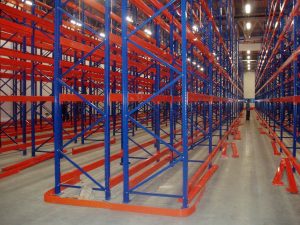
In a conventional selective rack layout, each pallet position is directly accessible from the aisle. That gives excellent selectivity, but it also means the warehouse uses more floor area for traffic lanes. A double-deep racking system changes that trade-off by storing two pallets in depth. The front pallet remains directly accessible, while the rear pallet sits behind it and requires a compatible reach truck to access safely.
Why this improves density
Because fewer aisles are needed, more of the warehouse can be dedicated to pallet positions. This is why high-density warehouse racking systems such as double-deep layouts are attractive to warehouses trying to optimize space without moving into a fully automated solution. It is a relatively structured way to raise storage density while keeping the system familiar to many warehouse teams.
What the warehouse gives up in return
Higher density usually means lower selectivity. In a double-deep pallet racking layout, the rear pallet cannot be accessed until the front pallet is removed. This changes inventory logic and generally favors operations where pallet flow is predictable, pallet characteristics are relatively consistent, and inventory rotation can tolerate a LIFO-style sequence.
Real Warehouse Scenario: When Double-Deep Layout Starts to Make Sense
Imagine a regional distribution warehouse handling mostly palletized packaged goods. The building footprint is fixed, SKU count is moderate, and a large share of inventory is stored in repetitive pallet groups rather than in single, highly fragmented picks. The warehouse currently uses single-deep selective racks, but pallet demand has grown enough that the aisles are starting to feel oversized compared with the remaining storage space.
In this situation, switching part of the layout to a double-deep racking system may create a meaningful increase in pallet positions without changing the building itself. If the warehouse is already using or is willing to adopt double-deep reach trucks, and if the pallet profile is stable enough, the layout can improve storage density while remaining operationally manageable. This is one of the most common scenarios in which the double-deep concept moves from theory to a serious ROI discussion.
How to Tell If Your Warehouse Is a Good Fit
1. Your warehouse needs more pallet density, not more SKU selectivity
The strongest fit appears when the business is trying to store more pallets per square meter rather than maximize direct access to every pallet position. If storage density is the priority, the double-deep racking system becomes much more attractive than a traditional single-deep layout.
2. Your pallet sizes and load conditions are relatively consistent
A double-deep layout performs best when pallets are standardized and loads remain stable during storage and retrieval. Highly inconsistent pallets, awkward load geometry, or unpredictable unitization can reduce the efficiency of deeper storage positions.
3. Your inventory rotation can tolerate restricted access to rear pallets
Because the rear position is blocked until the front pallet is removed, the system is better suited to goods with predictable flow and grouped inventory patterns. If every pallet requires immediate and independent access, a highly selective layout may still be preferable.
4. Your forklift strategy supports double-deep access
A serious double-deep pallet racking project must include compatible equipment planning. If the warehouse does not already operate double-deep reach trucks, it should account for equipment investment, operator training, and maneuvering requirements before finalizing the rack layout.
5. Your warehouse wants density gains without full automation
For many facilities, a high-density warehouse racking solution is desirable, but the cost or complexity of automation is not justified yet. In these cases, a structured steel rack system with the right reach truck support becomes an appealing middle ground between standard selective storage and more advanced automated systems.
Planning Table: Key Fit Questions Before Implementation
| 계획 요인 | What to Check | Why It Matters | Risk If Ignored |
|---|---|---|---|
| Storage goal | Need for higher density versus direct selectivity | Defines whether the layout logic matches the business objective | System improves density but hurts access more than expected |
| Pallet consistency | Uniform pallet dimensions and stable loads | Supports smoother rear-position storage and retrieval | Operational difficulty and rack handling inefficiency |
| Inventory flow | How often front and rear pallets need to be accessed | Determines whether LIFO-style access is acceptable | Excess reshuffling and lost productivity |
| 운전자 교육 | Availability of double-deep reach trucks | Essential for safe rear pallet access | Layout cannot be operated as designed |
| Aisle and height planning | Building clear height and traffic lane design | Affects practical storage gain and maneuvering safety | Density assumptions fail in real operation |
Where Double-Deep Racking Performs Especially Well
Distribution centers with grouped pallet inventory
Distribution operations that handle repeated pallet groups of the same SKU often benefit because the loss of full pallet selectivity is less damaging than it would be in a fragmented inventory environment. In these conditions, the gain in pallet density can outweigh the access trade-off.
Cold storage facilities
Double-deep racking for cold storage is especially attractive because cold-room construction and refrigerated cubic space are expensive. When the warehouse can safely and efficiently store more pallets inside the same controlled environment, the storage economics often improve significantly.
Manufacturing warehouses with stable inventory patterns
Facilities holding raw materials, packaging materials, or finished goods with predictable turnover often fit well because the storage sequence is easier to manage and rear-position pallets can be planned in a more structured way.
Space-constrained warehouses under growth pressure
When the warehouse cannot expand physically in the short term, denser rack configurations become much more valuable. A double-deep racking system can often create the next level of storage improvement without requiring a building project.
Where the System May Be Less Suitable
Operations with very high SKU fragmentation
If each pallet position must remain independently accessible at almost all times, the operational penalty of rear-pallet blocking may be too high. In such environments, selective racking or other highly accessible layouts may be more appropriate.
Warehouses with inconsistent pallet quality
Unstable loads, irregular pallets, or frequent damage to pallet bases can reduce the practicality of deeper rack storage. A denser layout needs more pallet discipline, not less.
Sites without the right equipment strategy
A double-deep rack layout should never be planned in isolation from forklift selection. If the warehouse does not commit to the correct truck type and operator capability, the system may look efficient on paper but perform poorly in daily use.
Comparison Table: Single-Deep vs Double-Deep Racking
| 비교 요소 | Single-Deep Selective Racking | Double-Deep Racking System | Commercial Meaning |
|---|---|---|---|
| Pallet Access | Every pallet directly accessible | Rear pallet blocked by front pallet | Trade-off between access and density |
| 스토리지 밀도 | Lower | 더 높음 | Important for limited-space warehouses |
| 통로 요구사항 | More aisles needed | Fewer aisles needed | Direct effect on floor-space utilization |
| Forklift Requirement | Standard reach or forklift options | Double-deep reach truck required | Equipment planning becomes critical |
| Inventory Logic | 높은 선택성 | More suitable for LIFO-style handling | Best for grouped and predictable inventory |
Why Forklift Compatibility Is Not a Secondary Detail
One of the most important planning points in a double-deep racking system project is forklift compatibility. The rack design and the truck strategy must be developed together. Rear-position pallet access requires the reach and control capability of a double-deep reach truck, and this affects both equipment cost and operating discipline.
For buyers, this means the real project is not only “buying racks.” It is building a workable storage system. The rack layout, aisle design, pallet uniformity, operator visibility, and truck capabilities all have to support the same workflow. When these elements are aligned, the density gain becomes meaningful. When they are not, the warehouse may end up with a layout that is theoretically dense but practically inefficient.
How to Evaluate Return on Space Instead of Only Return on Equipment
Rack projects are often judged by cost per bay or cost per pallet position. Those metrics matter, but they do not tell the whole story. In many warehouses, the more valuable metric is return on space. If the building is difficult or expensive to expand, every gain in usable pallet density has strategic value. That is why a high-density warehouse racking layout can outperform a cheaper but less efficient alternative.
For example, if a warehouse can significantly increase pallet positions by reducing aisle count and reorganizing rack depth, it may delay building expansion, postpone leased overflow storage, or improve throughput within the existing footprint. In such cases, the economic benefit extends beyond the rack itself.
Why This Product Direction Works Well for Akuros
The current Akuros product page already frames this system as a high-density storage solution for space-constrained warehouses, which is the right commercial foundation. It also clearly signals the main fit conditions: two pallets stored in depth, higher density than single-deep layouts, compatibility with double-deep reach trucks, and suitability for warehouses with predictable inventory patterns and limited space.:contentReference[oaicite:1]{index=1}
That gives Akuros a strong content angle for long-tail search terms such as double-deep racking system, double-deep pallet racking, double-deep racking for cold storage, high-density warehouse racking, 공간 최적화를 위한 창고 랙및 double-deep racking manufacturer. These are commercially useful phrases because they reflect the way warehouse buyers actually search when they are comparing storage density options.
Industry Trend: Why Density-Focused Rack Layouts Remain Relevant
Warehouses continue to face the same structural pressures: more pallet volume, limited floor area, higher land and construction costs, and stronger expectations for storage efficiency. Not every operation is ready for automation, but many still need better use of existing cubic space. That is why intermediate density solutions such as double-deep pallet racking remain highly relevant. They allow the warehouse to improve capacity with a familiar steel structure and a clearer investment path than fully automated alternatives.
This is especially true in sectors such as distribution, food logistics, manufacturing storage, and cold-chain operations, where the economic value of additional pallet positions can be significant even before the warehouse reaches full automation maturity.
결론
아쿠로스 double-deep racking system is a strong option for warehouses that need higher pallet density without immediately expanding the building footprint. Its value comes from converting more of the warehouse into usable pallet storage while keeping the system structured, scalable, and practical for operations that can manage rear-position access and forklift compatibility.
However, the right fit depends on more than storage ambition. Buyers should evaluate pallet consistency, inventory rotation, reach truck planning, aisle logic, and long-term warehouse goals before implementation. When these conditions align, double-deep pallet racking can become one of the most effective ways to improve storage capacity inside an existing facility.
In other words, the system works best when it is chosen not simply as a denser rack, but as a warehouse strategy.
자주 묻는 질문
1. What is the main advantage of a double-deep racking system?
The main advantage is higher pallet storage density. By storing pallets two positions deep and reducing aisle count, the warehouse can use more of its floor area for actual storage instead of traffic lanes.
2. Is double-deep racking suitable for every warehouse?
No. It is best suited to warehouses that can accept reduced pallet selectivity in exchange for higher density. It generally works better where pallet sizes are consistent and inventory flow is predictable.
3. Why does double-deep racking require special forklifts?
Because the rear pallet is stored behind the front pallet, the truck must have the reach capability to access that deeper position safely and efficiently. This is why double-deep reach trucks are typically required.
4. Is double-deep racking a good option for cold storage?
Yes, it can be a strong option for cold storage because refrigerated space is expensive. Increasing pallet density inside the same controlled environment can improve storage economics significantly.
5. What should I prepare before asking for a quote?
You should provide pallet dimensions, pallet weight, inventory rotation pattern, clear warehouse height, aisle limits, and forklift preferences. These details help the supplier determine whether the layout is a practical fit.
Suggested Tags
double-deep racking system, double-deep pallet racking, high-density warehouse racking, cold storage racking, warehouse storage solution, pallet racking system, industrial racking, space optimization racking
Semantic Closure Block
How should buyers evaluate this system?
They should start by asking whether the warehouse needs more pallet density more than it needs direct access to every pallet. That single question usually determines whether double-deep logic makes sense.
Why is this system attractive in space-constrained warehouses?
Because it reduces aisle count and converts more of the building footprint into storage positions. In warehouses where expansion is difficult, that density gain can be strategically valuable.
What are the most important implementation conditions?
The warehouse should have relatively consistent pallet profiles, predictable inventory flow, compatible reach truck planning, and clear acceptance of rear-position access logic.
What makes this more than just a rack layout decision?
It is a warehouse operating model decision. The layout, inventory pattern, forklift strategy, and storage objectives all have to support the same logic for the system to deliver long-term value.