

 Italian
  English
  Russian
  French
  Spanish
  German
  Portuguese
  Korean
  Japanese
  Arabic
  Turkish
  Indonesian
  Dutch
Dutch 

Riepilogo rapido:A Pallet Truck is one of the most important warehouse handling tools for moving palletized goods safely and efficiently. The right choice depends on daily pallet volume, load capacity, fork dimensions, turning radius, travel distance, battery type, floor condition, operator fatigue, safety requirements, and ROI—not just purchase price.
A warehouse team moves hundreds of pallets every shift. Some loads are light cartons, some are heavy raw materials, some travel only a few meters, and others move repeatedly between storage zones, production lines, cold rooms, loading docks, and dispatch areas. Operators complain about fatigue. Picking speed is inconsistent. Manual pallet trucks are affordable, but labor pressure is rising. Electric pallet trucks look attractive, but managers still ask the painful question: is the upgrade really worth it?
That is why choosing the right Transpallet in 2026 is no longer a small equipment decision. It affects labor efficiency, product safety, operator fatigue, warehouse throughput, floor traffic, loading speed, injury risk, battery management, maintenance cost, and total ROI. A pallet truck may look simple, but buy the wrong model and it will quietly slow down your warehouse every single day. Tiny wheels, big consequences—warehouse comedy is usually expensive.
For companies reviewing warehouse handling solutions and supplier capability, the warehouse equipment supplier background can help buyers understand broader material handling support before selecting equipment for daily warehouse transfer.
This guide explains how to choose a pallet truck by comparing manual and electric options, checking load capacity, fork dimensions, turning radius, battery choices, use cases, ROI, safety, and supplier quality. It is written for warehouse managers, logistics teams, factory owners, procurement teams, cold-chain operators, and distribution centers that want equipment decisions based on real workload—not guesswork.

TRANSPALLET
What Is a Pallet Truck and Where Is It Used?
Basic Definition
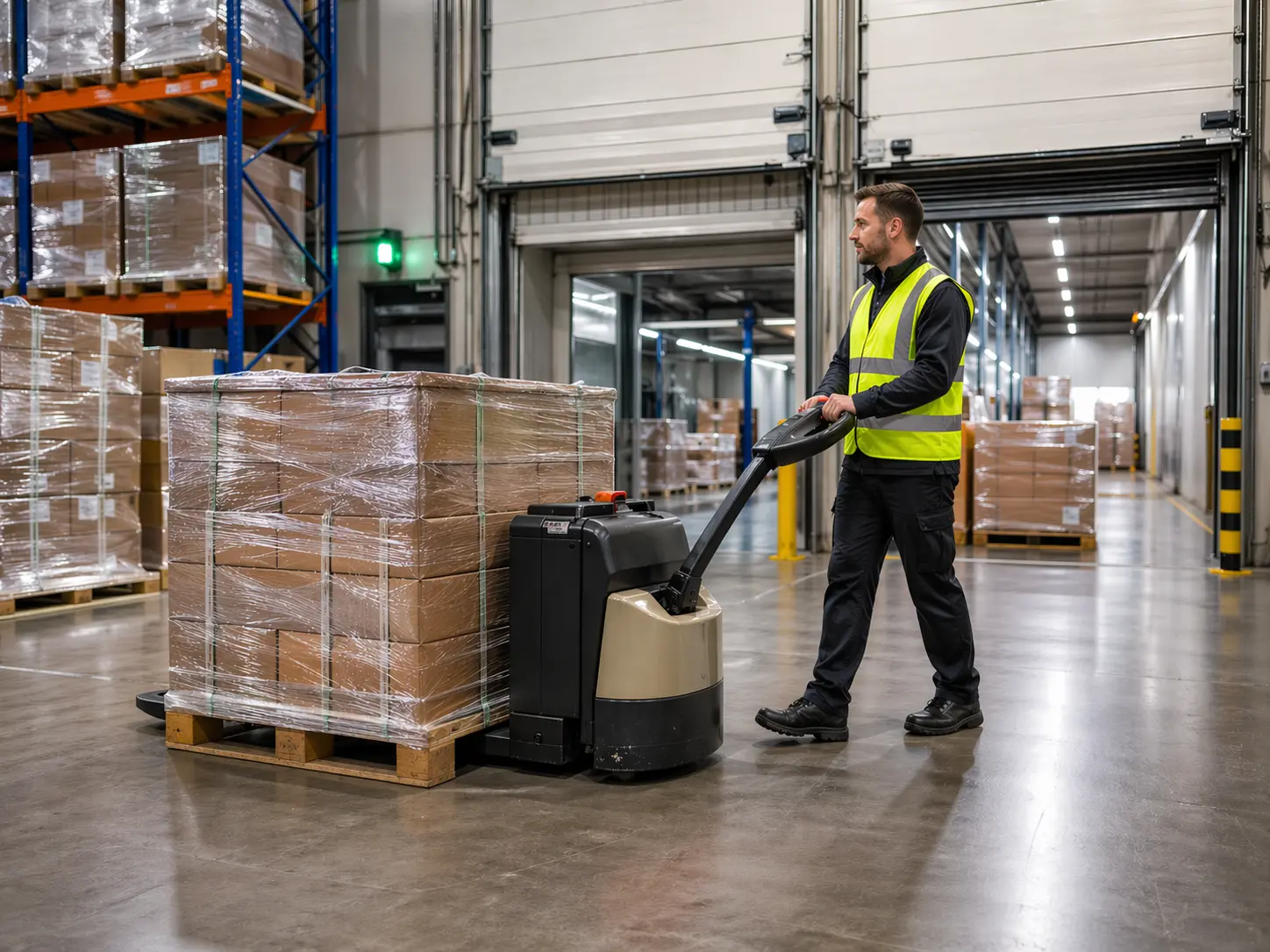
A Pallet Truck, also called a pallet jack, is a material handling device used to lift and move palletized goods over short to medium distances. It can be manual, semi-electric, or fully electric depending on the lifting and travel mechanism. In modern warehouses, pallet trucks are used for loading, unloading, internal transfer, production line feeding, order staging, retail backrooms, cold storage operations, and dock movement.
The main reason pallet trucks remain essential is simple: not every job needs a forklift. A pallet truck is more compact, lower cost, easier to operate, and better suited for confined spaces. It can move goods between aisles, loading zones, storage racks, sorting areas, and production workstations without requiring the same operating space as a forklift.
Common Pallet Truck Types
The most common types include transpallet manuale, transpallet elettrico, semi-electric pallet truck, lithium battery pallet truck, walkie pallet truck, ride-on pallet truck, low profile pallet truck, stainless steel pallet truck, weighing scale pallet truck, and heavy duty pallet truck. Each type serves a different operating condition.
For warehouse teams comparing common use cases, the article on uses of Pallet Trucks in modern warehouses gives helpful context on how pallet trucks support loading docks, inventory transfer, order staging, retail backrooms, and daily warehouse movement.
| Pallet Truck Type | Best Use | Buyer Consideration |
|---|---|---|
| Transpallet manuale | Short-distance, low-frequency movement | Low cost but higher operator effort |
| Semi-Electric Pallet Truck | Moderate use with powered travel or lift | Balance between cost and productivity |
| Transpallet elettrico | Frequent movement and heavier loads | Higher upfront cost, better efficiency |
| Ride-On Pallet Truck | Long-distance warehouse travel | Needs more space and operator training |
| Stainless Steel Pallet Truck | Food, pharmaceutical, wet environments | Higher cost but better corrosion resistance |
Manual vs. Electric Pallet Trucks: Assessing Your Needs
When Manual Pallet Trucks Still Make Sense
Manual pallet trucks still have a place in many warehouses. They are simple, affordable, easy to maintain, and useful as backup equipment. If pallet movement is occasional, travel distance is short, load weight is moderate, and operators do not move pallets continuously throughout the day, a manual pallet truck may be the most practical choice.
Manual models are also useful in retail backrooms, small workshops, compact storage rooms, and low-frequency loading areas. They require no battery, no charging schedule, and fewer electrical components. For low-volume handling, this simplicity is valuable.
When Electric Pallet Trucks Become the Better Choice
Un transpallet elettrico becomes the better choice when operators move pallets repeatedly, loads are heavier, travel distance is longer, and throughput matters. Electric travel reduces pushing and pulling effort, helps reduce fatigue, and improves movement consistency across long shifts.
Electric models are especially useful in e-commerce warehouses, manufacturing plants, distribution centers, loading docks, cold storage operations, and high-frequency transfer routes. If workers are moving pallets all day, manual equipment may look cheaper at purchase but become more expensive through slow movement, fatigue, and higher injury risk.
For operations comparing powered handling equipment and manual movement, this discussion on electric stacker truck vs manual pallet truck can help buyers understand when simple manual transfer is enough and when powered warehouse handling equipment becomes more practical.
| Fattore | Transpallet manuale | Transpallet elettrico |
|---|---|---|
| Costo iniziale | Più basso | Più alto |
| Operator Effort | Più alto | Più basso |
| Daily Productivity | Moderato | Più alto |
| Best Distance | Short | Medium to long |
| Manutenzione | Simple | Battery and electrical system required |
| ROI Potential | Best for low usage | Strong for frequent usage |
Buyer Decision Logic
If pallet movement is occasional, choose manual. If movement is frequent but the budget is controlled, consider semi-electric. If loads are heavy or travel distance is long, choose electric. If operators move pallets all day, electric is usually the better long-term investment. If aisles are narrow, check turning radius before choosing any powered model. The right decision is not “manual is cheap” or “electric is modern.” The right decision is workload matched to equipment.
Key Specs: Load Capacity, Fork Dimensions, and Turning Radius
Load Capacity: Do Not Choose by Guesswork
Pallet truck load capacity is one of the first specifications buyers check, but it should not be selected casually. Common capacities may include 1.5 tons, 2 tons, 2.5 tons, 3 tons, or higher depending on the model. Buyers should consider maximum pallet weight, not just average load weight. A safety margin is important because overloaded trucks can damage wheels, forks, hydraulic systems, motors, brakes, batteries, and warehouse floors.
Load distribution also matters. A pallet truck may be rated for a certain load under proper loading conditions, but unstable or unevenly distributed goods can create handling risk. Heavy industrial materials, beverage pallets, cold storage goods, and manufacturing components should be evaluated more carefully than light cartons.
Fork Dimensions: Match Your Pallets
Pallet truck fork dimensions must match pallet size, pallet entry opening, and handling method. Fork length should support the pallet correctly. Fork width should enter pallet openings without forcing. Lowered fork height matters if the warehouse uses low-clearance pallets. Different regions may use different pallet standards, so export buyers should confirm local pallet dimensions before ordering.
Wrong fork dimensions can cause unstable lifting, pallet damage, poor maneuverability, and wasted handling time. This is one of those mistakes that seems small in the purchase order and very large on the warehouse floor.
Turning Radius: The Hidden Productivity Factor
Pallet truck turning radius affects how smoothly equipment moves through aisles, docks, storage zones, and production areas. A smaller turning radius is valuable in tight warehouses. Electric and ride-on models may need more maneuvering space than manual trucks, so buyers should compare turning radius with real aisle width.
Wheels and Floor Compatibility
Wheel material affects floor protection, noise, rolling resistance, durability, and operator comfort. PU wheels are common in warehouses because they are quieter and floor-friendly. Nylon wheels are durable and have lower rolling resistance on hard surfaces. Rubber wheels provide grip but may increase effort. Rough or uneven floors require stronger wheels and more durable construction.
| Spec | Why It Matters | Buyer Check |
|---|---|---|
| Capacità di carico | Prevents overload and equipment damage | Maximum pallet weight + safety margin |
| Fork Length | Supports pallet properly | Match pallet dimensions |
| Fork Width | Fits pallet entry | Check regional pallet type |
| Lowered Fork Height | Works with low-clearance pallets | Confirm pallet clearance |
| Turning Radius | Affects aisle maneuvering | Match warehouse layout |
| Wheel Material | Affects floor, noise, rolling resistance | PU, nylon, or rubber |
Battery and Power Options for Electric Pallet Trucks
Lead-Acid vs Lithium Battery
Battery selection strongly affects electric pallet truck performance. Lead-acid batteries are mature and cost-effective, but they are heavier, charge more slowly, and require more maintenance. Lithium batteries charge faster, support opportunity charging, and usually require less maintenance. For high-frequency warehouses or multi-shift operations, lithium battery models are often more practical.
A lithium battery pallet truck can be useful when uptime matters, charging windows are short, and operators need equipment available throughout the day. However, buyers still need to evaluate charging points, battery safety, spare battery planning, and total operating cost.
Battery Runtime and Charging Strategy
Battery runtime depends on load weight, travel distance, floor condition, starts and stops, route length, operator behavior, and working temperature. Cold storage can reduce battery performance, so cold-chain buyers should be especially careful when selecting battery type and protection level.
For cold-chain or low-temperature environments, this guide on low-temperature electric pallet truck selection gives additional context on durable transfer solutions for demanding cold storage operations.
| Battery Type | Vantaggi | Limitazioni | Best Use |
|---|---|---|---|
| Lead-Acid | Lower initial cost, mature technology | Heavier, longer charging, maintenance required | Standard single-shift operations |
| Litio | Fast charging, lighter, low maintenance | Higher initial cost | High-frequency and multi-shift warehouses |
| Removable Battery | Easy replacement | Requires spare battery planning | Continuous operation |
How to Calculate the ROI of Upgrading Your Fleet
Why ROI Matters More Than Purchase Price
A manual pallet truck costs less upfront. That is obvious. What is less obvious is how much time and labor it consumes when workload becomes frequent. Electric pallet trucks can reduce operator fatigue, improve throughput, reduce movement time, and support safer handling. ROI depends on daily pallet volume, distance, labor cost, time saved, injury risk, downtime, maintenance, and equipment life.
Instead of asking, “How much does the truck cost?” buyers should ask, “How much does each pallet movement cost us today?” That question changes the entire procurement conversation.
ROI Formula Concept
To estimate ROI, calculate daily pallets moved, time saved per pallet, labor cost per hour, working days per year, equipment cost difference, maintenance cost, downtime reduction, and possible injury risk reduction. The goal is not to make a perfect financial model. The goal is to avoid buying blind.
For buyers studying powered pallet movement, the article on battery powered pallet truck for warehouse transfer provides useful background on transfer frequency, battery selection, and warehouse movement planning.
| Metrica | Example Value |
|---|---|
| Pallets moved per day | 150 |
| Time saved per pallet | 35 seconds |
| Daily time saved | 5,250 seconds / 87.5 minutes |
| Annual working days | 260 |
| Annual hours saved | About 379 hours |
| Labor cost per hour | $18 |
| Annual labor value saved | About $6,822 |
| Equipment cost difference | Example $4,500 |
| Estimated payback period | About 8 months |
ROI Warning
Real ROI varies by wage level, route distance, pallet volume, load weight, warehouse layout, floor condition, downtime, and operator skill. Do not buy electric only because it looks modern. Buy electric when the workload justifies it. Shiny equipment without workload logic is just expensive decoration with wheels.
Pallet Trucks Supplier
Use Cases: Which Pallet Truck Fits Which Warehouse?
Small Warehouse or Retail Backroom
A small warehouse or retail backroom often needs a manual pallet truck because movement is occasional, travel distance is short, and maintenance simplicity matters. Compact size and standard fork dimensions are usually enough.
E-Commerce Fulfillment Center
E-commerce warehouses often move pallets frequently between receiving, storage, picking, packing, and dispatch zones. A compact electric pallet truck with a small turning radius and lithium battery can improve movement efficiency.
Cold Storage Warehouse
Cold storage operations need equipment designed for low-temperature performance, corrosion resistance, battery stability, and safe operation on potentially slippery floors. Buyers should check battery behavior, wheel grip, braking, and material protection.
Food and Beverage Warehouse
Food and beverage warehouses may require corrosion-resistant or stainless steel pallet trucks in wet or hygiene-sensitive areas. Easy-clean structures, safe wheels, and optional weighing functions can also be useful.
Manufacturing Plant
Manufacturing plants often handle raw materials, components, semi-finished goods, and finished products. A heavy duty pallet truck or electric model may be better when loads are heavy and movement is frequent.
Loading Dock and Distribution Center
Loading docks and distribution centers often benefit from electric or ride-on pallet trucks because travel distances and pallet volumes are higher. Braking, turning radius, battery uptime, and operator training become important.
| Caso d'uso | Recommended Pallet Truck | Main Reason |
|---|---|---|
| Retail Backroom | Manual pallet truck | Low-cost and simple |
| E-commerce Warehouse | Electric pallet truck | Frequent movement |
| Stoccaggio a freddo | Cold-room compatible electric truck | Battery and safety needs |
| Food Warehouse | Stainless steel pallet truck | Hygiene and corrosion resistance |
| Distribution Center | Ride-on electric pallet truck | Long-distance transport |
Safety, Regulations, and Operator Ergonomics
Operator Fatigue and Injury Risk
Repeated pulling and pushing can strain the back, shoulders, wrists, knees, and hips. Heavy loads make this worse. Manual pallet trucks are useful, but in high-frequency environments, operator fatigue becomes a productivity and safety issue. Electric trucks reduce physical effort and can help maintain more consistent movement across shifts.
Safety Features to Check
For electric models, buyers should check emergency stop, horn, anti-crush reverse button, braking system, speed control, anti-slip handle, wheel quality, stability control, and operator visibility. For manual models, wheel condition, hydraulic lifting function, fork integrity, handle control, and load rating are essential.
Compliance and Training
Warehouses should follow material handling safety concepts, operator training procedures, daily inspection routines, load limit markings, charging safety guidelines, and personal protective equipment rules where required. CE or local market documentation may be needed depending on the target region.
| Safety Item | Why It Matters | Buyer Action |
|---|---|---|
| Load Rating | Prevents overload | Check rated capacity |
| Emergency Stop | Stops powered movement | Required for electric models |
| Braking System | Controls movement | Important on ramps or docks |
| Formazione degli operatori | Reduces accidents | Train before use |
| Daily Inspection | Finds faults early | Check wheels, forks, hydraulics |
Common Buyer Mistakes When Choosing Pallet Trucks
Buying Only by Load Capacity
Load capacity matters, but it is not enough. A truck may lift the load but still fail your operation if the fork size is wrong, turning radius is too large, battery runtime is insufficient, or wheels do not match the floor.
Choosing Manual for High-Frequency Work
Manual trucks are useful for low-frequency work. But if operators move pallets repeatedly over long distances, manual handling can increase fatigue, slow throughput, and create ergonomic risk.
Ignoring Aisle Width and Turning Radius
A model that works perfectly in a catalog may be awkward in a tight warehouse. Always compare equipment turning radius with real aisle width, dock space, and pallet positioning areas.
Forgetting Pallet Type
Forks must match the pallet entry and dimensions. If the truck cannot enter pallets smoothly or support them correctly, handling becomes slow and unsafe.
Underestimating Battery Needs
Electric trucks need a charging plan. If runtime is too short, the truck may stop mid-shift. For high-frequency operations, lithium battery options and opportunity charging may be worth considering.
Ignoring Floor Conditions
Rough floors, ramps, wet areas, freezer zones, and uneven surfaces can damage wheels and reduce safety. Wheel selection is not a small detail; it is daily survival for the truck.
How to Choose a Pallet Truck Supplier
What a Reliable Supplier Should Provide
A reliable pallet truck supplier should provide load capacity options, manual and electric models, fork size options, battery options, wheel material choices, turning radius data, spare parts support, warranty, technical documentation, safety features, customization support, warehouse application advice, after-sales service, export packaging, and compliance documentation.
For buyers comparing equipment configuration and selection logic, this detailed guide on how to choose the right Pallet Truck for your warehouse can support internal procurement discussions and help match truck type to daily handling conditions.
| Fattore di valutazione | Weight | What to Check |
|---|---|---|
| Model Range | 15% | Manual, electric, heavy-duty, low-profile |
| Load Capacity Options | 15% | Match real warehouse loads |
| Fork Dimension Options | 10% | Match pallet types |
| Battery Support | 15% | Lithium, lead-acid, charging support |
| Caratteristiche di sicurezza | 15% | Brakes, emergency stop, anti-crush design |
| Assistenza post-vendita | 10% | Warranty and service response |
When to Contact a Supplier
Buyers should contact suppliers after preparing basic warehouse information: maximum load weight, pallet size, daily pallet movement volume, travel distance, aisle width, floor condition, shift schedule, cold storage requirement, battery preference, and required delivery timeline. For equipment consultation or quotations, buyers can reach an warehouse equipment supplier with these details to receive more accurate recommendations.
Practical Recommendation: How to Choose the Right Pallet Truck in 2026
Choose Manual Pallet Truck If
Choose a manual model if pallet movement is occasional, travel distance is short, loads are moderate, budget is limited, backup equipment is needed, and maintenance simplicity matters. Manual trucks remain useful, especially for smaller facilities and light-duty transfer.
Choose Electric Pallet Truck If
Choose an electric model if pallets are moved frequently, travel distance is longer, loads are heavy, operator fatigue is a problem, warehouse throughput matters, and labor cost is rising. Electric trucks are often better for distribution centers, factories, e-commerce warehouses, and loading docks.
Choose Lithium Battery Pallet Truck If
Choose a lithium battery pallet truck if multi-shift operation is common, fast charging matters, equipment uptime is important, and maintenance reduction is a priority. Lithium models often provide better productivity when the warehouse has frequent use and limited charging windows.
Choose Low Profile Pallet Truck If
Choose a low profile pallet truck if your pallets have low clearance and standard forks cannot enter smoothly. This is common in certain custom pallets, display pallets, and special packaging systems.
Choose Stainless Steel Pallet Truck If
Choose stainless steel or corrosion-resistant models if the warehouse is wet, food-related, pharmaceutical, chemical, cold-chain, or hygiene-sensitive. The upfront cost may be higher, but corrosion resistance and cleanability can be more important than the initial price.
Choose Heavy Duty Pallet Truck If
Choose heavy duty pallet trucks when loads exceed standard warehouse weight, industrial materials are handled, or durability is more important than light weight. Heavy-duty models should be selected with capacity margin and floor conditions in mind.
Final Recommendation: Match the Truck to the Workload, Not the Catalog
The right Pallet Truck is not simply the cheapest model, the strongest model, or the newest electric model. It is the model that matches real warehouse movement. Manual trucks are still valuable for low-frequency, short-distance work. Electric pallet trucks are stronger choices for high-frequency movement, heavier loads, longer travel routes, and labor-sensitive operations. Lithium battery models make sense when uptime and charging flexibility matter.
If your team moves a few pallets per day, manual may be enough. If your team moves hundreds of pallets per shift, electric deserves a serious ROI calculation. If your warehouse is cold, wet, narrow, busy, or multi-shift, the decision becomes more specific. The safest buying logic is simple: measure the workload, check the route, confirm the pallet, calculate the ROI, and then choose the truck. Your warehouse floor will tell the truth faster than any brochure.
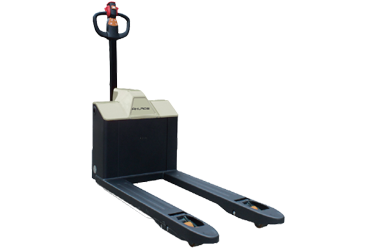 Transpallet |
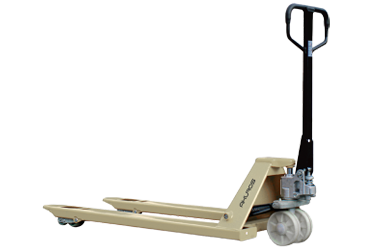 Transpallet manuale |
FAQ About Pallet Trucks
1. What is a Pallet Truck used for?
A Pallet Truck is used to lift and move palletized goods in warehouses, factories, logistics centers, retail backrooms, loading docks, cold storage facilities, and production areas. It helps workers transfer goods over short to medium distances without using a full forklift. Pallet trucks are commonly used for receiving, dispatch, order staging, internal transfer, stock movement, and loading support.
2. What is the difference between manual and electric pallet trucks?
A manual pallet truck uses human force to push, pull, steer, and pump the hydraulic lift, while an electric pallet truck uses battery power for travel and sometimes lifting, depending on the model. Manual pallet trucks are lower cost and simpler to maintain, making them suitable for occasional short-distance use. Electric pallet trucks reduce operator effort and are better for frequent movement, heavier loads, longer travel routes, and productivity-focused warehouses.
3. How do I choose the right Pallet Truck capacity?
To choose the right Pallet Truck capacity, check the maximum pallet weight, not only the average load. Add a safety margin and consider load distribution, pallet stability, floor condition, and daily handling frequency. Common capacities may include 1.5 tons, 2 tons, 2.5 tons, 3 tons, or higher depending on the model. Overloading can damage forks, wheels, hydraulics, motors, brakes, batteries, and warehouse floors.
4. Is an electric pallet truck worth it?
An electric pallet truck is worth it when the warehouse moves pallets frequently, handles heavier loads, has longer travel distances, or wants to reduce operator fatigue and improve throughput. The ROI depends on daily pallet volume, time saved per pallet, labor cost, working days, downtime reduction, maintenance cost, and injury-risk reduction. For low-frequency movement, a manual pallet truck may be enough. For high-frequency transfer, electric models often provide better long-term value.
5. What fork size do I need for a pallet truck?
The right fork size depends on pallet dimensions, pallet entry openings, load size, and warehouse layout. Fork length should properly support the pallet, while fork width must fit the pallet entry without forcing. Lowered fork height is important for low-clearance pallets. Buyers should confirm regional pallet standards, maximum load dimensions, aisle width, and turning radius before ordering. Wrong fork dimensions can cause unstable lifting, pallet damage, and poor maneuverability.
Riferimenti
1. Warehouse Management: A Complete Guide to Improving Efficiency and Minimizing Costs in the Modern Warehouse, Gwynne Richards, Kogan Page.
2. Introduction to Materials Handling, Siddhartha Ray, New Age International Publishers.
3. Occupational Safety and Health Standards for Materials Handling and Storage, Occupational Safety and Health Administration.
4. Forklift Safety Guide, Health and Safety Executive, Workplace Transport Safety Resource.
5. Ergonomic Guidelines for Manual Material Handling, National Institute for Occupational Safety and Health.
6. Material Handling Equipment, Michael G. Kay, North Carolina State University Industrial Engineering Notes.
7. Warehouse Safety Best Practices, National Safety Council.
8. Facility Layout and Location: An Analytical Approach, Richard L. Francis, Leon F. McGinnis, and John A. White, Pearson.
Strategic Insight: How Buyers Should Choose a Pallet Truck in 2026
What does a Pallet Truck solve?
It improves warehouse transfer by moving palletized goods between receiving, storage, production, picking, packing, and dispatch areas. The right model reduces labor effort, movement time, product damage, and handling risk.
Why does manual vs electric matter?
Manual pallet trucks are practical for low-frequency and short-distance movement. Electric pallet trucks are better for frequent movement, heavier loads, longer travel distances, operator fatigue reduction, and higher warehouse throughput.
What specifications should buyers compare?
Buyers should check load capacity, fork length, fork width, lowered fork height, turning radius, wheel material, brake system, battery type, charging time, floor compatibility, and safety features. One wrong specification can reduce productivity even if the truck can lift the load.
How should buyers calculate ROI?
Estimate daily pallets moved, time saved per pallet, labor cost per hour, working days per year, maintenance cost, downtime reduction, and injury-risk reduction. Electric pallet trucks often make more sense when daily pallet volume and travel distance are high enough to justify the upgrade.
What risks should buyers avoid?
Avoid buying only by load capacity, choosing manual trucks for high-frequency work, ignoring turning radius, forgetting pallet type, underestimating battery needs, and overlooking floor conditions. A reliable supplier should help match the truck to the real warehouse workload, not just sell a standard model.