

 French
  English
  Russian
  Spanish
  German
  Italian
  Portuguese
  Korean
  Japanese
  Arabic
  Turkish
  Indonesian
  Dutch
Dutch 

Maximizing Versatility in Tight & Frozen Environments
In cold storage warehouses, forklift attachments often deliver higher ROI than adding extra forklifts. This article explains how the right forklift attachments improve versatility, safety, and efficiency in frozen and space-constrained environments—without increasing fleet size.
1. Why Forklift Attachments Matter More in Cold Storage
Cold storage warehouses operate under constraints that magnify the value of forklift attachments:
-
Limited maneuvering space
-
High racking density
-
Low tolerance for handling errors
-
Expensive equipment downtime
In these environments, adding forklifts is often not the most efficient solution. Instead, attachments allow one forklift to perform multiple tasks, reducing congestion and capital expenditure.
This is why attachments should be selected as part of an intégré solution d'entrepôt, not as afterthoughts.
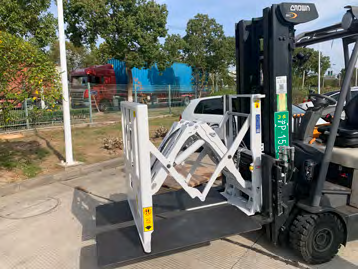 2. Cold Storage Forklift Attachment Challenges — Overview Table
Before reviewing specific attachment types, the table below summarizes the challenges that make attachment selection critical in cold storage.
📊 Cold Storage Attachment Challenges & Priorities
| Challenge | Impact opérationnel | Attachment Priority |
|---|---|---|
| Narrow aisles | Limited maneuverability | Side-shift & positioning |
| High racking density | Precision required | Controlled load handling |
| Frozen, slippery floors | Safety risk | Stable load retention |
| Mixed pallet standards | Handling inefficiency | Adjustable attachments |
| High uptime requirement | Downtime cost | Reliable, sealed designs |
In cold storage, attachments are productivity tools—not optional accessories.
3. Side Shifter: The Most Valuable Cold Storage Attachment
Le levier de vitesse latéral is one of the most widely used attachments in cold storage warehouses.
Key benefits include:
-
Reduced need for precise forklift alignment
-
Faster pallet positioning in narrow aisles
-
Lower rack and pallet damage rates
In frozen environments where braking distance increases, side shifters significantly improve safety and handling accuracy.
4. Fork Positioners: Adapting to Mixed Pallet Sizes
Cold storage facilities—especially 3PL and export-oriented warehouses—often handle pallets of varying widths and standards.
Positionneurs de fourches allow operators to:
-
Adjust fork spacing without leaving the cabin
-
Switch between pallet formats quickly
-
Reduce handling time and operator fatigue
This flexibility is particularly valuable in multi-client cold storage operations.
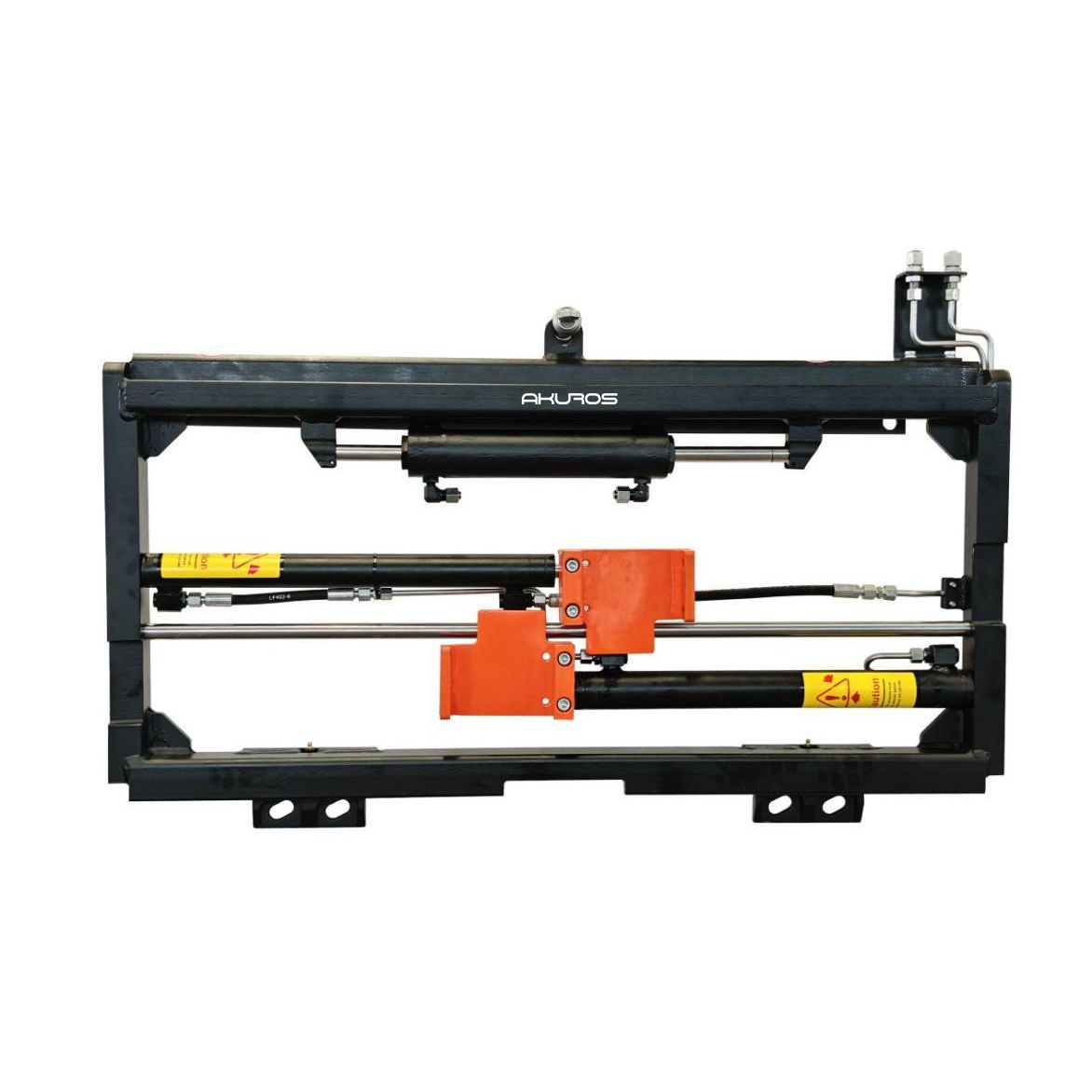 5. Double Pallet Handlers: Increasing Throughput Without More Forklifts
Double pallet handlers enable forklifts to move two pallets simultaneously under suitable conditions.
In cold storage, they are commonly used in:
-
Inbound receiving zones
-
Short-distance transfers
-
High-volume staging areas
When applied correctly, double pallet handlers reduce travel cycles and increase throughput without adding forklifts—an immediate ROI gain.
6. Load Stabilizers and Safety Attachments
Frozen products often have compromised packaging due to temperature effects. Load stability is therefore critical.
Attachments such as:
-
Load backrests
-
Stabilizing arms
-
Anti-slip fork coatings
help reduce load movement, prevent product damage, and improve operator confidence in cold storage environments.
7. Attachment Selection vs Adding More Forklifts
A common planning mistake is adding forklifts to solve efficiency problems that could be addressed with attachments.
In many cases:
-
One forklift + the right attachment
-
Outperforms
-
Two forklifts without attachments
This approach reduces congestion, energy consumption, and maintenance complexity—key advantages in cold storage operations.
8. Common Mistakes When Using Forklift Attachments in Cold Storage
Frequent errors include:
-
Selecting attachments without considering cold resistance
-
Ignoring attachment weight impact on residual capacity
-
Using attachments that are difficult to maintain in frozen zones
-
Applying high-throughput attachments in unsuitable areas
Proper evaluation and testing are essential to realizing the full benefit of attachments.
9. When Forklift Attachments Are Not the Right Solution
Attachments may not be suitable when:
-
Loads are irregular or unstable
-
Lift height is extremely high and capacity margins are tight
-
Fully automated handling is planned
In these cases, dedicated equipment or automation may be more appropriate.
10. Sujets populaires de Google (réponses contextuelles)
Do forklift attachments work reliably in cold storage?
Yes, when designed and specified for low-temperature environments.
Which forklift attachment is most useful in cold storage?
Side shifters are the most commonly used due to precision and safety benefits.
Can attachments reduce the number of forklifts needed?
Yes, attachments often increase task versatility and throughput.
Do attachments affect forklift capacity in cold storage?
Yes. Attachment weight reduces residual capacity and must be calculated.
Are attachments suitable for -25°C warehouses?
Only if they are engineered for cold environments and properly maintained.