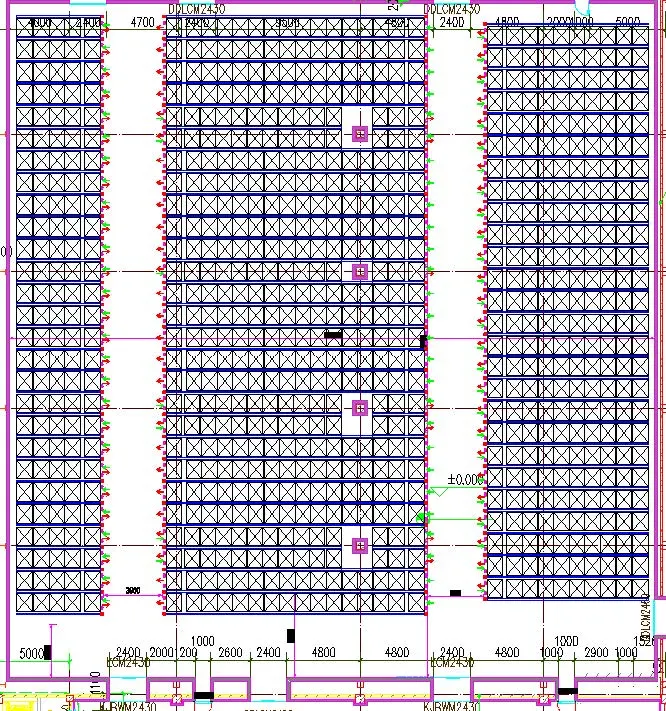
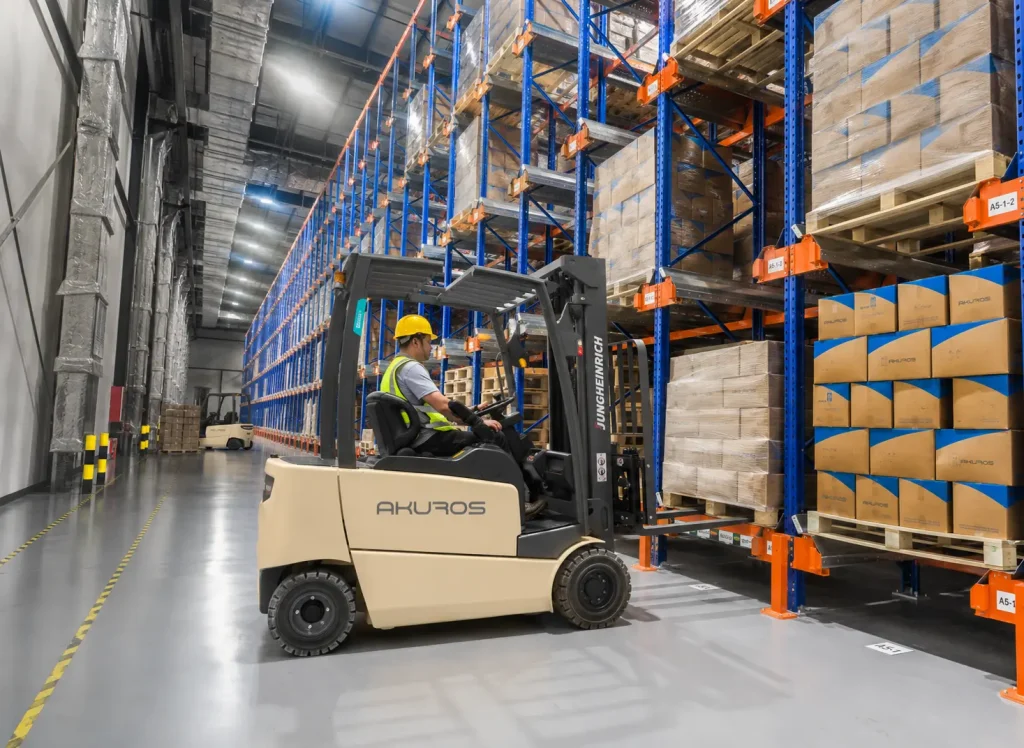
Pallet shuttle racking is a high-density storage solution that uses a motorized shuttle cart to move pallets inside deep rack lanes. Forklifts only place pallets at the lane entrance, while the shuttle automatically transports pallets to the assigned storage position. This reduces forklift travel inside the rack system and helps improve storage capacity, operating safety and pallet handling efficiency.
Pallet shuttle racking is a semi-automated storage system designed for deep-lane pallet storage. It combines high-density racking, shuttle carts, forklift support and a control system to improve storage capacity and reduce manual handling inside rack lanes.
Unlike drive-in racking, forklifts do not need to drive deep into the rack structure. The forklift places the pallet at the front of the lane, and the shuttle cart moves the pallet along the rail to the correct storage position. This helps reduce rack impact risk and improves operational safety.
Pallet shuttle racking is especially suitable for cold storage, frozen food warehouses, beverage storage, chemical storage, third-party logistics and other operations with large pallet quantities, clear batch management and high storage density requirements.
Key Points
Semi-automated high-density storage
Shuttle cart moves pallets inside rack lanes
Forklifts work mainly at the lane entrance
Suitable for FIFO or LIFO layouts
Reduces forklift travel inside rack structure
Ideal for cold storage and bulk pallet operations
Key Benefits
Very High Storage Density
Pallet shuttle racking uses deep storage lanes to increase pallet capacity and reduce the number of working aisles. It is suitable for warehouses that need maximum storage density, especially where floor space or cold storage volume is expensive.
Semi-Automated Operation
The shuttle cart automatically moves pallets inside the rack lane, reducing manual forklift movement and improving handling consistency. Operators can control pallet storage and retrieval more efficiently with a remote controller or warehouse control system.
Reduced Forklift Travel
Forklifts only need to load and unload pallets at the lane entrance. This reduces travel distance inside the rack structure, lowers the risk of rack collision and improves operating safety compared with traditional drive-in racking.
Suitable for FIFO / LIFO Layouts
Pallet shuttle systems can be designed for either FIFO or LIFO operation depending on warehouse layout and inventory flow. This gives the system more flexibility for different industries, product batches and stock rotation requirements.
Typical Layout / Working Principle
The forklift places the shuttle cart into the selected rack lane.
The forklift loads a pallet at the lane entrance.
The shuttle cart carries the pallet into the lane automatically.
Pallets are stored in sequence according to system settings.
During retrieval, the shuttle brings the pallet back to the lane entrance.
The forklift removes the pallet and continues the handling process.
Planning Highlights
Lane Depth
Lane depth should be designed according to SKU quantity, batch size, pallet movement frequency and inventory flow. Deeper lanes improve storage density, but the layout must still support efficient stock rotation and practical operation.
Product Batch Control
Pallet shuttle racking works best when products can be stored by SKU, batch or production date. Good batch control helps avoid storage confusion and improves FIFO or LIFO management.
Pallet Quality
Consistent and strong pallets are important for shuttle system operation. Damaged pallets, weak pallet bottoms or irregular pallet dimensions may affect shuttle movement, safety and system reliability.
Throughput Frequency
Daily inbound and outbound frequency should be reviewed before selecting shuttle quantity and lane configuration. Higher throughput may require more shuttle carts, better lane allocation and more precise workflow planning.
Shuttle Quantity
The number of shuttle carts should match operating intensity, lane quantity, forklift quantity and daily pallet movement. Too few shuttle carts may limit efficiency, while too many can increase investment cost unnecessarily.
Pros and Cons
Pros
Cons
Very high storage density
Semi-automated pallet handling
Reduced forklift travel inside rack lanes
Lower rack impact risk compared with drive-in racking
Suitable for FIFO or LIFO operation
Excellent for cold storage and bulk pallet storage
High efficiency for batch-based pallet handling
Can reduce labor intensity and improve operation consistency
Better safety because forklifts do not need to enter deep lanes
Higher initial investment than standard racking or drive-in racking
Requires shuttle carts and control system
Pallet quality must be consistent
Product batch management must be clear
Less suitable for random single-pallet picking
System planning is more complex than conventional racking
Shuttle charging, maintenance and spare parts should be considered
Lane allocation must be carefully managed to avoid capacity loss
Best-Fit Applications
Entreposage frigorifique
Pallet shuttle racking is highly suitable for frozen and chilled warehouses where storage density and operating efficiency are both important. It helps reduce forklift travel inside cold rooms and increases pallet capacity in expensive temperature-controlled space.
Frozen Food
Frozen food warehouses often store large quantities of palletized products by batch or production date. Pallet shuttle racking supports dense storage, organized stock rotation and efficient pallet movement.
Beverage Warehouses
Beverage warehouses usually handle high pallet volumes and repeated SKU batches. Shuttle racking can improve storage density and reduce forklift travel for bottled drinks, canned beverages and other palletized products.
High-Throughput Pallet Storage
For warehouses with frequent inbound and outbound pallet movement, shuttle racking can improve handling efficiency when lane allocation, shuttle quantity and forklift workflow are properly planned.
Ready to Upgrade to Pallet Shuttle Racking?
Pallet shuttle racking is a practical solution when your warehouse needs high storage density, semi-automated handling and better pallet flow for bulk or batch-based inventory.
Share your warehouse size, pallet dimensions, pallet weight, SKU quantity, lane depth requirement, temperature range and daily handling frequency with Akuros. Our team can help you evaluate whether pallet shuttle racking is suitable for your storage density, operation efficiency and budget.
Envoyez vos besoins spécifiques
Related Equipment
Shuttle Cart
The shuttle cart is the core equipment of the pallet shuttle racking system. It runs on rails inside the rack lane and transports pallets automatically to the assigned storage or retrieval position.
Chariot élévateur à contrepoids
Counterbalanced forklifts are commonly used to place pallets and shuttle carts at the lane entrance. They are suitable for loading areas, pallet transfer and general warehouse handling around the shuttle racking system.
Drive-in racking requires forklifts to enter the rack lanes to store and retrieve pallets. Pallet shuttle racking uses a shuttle cart to move pallets inside the lanes, so forklifts mainly work at the lane entrance. This improves safety, reduces rack impact risk and can improve handling efficiency.
Yes. Pallet shuttle racking can support FIFO operation if the system is designed with loading from one side and retrieval from the opposite side. It can also be designed for LIFO operation when loading and retrieval happen from the same side.
Yes. Pallet shuttle racking is very suitable for cold storage because it increases storage density and reduces forklift travel inside low-temperature areas. It is commonly used for frozen food, seafood, meat, dairy products, beverages and other cold chain products.
Pallets should be strong, consistent and suitable for shuttle operation. Irregular pallet dimensions, damaged pallet bottoms or weak pallet structures can affect shuttle movement and system safety.
The number of shuttle carts depends on daily pallet movement, lane quantity, forklift quantity, operating shifts and required throughput. Akuros can help calculate a practical shuttle quantity based on your warehouse workflow.
Pallet shuttle racking is best suited for medium to low SKU variety with multiple pallets per SKU or batch. If SKU variety is very high and every pallet needs random direct access, selective racking or VNA racking may be more suitable.
Obtenir un devis gratuit
Contactez-nous pour obtenir un devis gratuit et une connaissance plus approfondie des produits. Nous préparerons une solution professionnelle pour vous.



 French
  English
  Russian
  Spanish
  German
  Italian
  Portuguese
  Korean
  Japanese
  Arabic
  Turkish
  Indonesian
  Dutch
Dutch