

 Spanish
  English
  Russian
  French
  German
  Italian
  Portuguese
  Korean
  Japanese
  Arabic
  Turkish
  Indonesian
  Dutch
Dutch 

When Pallet Volume Outgrows Aisle Space
A large warehouse does not become inefficient in one dramatic moment. It usually happens quietly. A few extra pallets stay near the receiving area. Seasonal inventory begins to occupy floor space. Forklift routes become longer. Operators start placing pallets “temporarily” in open areas, and somehow that temporary solution becomes part of the daily workflow. At that point, the warehouse does not simply need more space. It needs a better storage structure.
Aquí es donde Estanterías autoportantes becomes a practical high-density storage option. Instead of giving every pallet direct aisle access like selective racking, drive-in systems allow forklifts to enter deep rack lanes and store pallets multiple positions deep. For large-scale warehouses handling repeated SKUs, batch inventory, cold storage goods, food products, or manufacturing stock, this system can significantly improve pallet density and reduce wasted aisle space.
However, this system is not a magic answer for every warehouse. It works best when the inventory profile matches the design. If a warehouse stores many pallets of the same SKU, drive-in lanes can be highly efficient. If every pallet is different and urgent direct access is required, the system may create handling delays. The smart buyer does not ask, “Can this store more pallets?” The better question is, “Can this store more pallets while still supporting our workflow?”
For warehouse teams trying to improve high-density storage, the first step is understanding how Drive-in Racking systems maximize storage density by replacing multiple access aisles with deep pallet lanes. This is where the real storage gain begins.
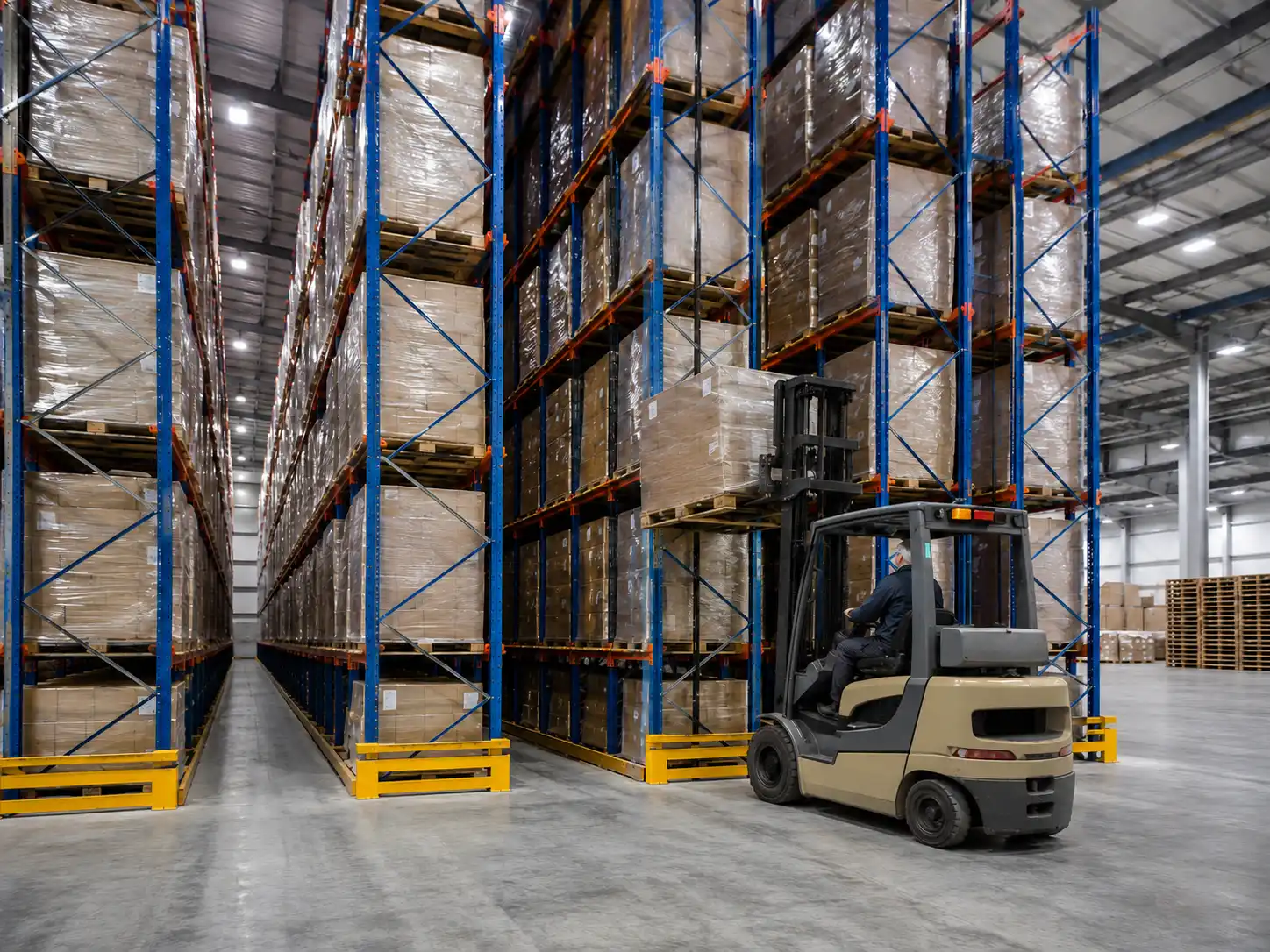
Estanterías autoportantes
What Is Drive-in Racking?
Estanterías autoportantes is a pallet racking system designed for deep-lane storage. Instead of storing pallets only one or two positions deep, it allows forklifts to drive into the rack structure and place pallets several positions deep along support rails. Pallets are stored on continuous rails instead of traditional front beams at every pallet position.
In a standard drive-in layout, forklifts enter the lane from one side. The last pallet loaded is often the first pallet retrieved, which means the system usually follows a LIFO storage logic. LIFO means “last in, first out.” This is suitable for goods that do not require strict first-in, first-out rotation, or for inventory stored by batch.
Drive-through racking is slightly different. It can allow forklift access from both ends of the lane, making FIFO inventory control more possible when properly designed. FIFO means “first in, first out.” For food, pharmaceutical, or time-sensitive inventory, this distinction matters.
Basic Drive-in Rack Structure
| Componente | Función | Buyer Check |
|---|---|---|
| Upright Frames | Support vertical rack loads | Confirm frame capacity and steel specification |
| Pallet Rails | Support pallets inside deep lanes | Match pallet width, load, and quality |
| Top Bracing | Improves structural stability | Check design drawings |
| Floor Anchors | Secure racks to concrete | Confirm floor strength and anchor type |
| Guide Rails | Help forklift alignment | Recommended for deep lanes |
| Column Guards | Reduce forklift impact damage | Essential in busy warehouses |
| Load Signs | Display safe capacity | Required for safer operation |
A drive-in system should be designed around the warehouse’s actual pallet dimensions, pallet weight, forklift type, ceiling height, lane depth, SKU profile, and safety requirements. Buying it only by rack size or appearance is risky. This is a load-bearing system, not furniture with ambition.
Why Large-Scale Warehouses Choose Drive-in Racking
The biggest benefit of drive-in racking is higher storage density. Because the system reduces the number of aisles required, more floor area can be used for pallet storage. This is especially valuable in large-scale warehouses where pallet volume is high and many products are stored in batches.
In selective racking, every pallet position needs aisle access. This gives excellent flexibility, but it consumes a lot of space. In drive-in racking, pallets are grouped in deep lanes, reducing aisle requirements and increasing pallet capacity.
This is why many warehouses evaluate the benefits of using a Drive-in Racking system when they need better density without immediately expanding the building. For cold storage, food distribution, beverage warehouses, and manufacturing inventory, the space-saving benefit can be especially valuable.
Operational Benefits of Drive-in Racking
| Warehouse Need | How Drive-in Racking Helps | Commercial Value |
|---|---|---|
| More pallet positions | Reduces aisle space | Delays warehouse expansion |
| Bulk SKU storage | Groups same SKUs in lanes | Easier batch control |
| Cold storage efficiency | Uses expensive cold space better | Improves storage economics |
| Manufacturing inventory | Stores raw materials by batch | Supports production staging |
| Lower aisle count | More area for pallets | Higher storage density |
| Organized pallet lanes | Creates systematic storage | Better warehouse discipline |
The system is especially strong when the warehouse stores repeated SKUs. For example, a beverage distributor may receive truckloads of the same drink. A frozen food warehouse may store large batches by production date. A manufacturing warehouse may store raw materials or finished goods in bulk. In these situations, direct access to every pallet is less important than storing more pallets efficiently.
Drive-in Racking vs Selective, Double Deep, and Shuttle Systems
Drive-in racking should not be compared only to selective racking. It should be compared with several warehouse storage options because each system solves a different problem.
Selective racking provides direct access to every pallet. It is excellent for high SKU variety and frequent picking. Double deep racking stores two pallets deep, improving density while keeping moderate access. Drive-in racking stores pallets many positions deep, offering higher density but lower selectivity. Pallet shuttle systems provide deep-lane storage with semi-automated movement, improving efficiency but requiring more system investment and operational planning.
Racking System Comparison
| Sistema | Densidad de almacenamiento | Pallet Access | Best Inventory Type | Requisito de carretilla elevadora | Best Use Case |
|---|---|---|---|---|---|
| Selective Racking | Medio | Very high | Alta variedad de SKU | Standard forklift or reach truck | Direct pallet access |
| Estanterías de doble profundidad | Alta | Medio | Variedad media de SKU | Reach truck or deep-reach forklift | Higher density with some access |
| Estanterías autoportantes | Very high | Baja a media | Low-to-medium SKU variety | Skilled forklift operation | Bulk pallet storage |
| Drive-through Racking | Alta | Medio | FIFO batch storage | Skilled forklift operation | Time-sensitive goods |
| Pallet Shuttle | Very high | Medium to high | High-volume deep storage | Shuttle plus forklift | Semi-automated bulk storage |
If the warehouse needs direct access to every pallet, selective racking is usually better. If the warehouse needs higher density but still wants some access flexibility, double deep racking may fit. If the warehouse stores many pallets of the same SKU, Estanterías autoportantes can be a strong choice. If deep-lane storage needs higher throughput, a pallet shuttle system may be worth considering.
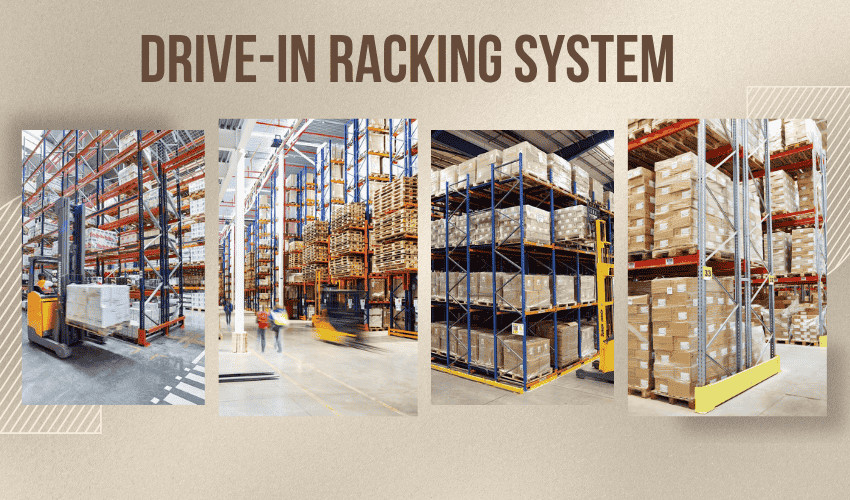
Sistema de estanterías drive-in
Solving Warehouse Space Pressure
Warehouse space pressure is one of the most common reasons buyers consider drive-in storage. When pallets overflow into staging areas, picking paths, or temporary floor zones, the warehouse becomes slower and less safe. Floor stacking may feel convenient, but it often hides deeper layout problems.
A well-designed drive-in system can help large-scale warehouses store more inventory inside the same footprint. This can reduce the need for off-site storage, delay facility expansion, and improve overall storage discipline.
For companies struggling with warehouse space, drive-in racking may offer a practical path forward when inventory is suitable for bulk lane storage. The key is to confirm that the warehouse stores enough pallets per SKU to justify the lane depth.
Inventory Logic: Is Drive-in Racking Right for Your SKU Profile?
Drive-in racking works best when each lane stores the same SKU, same batch, or same product family. This reduces access problems because the front pallets and rear pallets are related. If different SKUs are mixed randomly in the same lane, operators may need to remove several pallets just to reach the correct one. That destroys productivity.
This system is usually best for low-to-medium SKU variety, bulk storage, seasonal inventory, cold storage goods, manufacturing batches, and slow-moving large-volume items. It is less suitable for warehouses with many single-pallet SKUs or urgent random picking requirements.
SKU Suitability Table
| Inventory Profile | Drive-in Racking Suitability | Reason |
|---|---|---|
| Many pallets of same SKU | Excelente | Lane storage works efficiently |
| Batch manufacturing inventory | Excelente | Grouped pallet movement |
| Cold storage goods | Excelente | Dense storage improves space value |
| Many single-pallet SKUs | Pobre | Access conflicts increase |
| Strict FIFO goods | Medium to poor | Standard drive-in is usually LIFO |
| Seasonal stock | Bueno | Bulk storage by batch |
| Slow-moving bulk inventory | Bueno | High density is useful |
A simple rule works well: if the warehouse often has several pallets of the same product, drive-in racking may be suitable. If the warehouse has thousands of SKUs and only one pallet per SKU, do not force drive-in racking into the project. The rack will not thank you. Neither will the forklift drivers.
Cold Storage and Food Warehouse Applications
Cold storage is one of the strongest application areas for drive-in racking. Temperature-controlled space is expensive to build and operate. Every cubic meter matters. If a cold room uses too many aisles, the business is paying to chill empty driving space.
Drive-in racking improves capacity per cubic meter by storing pallets in deep lanes. This is useful for frozen food, chilled products, beverage storage, dairy, meat, seafood, and other batch-based inventory. However, cold storage requires additional planning. Forklifts must be suitable for low temperatures. Rack coating should resist corrosion. Floor conditions must be checked. Inventory rotation must be disciplined. Hygiene access should also be considered for food warehouses.
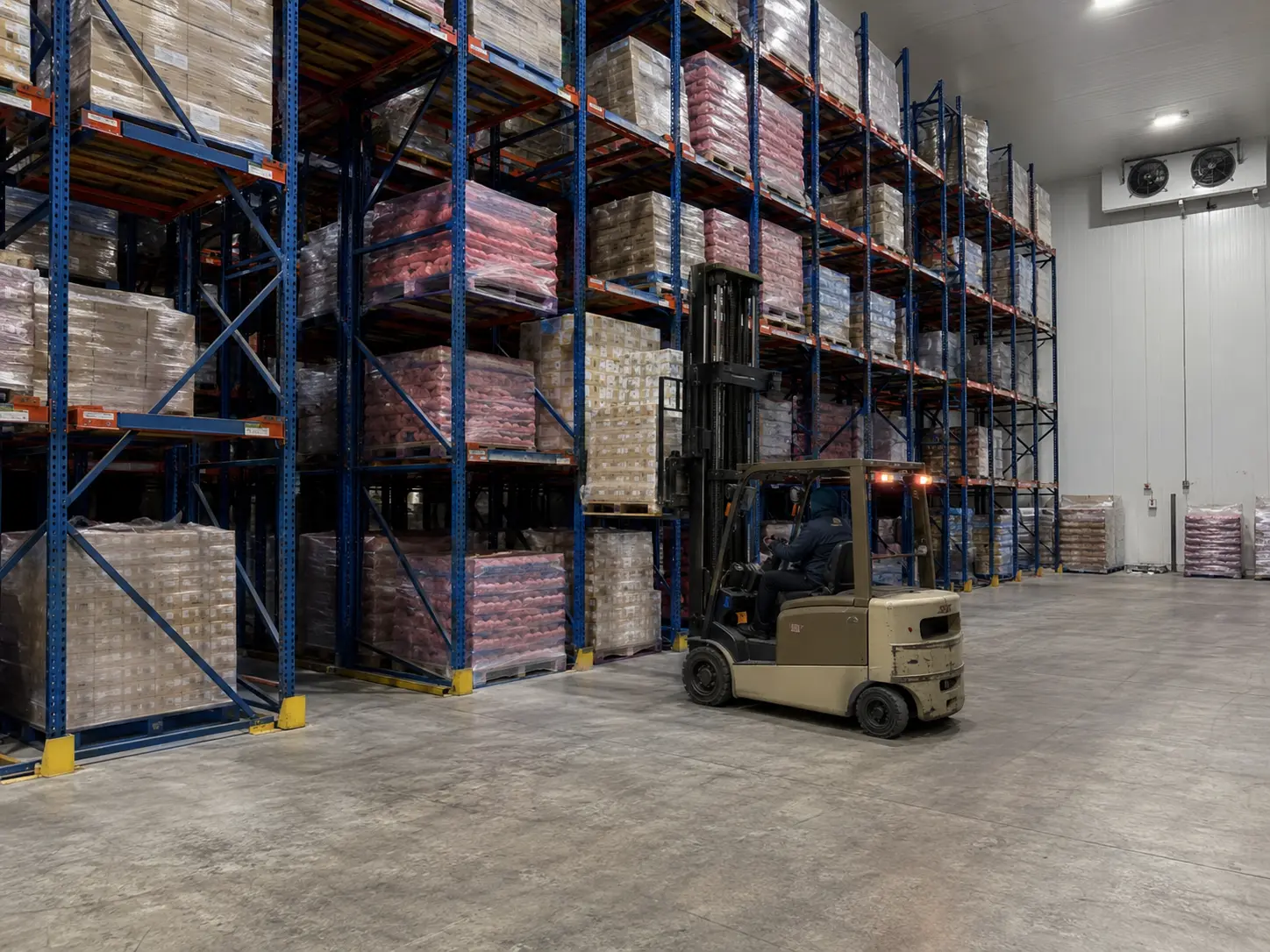
Drive-in Racking System for Cold Storage
Cold Storage Planning Table
| Factor | Por qué importa | Buyer Recommendation |
|---|---|---|
| Rack Coating | Cold and humidity may cause corrosion | Use suitable protective finish |
| Tipo de carretilla elevadora | Equipment must operate in cold rooms | Confirm battery, tire, and hydraulic suitability |
| Lane Depth | Affects storage and access | Match SKU batch volume |
| Floor Condition | Stability is critical | Check levelness and frost impact |
| Food Safety | Layout must support hygiene | Plan cleaning and inspection access |
| Inventory Rotation | Prevents expired stock | Use WMS and clear lane rules |
For food and beverage warehouses, drive-in racking for food warehouse projects should be planned with both density and traceability in mind. Storing the same batch in a lane helps simplify rotation and reduce confusion, but the warehouse management system must support it.
Load Capacity and Structural Parameters Buyers Should Verify
Drive-in racks carry heavy loads across deep lanes and multiple levels. Buyers must calculate real pallet weight, not estimate casually. Pallet load includes product, pallet weight, packaging, moisture, wrapping, and any variation in actual operating conditions.
Important design factors include upright frame capacity, rail capacity, lane depth, bracing design, anchor specification, forklift clearance, and rack protection. Because forklifts enter the rack, impact protection is especially important.
A professional Drive-in Racking system should be engineered according to pallet size, maximum load, lane depth, warehouse layout, and forklift operation. Buyers should request drawings, load data, and safety recommendations before approving production.
Technical Parameter Table
| Parameter | Por qué importa | Buyer Check |
|---|---|---|
| Pallet Weight | Determines load requirement | Confirm maximum loaded pallet weight |
| Lane Depth | Affects capacity and access | Match SKU batch size |
| Rail Capacity | Supports pallets inside lanes | Request load data |
| Upright Frame Capacity | Carries vertical load | Confirm rack engineering |
| Bracing Design | Improves stability | Check structural drawings |
| Anchor Specification | Secures rack to concrete | Match concrete floor condition |
| Forklift Clearance | Prevents impact | Confirm aisle and lane width |
| Rack Protection | Reduces damage | Add guide rails and guards |
The stronger the warehouse operation, the more seriously it treats load data. “It looks strong enough” is not an engineering method. It is a future incident report wearing a confident smile.
Forklift Operation and Safety Requirements
Unlike selective racking, drive-in racking requires forklifts to drive inside rack lanes. That makes forklift skill and layout accuracy critical. Operators must enter lanes carefully, avoid rail impact, position pallets correctly, and follow load rules.
Safety accessories can make a major difference. Guide rails help forklift alignment. Column guards reduce impact damage. Rack end protection protects vulnerable front uprights. Load signs remind workers of capacity limits. Floor markings help traffic control. Back stops may be used where appropriate. Routine inspection should identify damage before it becomes dangerous.
Safety Risk and Prevention Table
| Safety Risk | Common Cause | Prevention |
|---|---|---|
| Forklift impact | Poor alignment or rushed operation | Use guide rails and trained operators |
| Pallet fall | Wrong pallet size or damaged pallet | Standardize pallet quality |
| Rack overload | Poor load calculation | Use rated load signage |
| Lane blockage | Poor SKU planning | Store same SKU per lane |
| Rack deformation | Repeated impacts | Inspect and repair regularly |
| Inventory confusion | Weak WMS control | Use lane labels and scanning |
Buyers should also consider safety regulations and recognized guidance. OSHA material handling and forklift safety principles, ANSI/RMI rack design guidance, EN 15512 for adjustable pallet racking, local fire codes, sprinkler clearance, and food warehouse hygiene rules may all be relevant depending on region and application.
A good Drive-in Racking manufacturer should understand that safety is not an optional accessory. It is part of the product.
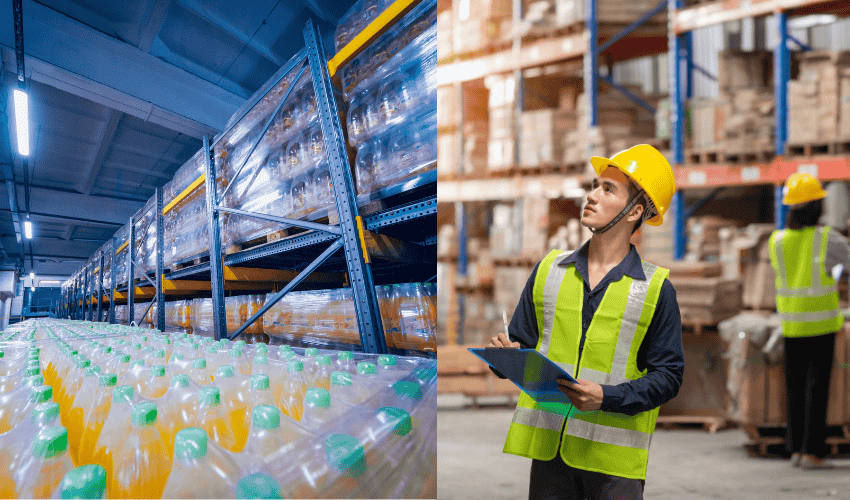
Almacenes de alimentos y bebidas Sistema de estanterías autoportantes
Real Warehouse Scenario: Before and After Drive-in Racking
Consider a beverage distributor storing large batches of repeated SKUs. Before drive-in racking, selective racks take up much of the floor with aisles. The same product is scattered across several zones. Forklift drivers travel longer distances, and temporary floor storage appears during peak seasons.
After installing drive-in racking, the warehouse groups pallets by SKU and batch inside deep lanes. Aisle count is reduced. Storage density improves. Forklift movement becomes more organized. Floor stacking decreases. The warehouse gains more control over bulk inventory.
Now consider a cold storage facility. Expansion is expensive, and every square meter must be refrigerated. By using drive-in racking for repeated frozen goods, the facility increases pallet capacity without increasing the cold room footprint. That improves space economics and reduces overflow pressure.
For manufacturing warehouses, drive-in lanes can store raw materials or finished goods by batch, supporting cleaner staging and production flow.
Before vs After Workflow
| Workflow Area | Before Drive-in Racking | After Drive-in Racking |
|---|---|---|
| Pallet Density | Mayor en ciclos repetitivos | Rendimiento en pasillos estrechos |
| Aisle Usage | More aisles | Fewer aisles |
| SKU Grouping | Scattered | Lane-based |
| Forklift Workflow | More travel | More organized lanes |
| Floor Stacking | Common | Reduced |
| Expansion Pressure | Rendimiento en pasillos estrechos | Delayed |
Common Buyer Mistakes When Choosing Drive-in Racking
The first mistake is using drive-in racking for too many SKUs. If every lane contains mixed products, access becomes painful.
The second mistake is ignoring FIFO requirements. Standard drive-in is usually LIFO. If strict FIFO is required, drive-through, pallet flow, or shuttle systems may be better.
The third mistake is underestimating forklift skill. Operators drive inside rack lanes, so training and clearance matter.
The fourth mistake is not checking pallet quality. Damaged or inconsistent pallets can create safety risks inside deep lanes.
The fifth mistake is buying without engineering data. Load capacity, rail design, frame strength, and anchoring must be verified.
The sixth mistake is forgetting rack protection. Because forklifts enter the system, impact protection is essential.
A reliable warehouse racking manufacturer should help buyers avoid these mistakes by evaluating layout, pallet data, load requirements, forklift type, safety accessories, and future expansion needs.
Industry Trends: Why Drive-in Racking Remains Relevant
Warehouses are under growing space pressure. Urban storage is expensive. Cold chain demand is rising. Food, beverage, pharmaceutical, and manufacturing companies need better use of warehouse volume. At the same time, more warehouses are combining systems instead of relying on one rack type.
A modern warehouse may use selective racking for fast-moving SKUs, double deep racking for medium-density storage, drive-in racking for bulk goods, and shuttle systems for deep-lane high-throughput zones. This hybrid approach is more practical than forcing one system to solve every problem.
Digital inventory control also makes drive-in systems easier to manage. Warehouse management systems, barcode scanning, lane labels, pallet tracking, and scheduled rack inspections can reduce confusion and improve safety.
How to Choose a Drive-in Racking Supplier
A qualified supplier should provide more than rack components. Buyers should expect layout design, load calculation, steel specification, custom lane planning, safety accessories, installation support, and after-sales service.
Important questions include:
What is the rack load capacity?
What pallet size is supported?
What lane depth is recommended?
What steel grade is used?
What forklift clearance is required?
Can the system be customized?
Can layout drawings be provided?
What safety accessories are included?
Does the design follow relevant standards?
Can installation guidance be supported?
For project-specific evaluation, buyers can use a Drive-in Racking supplier contact channel to share warehouse drawings, pallet size, pallet weight, forklift model, SKU profile, inventory rotation requirements, and safety needs before requesting a final proposal.
Final Buyer Decision Framework
| Buyer Situation | Recommended System |
|---|---|
| Many pallets of the same SKU | Estanterías autoportantes |
| Alta variedad de SKU | Selective Racking |
| Medium SKU variety and density need | Estanterías de doble profundidad |
| Strict FIFO requirement | Drive-through or Pallet Flow |
| Cold storage bulk inventory | Drive-in or Shuttle |
| High-throughput deep storage | Pallet Shuttle |
| Limited forklift skill | Selective or Double Deep |
| Large manufacturing batch storage | Estanterías autoportantes |
Drive-in Racking Is a Density Tool, Not a Universal Rack
Estanterías autoportantes is one of the most effective high-density pallet storage systems for large-scale warehouses with repeated SKUs, batch inventory, cold storage, food products, and manufacturing stock. It reduces aisle space, increases pallet capacity, and supports organized bulk storage when properly designed.
But it is not suitable for every operation. It works best when SKU variety is controlled, forklift operators are trained, pallet quality is consistent, and inventory rotation fits LIFO or lane-based storage. If strict FIFO or direct access is required, another system may be better.
Before ordering, buyers should prepare warehouse drawings, pallet sizes, pallet weights, SKU profile, forklift model, rotation requirements, and safety needs. A qualified industrial warehouse racking supplier can then recommend the right lane depth, rack structure, and storage strategy.
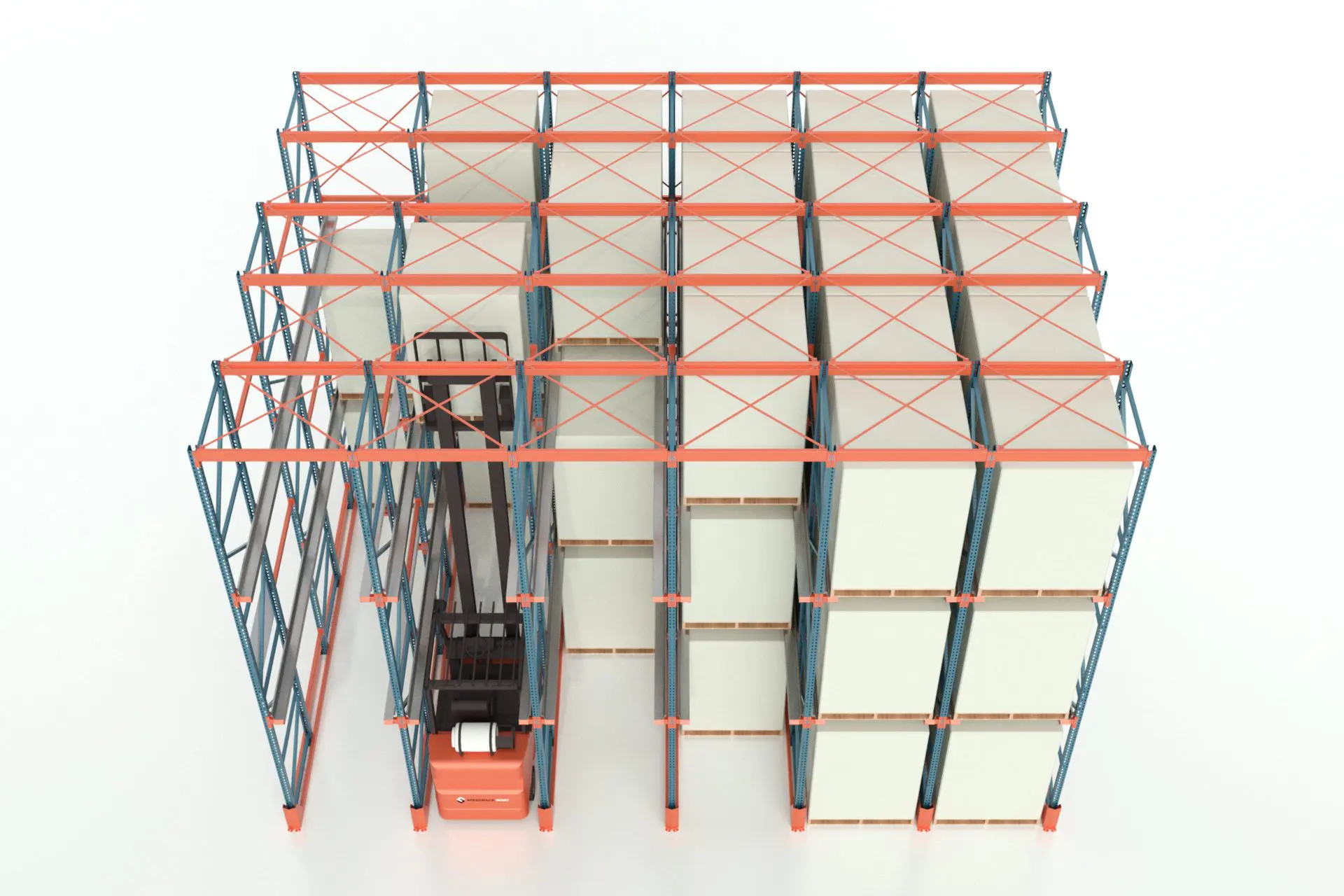
Soluciones de estanterías drive-in
Preguntas frecuentes
1. What is Drive-in Racking?
Drive-in Racking is a high-density pallet storage system where forklifts drive directly into deep rack lanes to place or retrieve pallets. Pallets are stored several positions deep and multiple levels high on support rails. This system reduces the number of aisles required and increases storage capacity. It is best suited for warehouses storing many pallets of the same SKU, batch inventory, cold storage goods, and large-scale bulk pallet storage.
2. What are the main benefits of Drive-in Racking?
The main benefits of Drive-in Racking include higher storage density, reduced aisle space, better use of warehouse volume, improved bulk pallet storage, and strong suitability for cold storage and manufacturing inventory. It helps large-scale warehouses delay expansion, reduce floor stacking, and organize repeated SKUs in deep lanes. The system works best when pallet movement is batch-based and direct access to every pallet is not required.
3. Is Drive-in Racking suitable for FIFO inventory?
Standard Drive-in Racking is usually better suited for LIFO inventory because the last pallet placed in a lane is often the first pallet removed. For strict FIFO inventory, drive-through racking, pallet flow racking, or pallet shuttle systems may be more suitable. Some warehouses can manage rotation with careful lane planning and WMS control, but buyers handling expiry-sensitive goods should evaluate FIFO requirements carefully before choosing standard drive-in racking.
4. What type of warehouse should use Drive-in Racking?
Drive-in Racking is suitable for warehouses with low-to-medium SKU variety, many pallets per SKU, batch storage, seasonal inventory, cold storage goods, food and beverage products, and manufacturing stock. It is especially useful when storage density is more important than direct access to every pallet. It is less suitable for warehouses with many single-pallet SKUs, frequent random picking, or strict direct-access requirements.
5. What safety issues should buyers consider before installing Drive-in Racking?
Buyers should consider forklift operation inside rack lanes, rack impact protection, pallet quality, load capacity, floor condition, anchoring, operator training, lane labeling, and routine rack inspections. Because forklifts enter the racking structure, guide rails, column guards, clear load signage, and trained operators are important. Buyers should also confirm that the system is engineered for actual pallet weight, lane depth, and warehouse operating conditions.
Referencias
- “ANSI MH16.1: Specification for the Design, Testing and Utilization of Industrial Steel Storage Racks” — Rack Manufacturers Institute, MHI
- “EN 15512: Steel Static Storage Systems — Adjustable Pallet Racking Systems” — European Committee for Standardization
- “Materials Handling and Storage” — Occupational Safety and Health Administration, OSHA
- “Powered Industrial Trucks Standard” — Occupational Safety and Health Administration, OSHA
- “Warehousing and Storage: A Guide to Health and Safety” — Health and Safety Executive, HSE
- “Storage Rack Safety Guidelines” — Canadian Centre for Occupational Health and Safety
- “Warehouse Space Optimization and Pallet Storage Strategy” — International Warehouse Logistics Association
- “Cold Storage Warehouse Design and Operation” — Global Cold Chain Alliance
How to Choose Drive-in Racking with Less Risk
What matters most: Drive-in Racking should be selected by inventory profile, not by storage density alone. Buyers should review SKU variety, pallet quantity per SKU, inventory rotation, forklift capability, lane depth, rack load capacity, pallet quality, floor condition, and safety protection before confirming a layout.
How buyers should decide: Choose Drive-in Racking when the warehouse stores many pallets of the same SKU, uses batch storage, or needs high-density storage in cold rooms, food warehouses, or manufacturing facilities. Choose selective racking when direct pallet access is more important. Choose drive-through, pallet flow, or shuttle systems when FIFO or higher deep-lane throughput is required.
Why mistakes happen: Many drive-in projects fail because buyers focus only on pallet count. A denser layout can still create problems if SKU variety is too high, forklift operators are not trained, pallets are inconsistent, rack protection is weak, or inventory rotation does not match LIFO lane storage.
Option logic: Use Drive-in Racking for low-to-medium SKU variety and bulk pallet storage. Use double deep racking when moderate access is still needed. Use selective racking for high SKU variety. Use pallet shuttle systems when deep-lane storage needs stronger automation and throughput.
Final consideration: Before ordering a Drive-in Racking system, buyers should prepare pallet dimensions, pallet weights, SKU data, batch movement frequency, forklift specifications, warehouse drawings, ceiling height, floor condition, safety requirements, and rotation rules. A professional supplier can then design a safer and more efficient large-scale warehouse storage system.