

 German
  English
  Russian
  French
  Spanish
  Italian
  Portuguese
  Korean
  Japanese
  Arabic
  Turkish
  Indonesian
  Dutch
Dutch 

In modern warehousing and logistics, the real question is no longer “How much does a forklift cost?” but rather “How much does it cost to operate over its lifetime?”
For many businesses, Total Cost of Ownership (TCO) — including energy, maintenance, downtime, labor efficiency, and equipment lifespan — is the key factor when choosing a new forklift.
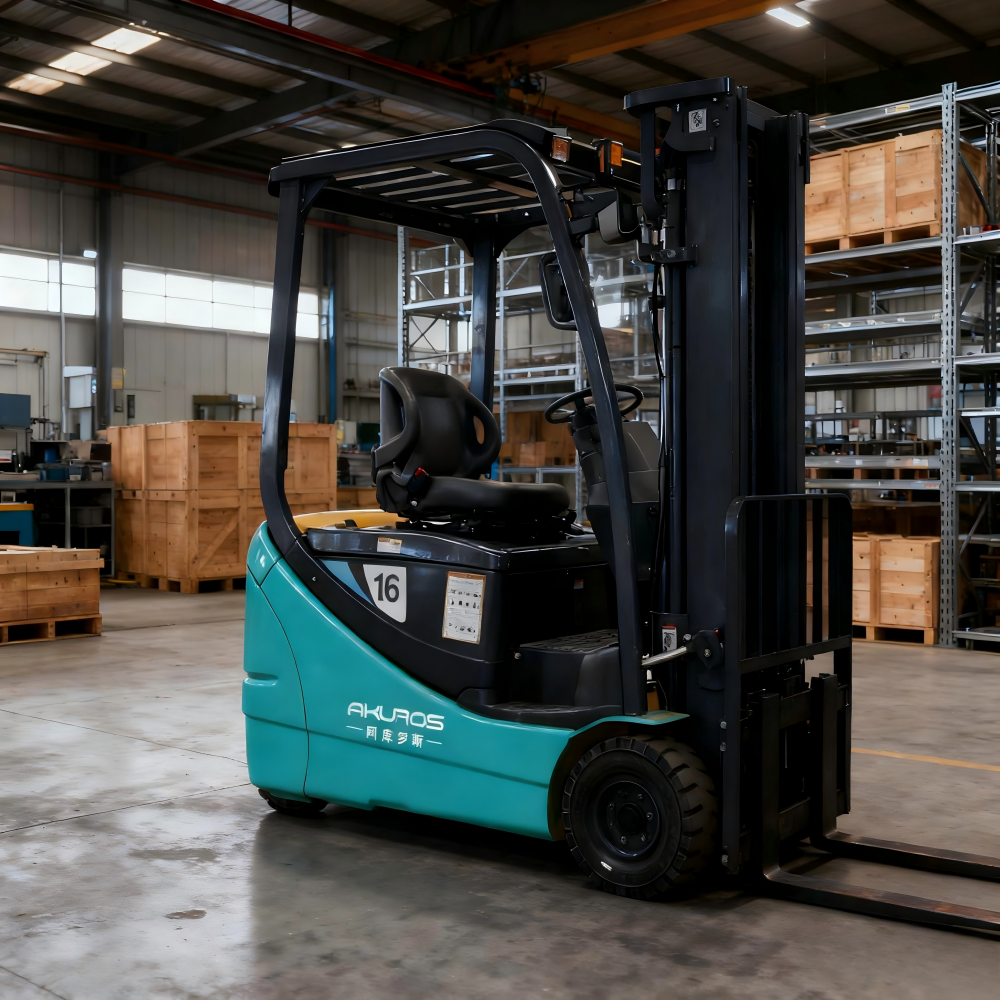
Die Akuros E16 three-wheel electric Gegengewichtsstapler is designed not only to perform, but to actively lower operational costs across the entire lifecycle of the equipment. This article breaks down how the E16 helps reduce expenses compared with conventional internal-combustion (IC) forklifts and older-generation electric models.
1. Understanding Total Cost of Ownership (TCO) for Forklifts
Before diving into the E16 specifically, it’s important to clarify what TCO usually includes in a warehouse or factory environment:
-
Initial purchase cost
-
Energy or fuel costs
-
Routine maintenance and spare parts
-
Unexpected breakdowns and downtime
-
Operator efficiency and fatigue
-
Accidents and product damage
-
Equipment lifespan and resale value
A forklift that is cheaper upfront but expensive to run, repair, or maintain is rarely the best long-term choice. The Akuros E16 is engineered to reduce cost in almost every one of these categories.
2. Energy Costs: From Fuel Burn to Smart Electric Efficiency
One of the largest recurring expenses in material-handling operations is energy.
2.1 Eliminating Fuel Expenses
Compared with diesel or LPG forklifts, the E16:
-
Uses no fuel at all
-
Requires no engine oil, filters, or exhaust treatment
-
Eliminates the cost of on-site fuel storage and management
Over a 5-year period in a multi-shift warehouse, switching from IC forklifts to electric models like the E16 can save tens of thousands of dollars in fuel and engine-related consumables alone.
2.2 High-Efficiency Electric Drive
The E16 is powered by an AC electric drive motor with optimized efficiency. This means:
-
Less energy wasted as heat
-
Smoother acceleration curves, reducing energy spikes
-
Consistent performance even under load
Energy usage becomes more predictable and easier to control — an advantage for budgeting and cost planning.
2.3 Battery Options Matching Your Operation
Depending on configuration, the E16 can be equipped with:
-
High-quality lead-acid batteries for cost-effective usage
-
Or lithium battery options for:
-
Faster opportunity charging
-
Longer cycle life
-
Higher energy efficiency
-
Both options are significantly cheaper to operate than combustion engines on a per-hour basis, especially in high-utilization fleets.
3. Lower Maintenance Costs with AC Technology and Robust Design
Maintenance is another critical cost center in forklift operations. The E16 reduces this through a combination of design choices and component selection.
3.1 Fewer Wear Parts, Less Maintenance
Compared with IC forklifts, the E16:
-
Has no engine, no gearbox, no exhaust system, no beltsund no spark plugs or injectors
-
Uses an AC motor, which is essentially brushless and low-maintenance
-
Does not require regular oil changes
This dramatically reduces:
-
Routine service frequency
-
Labor time for maintenance
-
Parts inventory and unexpected repair costs
3.2 Durable Chassis and Mast Design
The E16’s structural components — such as the chassis, mast, and forks — are engineered for long-term durability:
-
Reinforced frame structure to withstand repeated heavy use
-
High-rigidity mast to minimize bending and stress
-
Quality hydraulic components to reduce leaks and failures
By reducing major mechanical failures, the E16 helps avoid expensive downtime and emergency repairs.
4. Reducing Downtime: Reliability and Service-Friendly Construction
Downtime is one of the most expensive hidden costs in a warehouse. Every hour a forklift is offline, workflow is interrupted, labor is underutilized, and orders may be delayed.
4.1 Reliable Performance for Multi-Shift Operations
The E16 is designed for continuous-duty use in:
-
High-throughput logistics centers
-
E-commerce warehouses
-
Production-support roles in factories
Stable performance, even across long shifts, translates into fewer breakdowns and interruptions.
4.2 Easy Access for Faster Service
When maintenance is required, the E16 simplifies the process:
-
Easy-access service panels
-
Logical component layout
-
Straightforward diagnostic checks
This means technicians can complete inspection and repairs more quickly, reducing:
-
Labor hours in the workshop
-
Forklift downtime
-
Impact on daily operations
5. Labor Efficiency: More Work Done per Hour
Operational cost isn’t only about machines — it’s also about people. The design of the E16 helps operators work faster, safer, and with less fatigue, which directly improves output.
5.1 Precision Control Reduces Time per Task
Features such as:
-
Fingertip hydraulic controls
-
Proportional hydraulic valves
-
Smooth AC drive response
allow the operator to:
-
Position forks more quickly and accurately
-
Stack and retrieve pallets with fewer corrections
-
Maneuver confidently in narrow aisles
This can shave seconds off every cycle — and across hundreds of movements per shift, that adds up to a significant productivity gain.
5.2 Less Fatigue, More Consistency
The E16’s ergonomic features include:
-
Comfortable operator seat
-
Low effort steering
-
Intuitive control layout
-
Low vibration and low noise
Operators are less physically and mentally fatigued, especially in multi-shift operations. This helps maintain a steady level of performance throughout the day, instead of productivity dropping off in later hours.
Higher labor efficiency effectively reduces the cost per pallet handled.
6. Reducing Product Damage and Accident Costs
Every damaged pallet, broken carton, or workplace accident has a cost — in inventory loss, claims, or downtime.
6.1 Smooth Handling Protects Goods
The E16’s precision controls and smooth dynamics reduce:
-
Hard braking
-
Sudden directional changes
-
Fork jerking or uncontrolled mast movement
This lowers the risk of:
-
Pallets tilting or falling
-
Product damage at high stacking levels
-
Impact damage when docking into racks
Fewer incidents mean fewer hidden costs in write-offs and rework.
6.2 Built-In Safety Features
Standard or optional safety features on the E16 can include:
-
Automatic speed limitation when lifting
-
Speed reduction in turns
-
Anti-rollback on ramps
-
Emergency stop function
Better safety performance helps decrease:
-
Accident-related downtime
-
Medical and insurance-related costs
-
Damage to warehouse infrastructure
7. Longer Service Life and Better ROI
The final piece of cost analysis is how long the forklift can operate efficiently before needing replacement.
7.1 Long Lifecycle Design
Thanks to:
-
Robust structural design
-
AC motor technology
-
Quality materials and engineering
the E16 is built for a longer operational lifespan than many older electric or IC models. Over time, this means:
-
Fewer replacements
-
More years of value from the initial investment
7.2 Higher Residual Value
A well-maintained electric forklift like the E16 typically retains better resale value than heavily used IC equipment, especially in markets that increasingly favor low-emission machinery.
This further improves the Return on Investment (ROI) curve across the forklift’s lifecycle.
8. Putting It All Together: Where the Savings Come From
To summarize, the Akuros E16 helps reduce operational costs in multiple dimensions:
-
Energy: No fuel, efficient electric drive, optimized battery usage
-
Maintenance: Fewer moving parts, less complexity, lower routine service needs
-
Downtime: Reliable systems, fast service access, fewer breakdowns
-
Labor efficiency: Faster cycles, less fatigue, higher productivity
-
Safety & damage: Fewer accidents, less product damage
-
Lifecycle & ROI: Longer life, better residual value
When all of these factors are taken together, the E16 is not just a piece of equipment — it is a cost-optimization tool that supports smarter warehousing strategy.
Conclusion: The E16 as a Strategic Cost-Saving Investment
In a competitive logistics and manufacturing environment, every percentage point of cost reduction matters. The Akuros E16 electric forklift is designed from the ground up to help companies:
-
Lower their operational costs
-
Improve efficiency
-
Enhance safety
-
Build a more sustainable, future-ready fleet
For businesses looking to move beyond short-term purchase prices and focus on long-term value, the E16 offers a compelling, measurable advantage in total cost of ownership.