

 German
  English
  Russian
  French
  Spanish
  Italian
  Portuguese
  Korean
  Japanese
  Arabic
  Turkish
  Indonesian
  Dutch
Dutch 

Einleitung
When buyers compare an electric stacker truck, they often focus first on rated capacity, battery type, or price. Those factors matter, but in many warehouse projects the most important technical decision is actually lift height. If the lift height is too low, the truck cannot reach the intended rack position and the equipment becomes operationally incomplete. If the lift height is too high for the site, the buyer may pay for unnecessary mast complexity, extra cost, or reduced visibility without receiving a real return.
This is why lift height should not be treated as a simple catalog number. It is a workflow decision. A warehouse that stores pallets only at low staging level needs a different mast configuration from a facility using multiple rack beams for daily replenishment. The correct electric stacker truck lift height should match the real storage target, building clearance, pallet stability, and operator movement pattern.
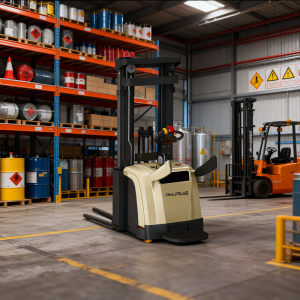
The Akuros electric stacker truck is positioned as a practical indoor pallet stacking solution for small and medium warehouse environments. That makes lift height selection especially important, because this type of machine is usually chosen to improve vertical storage efficiency in spaces where every meter of rack use matters. In that context, the right mast is not just a technical feature. It directly affects how much value the machine creates after delivery.
Why Lift Height Is One of the Most Important Buying Decisions
Lift height determines whether the truck can complete the job
A warehouse may describe its need as “we need a stacker,” but the real question is where the pallet must finally go. If the target beam is above the truck’s true usable reach, the machine will fail at the exact point where it is needed most. That is why lift height should be confirmed early, before discussing optional features or price adjustments.
Lift height also affects workflow speed
A truck that just barely reaches the desired level may still slow the operation if pallet positioning becomes less stable or visibility becomes weaker near maximum elevation. In practical use, the best choice is often a stacker with enough margin to perform comfortably rather than theoretically.
Higher is not always better
Some buyers assume the safest commercial choice is to ask for the highest mast available. In reality, higher lift height can increase cost, alter mast visibility, change the lowered mast profile, and in some cases create unnecessary design trade-offs for a warehouse that only uses low to medium rack positions. A well-matched electric stacker truck should be sized for the real job, not for an imagined maximum.
Real Warehouse Scenario: A Common Lift Height Mistake
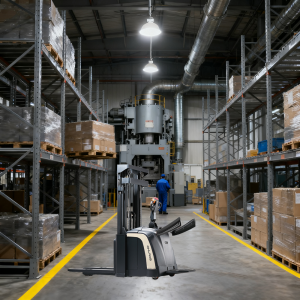
Consider a packaging warehouse using two rack beam levels plus a floor staging area. The manager orders a stacker based on nominal rack height alone, assuming that if the top beam is at 3.2 meters, any mast above that number will work. After delivery, the team discovers that pallet height, fork entry clearance, and safe placement margin all reduce usable lift. The truck can technically raise the forks high enough, but practical pallet placement at the top level becomes slow and uncomfortable.
This kind of mistake is common because buyers sometimes calculate only static rack dimensions and ignore real pallet geometry. A correct evaluation should include beam height, pallet height, load clearance, and safe operating margin. In many cases, the correct answer is not the absolute tallest mast, but the one that allows confident placement at the intended level under normal working conditions.
What Dimensions Buyers Should Measure Before Selecting Lift Height
1. Top beam height
The first measurement is the actual height of the rack beam where the pallet must be placed. This is the operational target, not just a general warehouse estimate.
2. Pallet height including load
Buyers should measure not only the pallet base, but also the loaded pallet height as it enters the rack. Taller loads may require more careful clearance and can affect how comfortably the operator can place the pallet.
3. Required clearance margin
There should always be a reasonable margin between the top of the load and the rack above it, especially if the operation involves frequent placement, wrapped loads, or variable pallet condition. A machine that works only with exact alignment can create unnecessary daily difficulty.
4. Lowered mast height
Many buyers focus only on maximum lift and forget to check lowered mast height. This can create a different problem: the truck may reach the rack, but fail to pass through doors, overhead structures, or internal bottlenecks. For any electric pallet stacker for warehouse racks, upward reach and downward fit must both be checked.
5. Floor and approach condition
If the rack approach includes uneven floor transitions, ramps, or dock plates, the truck’s practical positioning height and stability may differ from what a flat-floor calculation suggests. Real operating conditions should always guide mast selection.
Planning Table: How to Estimate the Right Lift Height
| Planning Item | What to Measure | Warum es wichtig ist | Buyer Risk If Ignored |
|---|---|---|---|
| Top beam height | Height of the actual storage level | Defines the minimum working target | Truck cannot reach intended rack level |
| Pallet plus load height | Total loaded height entering the rack | Determines placement clearance | Pallet placement becomes unstable or difficult |
| Safety margin | Additional space above the load | Allows practical positioning tolerance | Operator loses placement confidence |
| Lowered mast height | Truck mast height when fully lowered | Controls building and doorway compatibility | Machine fits the rack but not the building route |
| Bodenbeschaffenheit | Flatness, ramps, transition plates | Affects approach stability | Real performance differs from catalog expectation |
Typical Lift Height Logic by Warehouse Application
Low-level staging operations
If the warehouse mainly uses floor staging and low shelf placement, a lower mast may be enough. In this case, the commercial priority may be compactness, visibility, and lower overall equipment cost rather than maximum lift.
Standard rack replenishment
For warehouses using low to medium rack beams for regular pallet storage, lift height becomes more critical. The stacker should not only reach the rack but do so with enough handling confidence for repeated daily use.
Mixed-use warehouse layouts
Some sites use a combination of floor staging, lower beam storage, and occasional upper-level placement. In these environments, the ideal electric stacker truck often needs balanced mast performance rather than the lowest or highest configuration.
Growth-stage facilities
When a warehouse expects moderate expansion, buyers sometimes select a slightly more capable mast than current operations require. This can be reasonable if the future plan is concrete, but it should still be tied to real storage strategy rather than vague assumptions.
Comparison Table: Choosing Too Low, Too High, or Properly Matched
| Lift Height Choice | Hauptvorteil | Main Problem | Commercial Result |
|---|---|---|---|
| Too low | Lower initial cost | Cannot complete intended stacking work | Operational mismatch and early replacement risk |
| Too high | More theoretical flexibility | Higher cost and possible mast trade-offs | Over-specification without clear ROI |
| Properly matched | Best balance of performance and cost | Requires careful site evaluation | Higher daily efficiency and better long-term value |
How Lift Height Affects Safety and Operator Control
Lift height is not only a storage issue. It also affects visibility, stability perception, and operator confidence. As pallets rise higher, small alignment errors can matter more. This is why the warehouse should choose a mast that supports realistic daily operation, not just theoretical maximum reach.
In the United States, powered industrial truck use is covered by OSHA 29 CFR 1910.178, which includes operator training and workplace-specific safe use requirements. That means the warehouse should match the truck not only to the rack, but also to the operator environment, route conditions, and stacking practice. For export-oriented sourcing, broader industrial truck safety frameworks such as ISO 3691-1 are also important when evaluating an electric stacker truck manufacturer.
Why Buyers Often Ask the Wrong First Question
Many buyers begin with “What is the maximum lifting height?” A better first question is “What is the highest level where we need to place a real loaded pallet safely and repeatedly?” That wording is more useful because it reflects the real warehouse job instead of a brochure headline.
Similarly, the second best question is not “What is your cheapest model?” but “Which mast configuration best fits our rack level, pallet size, and doorway restrictions?” Serious suppliers usually respond better to specific application data than to generic price-only requests.
Why This Matters for Akuros Product Positioning
The Akuros electric stacker truck is strongest when positioned as a practical indoor warehouse solution rather than just a general lifting machine. That means the content should help buyers understand application fit, not only technical specs. Lift height is one of the best themes for doing that because it connects directly to buyer uncertainty, rack design, and storage efficiency.
Commercially, this also opens the door to valuable search intent around terms such as electric stacker truck lift height, electric pallet stacker for warehouse racks, walkie stacker with high lift, electric stacker truck factoryund electric stacker truck manufacturer. These are not just keywords. They represent real questions buyers ask before placing an order.
Industry Trend: Why Better Space Planning Increases the Value of Proper Lift Selection
Warehouses today are under pressure to increase storage output without always increasing building footprint. That means vertical space matters more than ever. As storage density becomes a stronger business priority, the correct lift height becomes more valuable because it directly affects how efficiently the rack system can be used.
This trend is especially relevant in indoor warehouses where forklifts may be oversized for the workflow and manual handling cannot support structured stacking. In these sites, a properly configured electric stacker truck becomes one of the most practical tools for translating rack design into usable daily storage capacity.
Schlussfolgerung
Choosing the right lift height for an electric stacker truck is one of the most important decisions in a warehouse equipment project. It determines whether the machine truly fits the rack system, supports practical pallet placement, and delivers long-term value after purchase.
The correct answer is rarely the lowest or highest mast by default. It is the mast that matches beam height, pallet dimensions, clearance margin, lowered height restrictions, and real operating conditions. When buyers evaluate those factors carefully, the stacker becomes not just a machine that can lift, but a machine that improves the warehouse’s actual storage performance.
For that reason, lift height should always be treated as an application decision, not only a specification line.
FAQ
1. How do I calculate the right lift height for an electric stacker truck?
You should start with the actual rack beam height, then add the real loaded pallet height and a practical clearance margin for safe placement. This gives a much more accurate requirement than using rack height alone.
2. Is maximum lift height the same as usable stacking height?
No. Maximum lift height is a technical figure, while usable stacking height depends on pallet dimensions, load condition, clearance, and practical operator control at the rack face.
3. Why is lowered mast height important?
Because the truck must also fit the building. A machine with the correct maximum lift may still fail operationally if its lowered mast height cannot pass through doors, overhead structures, or internal route restrictions.
4. Should I choose a higher mast for future expansion?
That can be reasonable if there is a clear and realistic warehouse growth plan. However, buying excessive lift height without a defined use case may only increase cost without adding real value.
5. What should I send to an electric stacker truck manufacturer before asking for a mast recommendation?
You should provide rack beam height, pallet size, maximum load weight, load height, aisle width, doorway height, floor condition, and daily operating pattern. These details help the supplier recommend the correct configuration.
Referenzen
- Powered Industrial Trucks, Occupational Safety and Health Administration, U.S. Department of Labor, regulatory guidance.
- ISO 3691-1 Industrial Trucks Safety Requirements and Verification, International Organization for Standardization, standard overview.
- Warehouse Storage Planning and Rack Use Practices, materials handling industry publications, operational guidance.
- Walkie Stacker Product Category Specifications, Toyota Material Handling, benchmark data.
- Pedestrian Stacker Product Specifications, Jungheinrich, benchmark data.
- Warehouse Operations and Equipment Trends, Modern Materials Handling, industry analysis.
- Annual Industry Reports, MHI, supply chain technology and investment trend reporting.
- Industrial Truck Safety and Training Assistance, Occupational Safety and Health Administration, operator training framework.
Suggested Tags
electric stacker truck, lift height, electric pallet stacker, warehouse racks, walkie stacker, indoor warehouse equipment, pallet stacking solution, electric stacker truck manufacturer
Semantic Closure Block
How should buyers think about lift height?
They should treat it as a warehouse application decision, not only a technical number. The correct lift height is the one that supports safe, repeatable pallet placement at the intended rack level under real conditions.
Why is this decision commercially important?
Because an under-specified mast can block warehouse productivity, while an over-specified mast can increase cost without improving daily value. A properly matched stacker creates the best balance between capability and investment.
What does this mean for indoor warehouse projects?
It means buyers should evaluate rack height, pallet size, door clearance, aisle approach, and actual operating flow together. The stacker must fit both the rack and the building.
Why does a supplier’s guidance matter?
A serious supplier helps translate warehouse measurements into a workable mast recommendation. That reduces the risk of mismatch and improves the buyer’s confidence before order confirmation.