

 Russian
  English
  French
  Spanish
  German
  Italian
  Portuguese
  Korean
  Japanese
  Arabic
  Turkish
  Indonesian
  Dutch
Dutch 

A Monday-Morning Bottleneck That Feels Familiar
“Why does dispatch always choke right before cutoff?” the operations lead asked, staring at the dashboard.
“Because inbound is late again, pick paths are crossing, and charging is fighting for sockets,” the supervisor replied.
“So we fix dispatch?”
“We fix the system. Dispatch is just where the pain shows up.”
That short exchange captures a 2025 reality: in fast-moving regions like Southeast Asia, and also in Europe’s efficiency-driven markets, bottlenecks are rarely isolated failures. They are coordination failures. Small delays stack across receiving, storage, replenishment, picking, packing, and equipment availability until the facility behaves like a traffic jam.
A One-Stop Warehouse approach is not a slogan. It is an operating model where the warehouse is designed and run as one system with one rhythm—so you stop “winning” one area and “losing” another.

Единый склад
Why Bottlenecks Keep Coming Back
Most warehouses “fix” bottlenecks in a way that guarantees they return. They patch the symptom: add temporary labour at packing, open extra staging, or push overtime. The underlying delay chain stays intact. When demand spikes, it breaks again.
Bottlenecks come back because of four common patterns:
-
Fragmented ownership: each team optimises its own area, not the end-to-end flow.
-
Invisible downtime: energy and charging routines create hidden losses that destroy waves.
-
Data that reports rather than prevents: issues are discovered after they hurt cutoffs.
-
Movement chaos: the building spends too much time walking, searching, staging, and waiting.
A Единый склад model changes the operating rules so the building behaves predictably under pressure.
Step 1: Map the “Delay Chain” Before You Touch Anything
The first move is not equipment. It is diagnosis. A delay chain is the cause-and-effect path that turns a small disturbance into a late cutoff.
Classify your bottleneck type (not just the location)
Use this simple classification to avoid chasing noise:
-
Flow bottleneck: congestion at docks, cross-aisles, pack lines
-
Inventory bottleneck: stockouts, mis-slots, slow replenishment, cycle count gaps
-
Equipment bottleneck: insufficient trucks, low uptime, maintenance lag, charging conflicts
-
Data bottleneck: unclear priorities, lagging WMS actions, no exception routing
-
People bottleneck: training gaps, inconsistent SOPs, unclear role ownership
Many facilities mislabel a flow bottleneck as a labour problem. The result is expensive labour used to compensate for layout and discipline issues.
Instrument your floor with “bottleneck KPIs”
You do not need a complex automation stack to measure like a disciplined operator. Track these KPIs for 2–3 weeks and you will see patterns:
-
Dock-to-stock time: receiving to putaway completion
-
Putaway latency by zone: where inbound gets stuck
-
Replenishment response time: trigger to restock completion
-
Pick travel time per order line: distance and time per line
-
Pack queue time and rework rate: how long work waits, how often it returns
-
Fleet availability: uptime, charging time, downtime causes
-
Exception rate: damage, short picks, missing items, mis-scans
You are looking for the “repeatable choke.” Bottlenecks that happen at predictable times are process and coordination issues, not random bad luck.
Step 2: Fix the Most Overlooked Accelerator—Internal Movement

Единый склад
When internal movement is slow, everything else becomes theatre. A One-Stop Warehouse approach treats movement as a design problem.
The movement rules that typically unlock capacity
-
Define staging ownership: who owns the zone, what the expiry time is
-
Create protected replenishment lanes: replenishment must not fight picking
-
Enforce one-way traffic rules in high-conflict areas
-
Standardise pallet profiles and handling etiquette
-
Separate replenishment timing from pick waves (avoid “replenish during chaos”)
Warehouses often assume forklifts will “figure it out.” In peak season, they do—by blocking each other. Movement discipline prevents the building from becoming self-inflicted congestion.
Slotting is not a spreadsheet—slotting is a traffic plan
A practical slotting approach is to assign SKUs into velocity bands, then design storage and pick faces around travel reduction. The goal is to reduce “search and travel,” the two largest hidden costs in picking.
-
A items: fast movers, close to pick/pack, clean access
-
B items: medium velocity, stable replenishment logic
-
C items: slow movers, stored to minimise disruption
If your A items are scattered across the building, congestion will always spike near cutoff.
Step 3: Build the One-Stop Warehouse Backbone (4 Layers)
One-stop does not mean “one vendor does everything.” It means one integrated backbone where each layer supports the others.
Layer 1: Process layer (SOPs that match reality)
Your SOPs must be designed for peak, not for calm days.
-
Inbound: appointment logic, unload discipline, staging rules
-
Putaway: velocity-based location logic, not “first available”
-
Replenishment: proactive triggers, protected lanes, timing discipline
-
Picking: wave rules, route protection, exception handling
-
Packing/dispatch: queue control, quality gates, scan discipline
-
Returns: separate flow, so returns do not contaminate dispatch rhythm
Layer 2: Equipment layer (material handling that fits the building)
Buying more equipment rarely fixes a system problem, but wrong-fit equipment can create permanent bottlenecks.
-
Match turning radius to aisle reality
-
Match load types and pallet quality to handling tools
-
Match lift height and rack interfaces to safety constraints
-
Standardise what tool is used for short moves vs long moves
Equipment standardisation reduces decision friction. Decision friction is a bottleneck multiplier.
Layer 3: Data layer (data that triggers action)
A One-Stop Warehouse uses data to prevent delays, not to explain them after the cutoff is missed.
-
Exceptions must route to owners within minutes, not hours
-
Replenishment triggers must reflect actual consumption
-
Wave priorities must be aligned to service targets
-
KPI dashboards must be tied to behaviour and escalation ladders
A common failure is running a WMS like a reporting system rather than a real-time control system.
Layer 4: Power layer (energy planning as a workflow)
Energy planning is now a throughput control variable. Unplanned charging creates hidden downtime that collapses waves.
Practical power rules include:
-
Shift-based charging windows
-
Battery health checks and safe charging zones
-
Clear ownership of fleet uptime KPIs
-
Planned rotation so “random dead trucks” stop occurring near cutoffs
When power is planned, fleet availability becomes predictable. Predictability is the backbone of cutoffs.
Step 4: Use Industry Fit to Prevent “Template Failure”
A Единый склад must adapt to what you store and how it moves. Different industries bottleneck differently.
Typical bottleneck patterns by industry
-
E-commerce: peak volatility, returns, wave stability
-
Cold chain: dock speed, temperature zoning, packaging integrity
-
Pharma: compliance flow, quarantine zones, traceability gates
-
Automotive parts: kitting accuracy, SKU complexity, error-proofing
The fastest way to fail is to copy an overseas layout without localisation. Product behaviour and labour patterns differ.
Единый склад
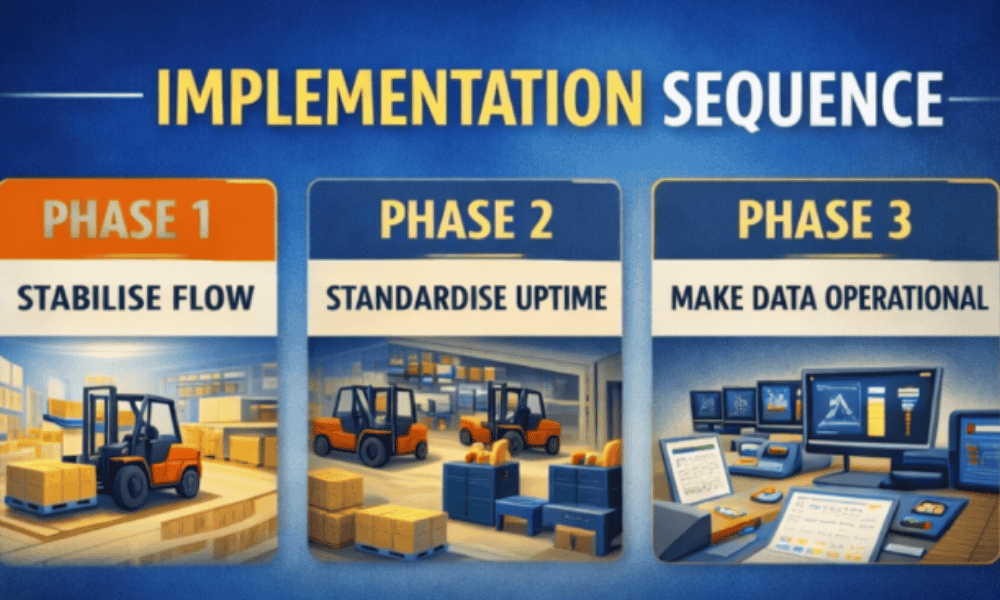
Step 5: The Implementation Sequence That Prevents Bottleneck Migration
Many projects stall because they try to speed up before stabilising. Use this sequence:
Phase 1: Stabilise flow before you add speed
-
Define staging rules and expiry times
-
Protect replenishment lanes
-
Re-slot fast movers to reduce travel
-
Introduce simple one-way rules in conflict areas
-
Add quality gates where rework is high
Phase 2: Standardise uptime, safety, and energy
-
Match equipment to aisle and load reality
-
Standardise short/long-move tools
-
Implement charging windows and accountability
-
Train collision-prevention behaviours
-
Put maintenance into a predictable rhythm
Phase 3: Make data operational
-
Exception routing and escalation ladder
-
Wave planning that reflects cutoffs and capacity
-
KPI reviews tied to actions, not presentations
-
Continuous slotting updates by velocity bands
Mini Case Snapshots (Practical Patterns)
These are field-style patterns that illustrate what changes when one-stop integration is applied.
Case 1: E-commerce cutoff misses (Jakarta-type volatility)
Problem: waves collapsed because replenishment always arrived late.
Fix: protected replenishment lane, velocity band slotting, disciplined wave timing.
Outcome pattern: fewer urgent replenishments, smoother pack queue, higher on-time cutoffs.
Case 2: Cold chain dock pressure (Bangkok-type constraint)
Problem: inbound congestion raised dwell time and created pack chaos.
Fix: dock appointment rules, cross-dock fast lane, stronger staging discipline.
Outcome pattern: cleaner flow, fewer exceptions, improved traceability.
Case 3: Industrial parts kitting errors (Ho Chi Minh-type complexity)
Problem: kitting errors created rework loops and late dispatch.
Fix: process checkpoints, error-proofing, exception workflow ownership.
Outcome pattern: fewer rework cycles, higher first-pass accuracy.
Заключение
Dispatch is rarely the true bottleneck. Dispatch is where upstream instability becomes visible. When inbound timing is inconsistent, staging has no ownership, replenishment is reactive, pick paths collide, and fleet charging is unpredictable, the facility builds a delay chain that ends at cutoff.
A One-Stop Warehouse approach reduces bottlenecks by removing the coordination gaps that cause delays to multiply. The core logic is system alignment: process discipline, equipment fit, data workflows, and energy planning must pull in the same direction. Many logistics engineering programmes and operational consulting frameworks emphasise the same principle: reliability beats isolated speed. A warehouse that runs as one integrated backbone can absorb volatility because it has predictable flow and clear ownership.
The practical payoff is not just higher throughput. It is fewer surprises, less firefighting, and fewer “multi-vendor blame loops.” If you want cutoffs to stop being a weekly drama, the solution is not to push dispatch harder. The solution is to make the warehouse behave like one business, one rhythm, one accountable system—so bottlenecks stop migrating and performance becomes repeatable.

универсальный склад
Часто задаваемые вопросы
1) Что такое «Единый склад»?
«Единый склад» — это интегрированная операционная модель, в которой проектирование процессов, материально-техническое обеспечение, потоки данных и энергетическое планирование объединены в единую систему, что позволяет предотвратить перенос узких мест между подразделениями.
2) Какой самый быстрый узкий участок следует устранить в первую очередь?
Внутреннее перемещение. Планирование размещения, управление стадиями и оптимизация сроков пополнения запасов часто позволяют быстро раскрыть дополнительные мощности без необходимости увеличения площадей.
3) Нужна ли автоматизация для сокращения узких мест?
Не всегда. Во многих операциях более значительные результаты достигаются за счёт стабилизации потока, стандартизации стандартных операционных процедур и повышения времени безотказной работы перед автоматизацией уже доказавшего свою эффективность ограничения.
4) Почему дисциплина зарядки так важна?
Непланируемая зарядка приводит к скрытым простоям и нарушению графика работы. Планирование энергетических режимов делает доступность автопарка предсказуемой.
5) Как понять, стоит ли внедрять интеграцию «всё в одном»?
If you have frequent cutoff misses, recurring congestion, high exception rates, or vendor blame loops, you are likely paying the fragmentation tax.
6) Какие ключевые показатели эффективности следует отслеживать в первую очередь?
Время от прибытия до размещения на складе, время перемещения при комплектации по линии, время реагирования на пополнение запасов, время ожидания упаковки, уровень исключений и доступность автопарка.
«Единый склад» — это не очередная тактика оптимизации, а операционная дисциплина. С точки зрения экспертов по операциям основной тезис ясен: надежность всегда превосходит изолированную скорость. Когда приемка, размещение, пополнение запасов, комплектация, упаковка и время работы автопарка рассматриваются как отдельные функции, склад не устраняет узкие места — он лишь переносит их. Именно поэтому повторяющиеся сбои в сроках выполнения заказов почти всегда возникают снова под давлением. Опытные логистические инженеры неизменно подчеркивают, что настоящий рост пропускной способности достигается за счет согласования всей системы, а не за счет усиления нагрузки на отдельные подразделения. Построение карты цепочки задержек позволяет увидеть, как небольшие ошибки во времени накапливаются по всем зонам. Как только эти задержки становятся видимыми, их можно нейтрализовать, выровняв четыре ключевых уровня — дисциплину процессов, соответствие технологий обработки материалов, логику операционных данных и планирование энергопотребления — чтобы поток оставался предсказуемым даже в периоды пиковой нагрузки.
Еще один консенсус экспертов заключается в том, что такие показатели эффективности, как время от прибытия до размещения на складе, время реагирования на пополнение запасов и время перемещения при комплектации по линии, — это не просто метрики; это сигналы раннего предупреждения. Когда эти показатели отклоняются от нормы, система теряет стабильность задолго до того, как это заметят сотрудники отдела отгрузки. Наконец, дисциплина управления мощностью и зарядкой стала структурным фактором пропускной способности. Доступность автопарка больше не является вопросом технического обслуживания — она напрямую определяет, выдержат ли волны нагрузки или рухнут.
Короче говоря, «Единый склад» работает, потому что заменяет тушение пожаров управлением. Рассматривая склад как единую ответственную систему с единым ритмом, узкие места перестают мигрировать — и результаты становятся повторяемыми, а не реактивными.