

 Korean
  English
  Russian
  French
  Spanish
  German
  Italian
  Portuguese
  Japanese
  Arabic
  Turkish
  Indonesian
  Dutch
Dutch 

The “Same Problem, Different Day” Moment
“Why are we still missing cutoffs even after adding weekend labour?” asked the operations manager.
“Because the delay chain didn’t change,” the supervisor replied. “We just paid more to survive it.”
That is the best test. If you can only hit targets by adding cost, the system is unstable. These upgrades stabilise flow so performance is repeatable.
원스톱 창고
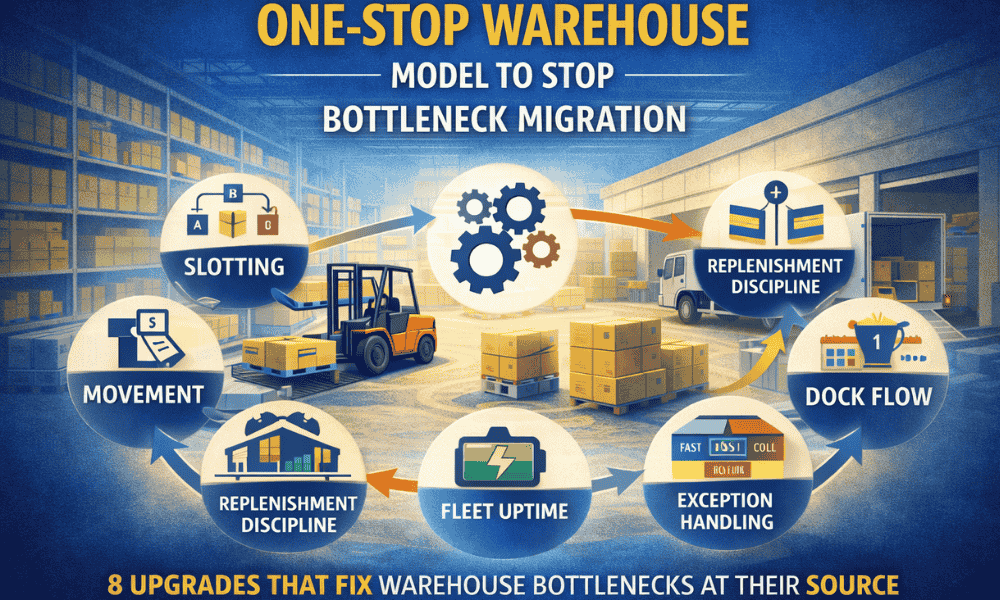
Upgrade 1: Velocity Band Slotting That Reduces Travel Before Anything Else
Travel time is the silent budget killer. If fast movers are scattered, congestion becomes predictable.
Practical actions:
-
Create A/B/C velocity bands using recent order history
-
Pull A items near pick/pack and into clean-access zones
-
Enforce replenishment rules so A locations stay full
-
Review slotting weekly during peak seasons
Expected impact: reduced travel, fewer cross-aisle conflicts, more stable waves.
Upgrade 2: Staging Ownership and Expiry Rules
Staging without ownership becomes a warehouse parking lot.
Practical actions:
-
Assign owners to each staging zone
-
Define expiry times (how long a load can sit)
-
Create clear “ready to putaway / ready to pick / ready to ship” labels
-
Enforce a daily staging reset
Expected impact: fewer hidden queues and fewer “where is it?” delays.
Upgrade 3: Protected Replenishment Lanes and Timing Discipline
Replenishment during chaos is the fastest way to create chaos.
Practical actions:
-
Build dedicated replenishment paths
-
Time replenishment to avoid peak pick waves
-
Use proactive triggers (not urgent calls)
-
Track replenishment response time as a KPI
Expected impact: fewer stockouts during waves, less emergency movement.
Upgrade 4: Dock Appointment Logic Matched to Capacity
Inbound arriving whenever it wants makes downstream performance impossible.
Practical actions:
-
Set appointment windows based on dock capacity and labour
-
Standardise unload and check-in steps
-
Separate fast cross-dock lanes from standard putaway
-
Track dock-to-stock time
Expected impact: reduced inbound spikes and more predictable putaway.
Upgrade 5: Fleet Uptime as a Managed KPI (Not a Maintenance Hope)
If trucks are unavailable near cutoff, waves collapse.
Practical actions:
-
Track uptime and downtime causes
-
Schedule charging windows and accountability
-
Standardise pre-shift checks
-
Build a predictable maintenance rhythm
Expected impact: fewer surprise pauses, more stable throughput.
Upgrade 6: Exception Workflows That Trigger Action in Minutes
Reports do not prevent bottlenecks. Exception routing does.
Practical actions:
-
Define the top exceptions (short pick, damage, missing label, mis-slot)
-
Assign owners and time-to-resolve targets
-
Add escalation ladders
-
Track exception rate and rework loop time
Expected impact: fewer downstream surprises and less rework.
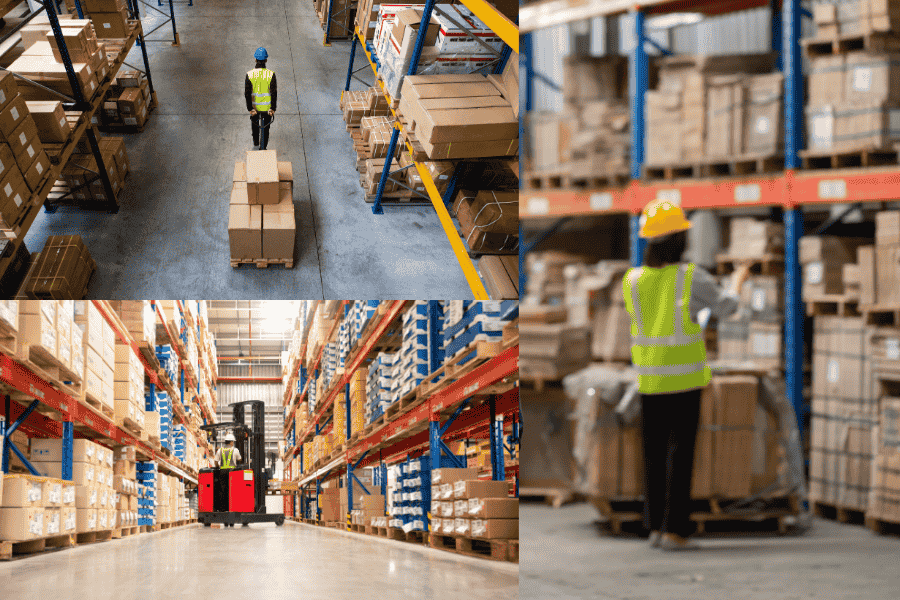
원스톱 창고 솔루션
Upgrade 7: Industry-Fit Zoning (Stop Using One Layout for Everything)
Warehouse flow must match product behaviour.
Practical actions:
-
Build zones for cold chain, regulated goods, fast movers, kitting
-
Separate returns flow from dispatch rhythm
-
Add compliance gates where required
-
Align packaging workflow to product sensitivity
Expected impact: fewer collisions between incompatible workflows.
Upgrade 8: One System Owner for End-to-End Flow
One-stop integration fails when ownership is fragmented.
Practical actions:
-
Assign a workflow owner who owns the end-to-end KPI set
-
Run weekly bottleneck reviews based on delay chain evidence
-
Stop “local optimisation” that harms cutoffs
-
Align improvement projects to the same operating promise
Expected impact: bottlenecks stop migrating because decisions stop conflicting.
Practical “Before vs After” Fit Check Table
| Warehouse Profile | Typical Bottleneck | One-Stop Upgrade That Usually Wins |
|---|---|---|
| High SKU, high velocity | pick congestion, exceptions | velocity slotting + exception routing |
| Low SKU, high volume | space and replenishment timing | protected replenishment lanes |
| Urban dense facility | staging chaos, cross-traffic | staging ownership + one-way rules |
| Cold chain | dock pressure, dwell time | dock appointments + cross-dock lanes |
| Regulated goods | audit friction, holds | controlled zones + compliance gates |
결론
Most warehouses experience bottleneck migration because improvements are applied as isolated patches. You speed up picking and packing becomes the new choke point. You add labour at dispatch and inbound creates a bigger staging queue. These upgrades work because they change the operating system: movement becomes disciplined, replenishment becomes protected, slotting reduces travel, docks become capacity-based, fleet uptime becomes predictable, exceptions trigger action, and zoning matches product behaviour.
Operational researchers and experienced practitioners repeatedly emphasise the same truth: reliability is engineered. It is not wished into existence. A one-stop model builds reliability by aligning the parts that usually conflict—process, equipment, data, and energy planning—so the facility has one rhythm under pressure. If your cutoffs are fragile, the problem is rarely “insufficient effort.” The problem is fragmented logic. Once the warehouse runs as one backbone with one accountable system owner, bottlenecks stop relocating and performance becomes repeatable.

High-quality One-Stop Warehouse
FAQs
1) Which upgrade usually delivers the fastest payoff?
Velocity slotting and staging ownership often unlock capacity quickly because they reduce travel and waiting.
2) Why do replenishment lanes matter so much?
Because replenishment conflicts with picking create congestion and stockouts during waves.
3) How do I reduce congestion without changing racks?
Improve movement rules, protect lanes, and enforce staging expiry rules first.
4) What KPI best predicts missed cutoffs?
Replenishment response time and fleet availability often correlate strongly with cutoff misses.
5) Should I automate before fixing discipline?
Not usually. Automation amplifies weak discipline; stabilise flow first.