

 Korean
  English
  Russian
  French
  Spanish
  German
  Italian
  Portuguese
  Japanese
  Arabic
  Turkish
  Indonesian
  Dutch
Dutch 

A Scene You’ll Recognize on Any Busy Warehouse Floor
“Why are we full again?” the warehouse manager asked, looking at a layout that should have worked on paper.
“Because we’re storing air,” the operations analyst replied, circling the aisles on the map. “Selective racking gives access, but it also eats floor.”
“So… drive-in?”
“Not unless you want LIFO headaches. We need density and control. Double deep is the compromise that actually behaves.”
That’s the real reason double-deep keeps showing up in modern facility redesigns: it increases storage density while staying compatible with practical order profiles—if (and only if) you design it like an operating system, not a metal purchase.
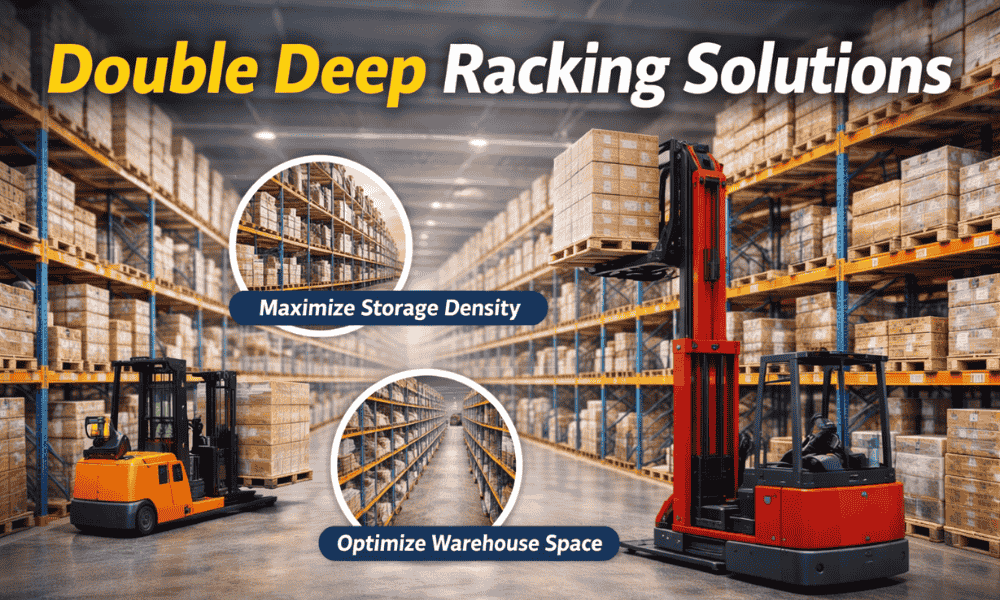
더블 딥 랙 솔루션
What 더블 딥 랙 솔루션 Actually Change (The “Hidden Math”)
Double-deep stores two pallets behind each other in the same bay. You gain pallet positions mainly by reducing the number of aisles needed for the same capacity.
아쿠로스 The upside
-
Higher storage density than standard selective racking
-
Better cubic utilization in facilities with tight footprints
-
Lower “aisle tax” while keeping a familiar rack structure
The trade you must accept (and manage)
-
Reduced immediate access to every pallet (the rear pallet depends on the front pallet)
-
More reliance on slotting rules, replenishment timing, and lift-truck capability
-
Higher penalty for messy inventory discipline
If you run chaotic replenishment, double-deep won’t “fix” it. It will expose it—loudly.
When Double Deep Wins (And When It Shouldn’t Be Your First Pick)
Best-fit profiles
Double deep works best when these conditions are true:
-
Moderate SKU variety, with meaningful depth per SKU (you aren’t constantly hunting single pallets)
-
Stable demand patterns, where you can predict replenishment and pick waves
-
Good inventory accuracy, because “rear pallet surprises” are expensive
-
A clear rotation logic, usually FIFO handled at the batch/location level, not per-lane perfection
-
Your operation can tolerate a small selectivity compromise to get big space gains
Red flags
Double deep is usually the wrong move if:
-
You have very high SKU variety with frequent single-pallet picks
-
You rely heavily on immediate access to every pallet at any moment
-
Your replenishment discipline is weak (late, reactive, inconsistent)
-
Your facility suffers from heavy congestion—double-deep can add handling steps that worsen peak-hour traffic
How to Design Double Deep So It Feels “Fast,” Not Just “Dense”
1) Start with the SKU truth, not the rack catalog
Before layout, create a slotting model:
-
A/B/C velocity bands (what actually moves daily/weekly/monthly)
-
Pallet depth per SKU (how many pallets you typically hold per SKU)
-
Order-line profile (single-pallet vs multi-pallet orders)
-
Seasonality and promo spikes (what breaks your “average day”)
Rule of thumb: double-deep likes SKUs that consistently have at least “two pallets worth of reason” to store them.
2) Engineer the travel paths
You can gain pallet positions and still lose throughput if your travel and cross-traffic explode. Protect flow by design:
-
Put the highest-velocity SKUs closer to shipping
-
Reduce cross-aisle conflict points
-
Separate replenishment travel from pick travel when possible
-
Keep staging disciplined so turning radius and sight lines aren’t compromised
A dense warehouse with messy staging is like a fast car in a parking lot: technically powerful, practically stuck.
3) Match the lift truck to the rack depth
Double-deep typically needs reach trucks or deep-reach attachments depending on height and load. What matters operationally:
-
Stability and visibility at height
-
Consistent pallet entry without clipping uprights
-
Handling time per cycle (rear pallet retrieval adds steps)
-
Operator fatigue and error risk during peak shifts
If rear pallet retrieval feels “hard,” your damage rate quietly climbs—then your KPI dashboard starts lying.
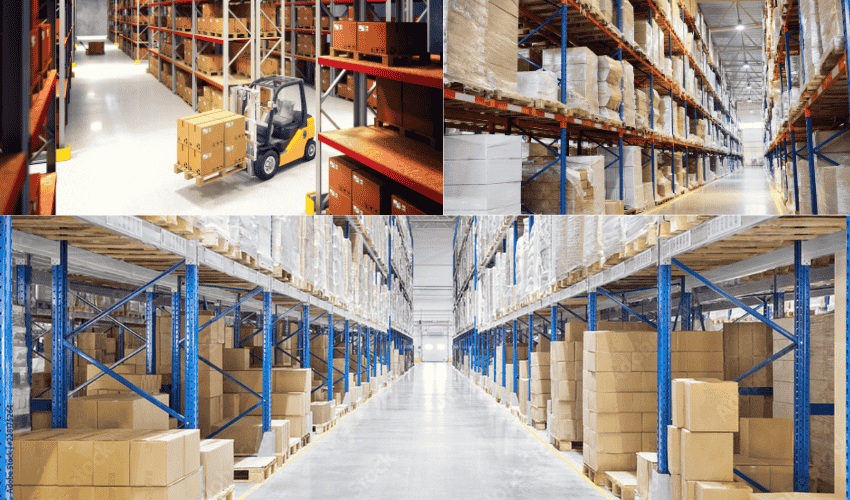
High-quality Double Deep Racking Solutions
The Operational Difference: Double Deep Needs Rules That Selective Racking Can “Forgive”
Selective racking tolerates sloppy habits. Double-deep charges interest on them.
The three rules that protect performance
-
Slotting discipline: rear positions belong to planned depth SKUs, not “wherever it fits today”
-
Rotation logic: define how you’ll preserve FIFO behavior (batch control, date-coded zones, or replenishment timing)
-
Exception handling: when front pallets are removed, rear pallets must be immediately “re-surfaced” or reallocated cleanly
Practical tip
Many successful operations treat double-deep as:
-
a bulk/medium-velocity zone및
-
keep ultra-fast movers in easier-access positions (selective or pick-face systems)
That hybrid approach often beats “double-deep everywhere.”
What Makes Double Deep “Better Than Normal” (In the Real World)
Compared to selective racking, double-deep can:
-
Increase usable storage capacity without expanding the building
-
Reduce aisle count and improve floor utilization
-
Improve long-term scalability when paired with a disciplined WMS slotting strategy
But the real advantage is strategic: it’s often the lowest-complexity way to move toward higher density while keeping your operation familiar enough to execute.
Drive-in can be denser, but it forces deeper compromises (rotation, access, impact risk). Double-deep is the density upgrade that still behaves like a warehouse—not a tunnel.
Expert Insight: Why “Integration Beats Isolated Density”
A recurring theme in modern logistics forums is that layout choices only work when they align with the full operating model—process, equipment, data, and training. Industrial engineering teams consistently emphasize the same logic:
-
Density without flow discipline increases congestion
-
Storage capacity without inventory accuracy increases reshuffles
-
Equipment upgrades without operator rules increase impacts and downtime
In plain terms: a good double-deep project is a systems project.
Mini Case Patterns: What Success Looks Like in Practice
Case Pattern 1: E-commerce reserve storage
Problem: selective racking ran out of reserve space; overflow created long travel and late cutoffs.
Double-deep move: reserve moved into double-deep zones; ultra-fast SKUs stayed accessible near outbound.
Result pattern: better space utilization, fewer overflow moves, more stable wave execution.
Case Pattern 2: Manufacturing raw materials (bulk pallets, stable rotation)
Problem: capacity pressure forced pallets into temporary staging areas, creating safety issues and blocked lanes.
Double-deep move: bulk SKUs assigned to double-deep with strict lane rules and protected replenishment windows.
Result pattern: fewer blocked aisles, better safety, predictable replenishment cycles.
Case Pattern 3: Cold-chain buffer storage (space pressure, controlled batch logic)
Problem: limited chilled footprint made selective storage too “wide.”
Double-deep move: batch-coded zoning plus disciplined replenishment restored FIFO behavior operationally.
Result pattern: higher cubic utilization without turning the facility into a retrieval puzzle.
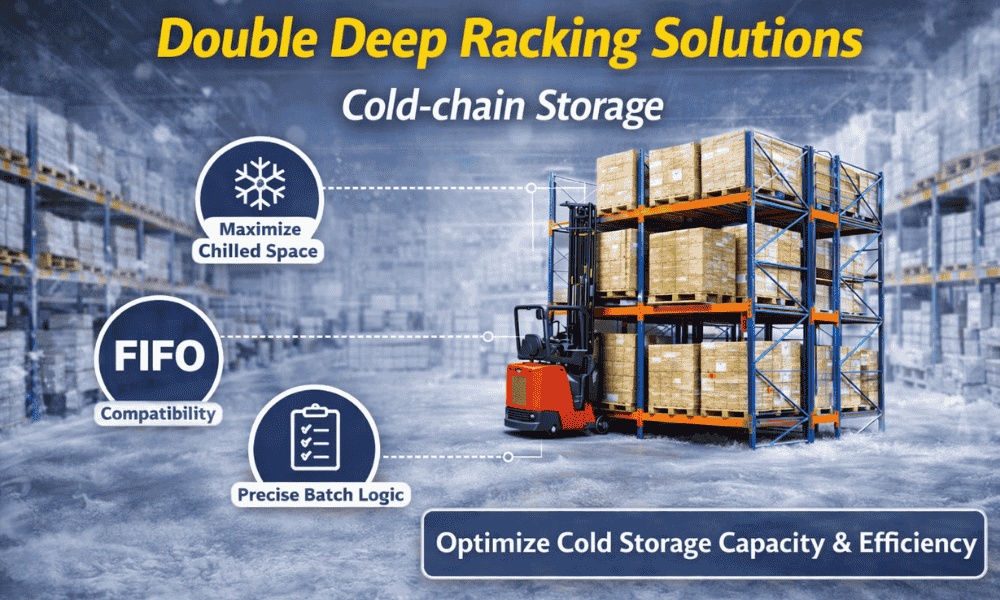
Double Deep Racking Solutions Cold-chain
FAQs
1) What is the main advantage of 더블 딥 랙 솔루션?
The biggest advantage is higher storage density with relatively low complexity compared with drive-in systems—especially when SKU depth is consistent and replenishment is disciplined.
2) Is double-deep compatible with FIFO?
Yes, but FIFO typically needs to be enforced through zoning, batch controls, and replenishment timing rather than assuming every pallet is instantly accessible.
3) What type of warehouse is the best fit for double-deep?
Warehouses with moderate SKU variety, stable demand, reliable inventory accuracy, and enough pallet depth per SKU to justify rear positions.
4) What’s the most common mistake buyers make?
Treating double-deep as a “space hack” without redesigning slotting rules, replenishment routines, and lift-truck capability.
5) Do rear pallets reduce throughput?
They can—unless you protect your fast movers, design travel paths carefully, and standardize the rules that prevent reshuffles.
6) What equipment is typically required?
Often reach trucks or deep-reach configurations. The correct choice depends on height, load stability, aisle width, and required cycle time.
7) How do I decide between double-deep and drive-in?
Choose double-deep when you still need controlled access and mixed-SKU handling. Choose drive-in when you store very high volumes of the same SKU and accept deeper access trade-offs.
결론
더블 딥 랙 솔루션 deliver real gains when they’re treated as a performance design—not a storage shortcut. The warehouses that win with double-deep don’t just stack pallets deeper; they protect flow with disciplined slotting, stable replenishment timing, and the right lift-truck reach. They also make a clear strategic choice: keep the fastest movers easy to access, and use double-deep for the SKUs that actually justify depth. That’s the difference between “we added capacity” and “we added capacity that still ships on time.” If your goal is density 그리고 operational reliability, double-deep is often the cleanest upgrade—provided you engineer the rules that selective racking never forced you to learn.