

 Korean
  English
  Russian
  French
  Spanish
  German
  Italian
  Portuguese
  Japanese
  Arabic
  Turkish
  Indonesian
  Dutch
Dutch 

익숙하게 느껴지는 월요일 아침의 병목 현상
“왜 항상 마감 직전에 출고가 막히는 거죠?” 운영 담당자가 대시보드를 바라보며 물었습니다.
“입고가 또 늦고, 피킹 경로가 겹치며, 충전도 콘센트를 두고 싸우니까요.”라고 감독이 답했습니다.
“그럼 출고를 고쳐야 하나요?”
“시스템을 고쳐야 합니다. 출고는 단지 고통이 드러나는 지점일 뿐이에요.”
이 짧은 대화는 2025년의 현실을 잘 보여줍니다: 동남아시아와 같은 빠르게 변화하는 지역뿐만 아니라 유럽의 효율성 중심 시장에서도 병목 현상은 거의 단독 실패가 아닙니다. 그것은 조율 실패입니다. 작은 지연들이 입고, 보관, 재보충, 피킹, 포장, 장비 가용성 등의 과정에서 차곡차곡 쌓여 결국 시설 전체가 교통 체증처럼 작동하게 됩니다.
원스톱 웨어하우스 접근법은 구호가 아닙니다. 이는 웨어하우스를 하나의 리듬으로 통합된 하나의 시스템으로 설계하고 운영하는 운영 모델로서, 한 영역에서는 승리하고 다른 영역에서는 패배하는 상황을 더 이상 반복하지 않도록 합니다.

원스톱 창고
병목 현상이 계속 재발하는 이유
대부분의 웨어하우스는 병목 현상을 해결한다고 해도 결국 다시 나타나게 만드는 방식으로 문제를 처리합니다. 증상만 임시로 덮어두는 것이죠: 포장 작업에 임시 인력을 추가하거나, 임시 스테이징 공간을 마련하거나, 초과 근무를 강요하는 식입니다. 하지만 근본적인 지연 사슬은 그대로 남아 있습니다. 수요가 급증하면 결국 또다시 문제가 발생합니다.
병목 현상이 반복되는 이유는 네 가지 일반적인 패턴 때문입니다:
-
분절된 소유권: 각 팀이 자신의 영역만 최적화할 뿐, 엔드투엔드 흐름은 고려하지 않습니다.
-
보이지 않는 가동 중단: 에너지와 충전 절차가 숨은 손실을 만들어 파도를 무너뜨립니다.
-
보고만 할 뿐 예방하지 못하는 데이터: 문제가 마감 시간에 영향을 미친 뒤에야 발견됩니다.
-
움직임의 혼란: 건물 내에서 걷기, 탐색, 스테이징, 대기 시간이 너무 많습니다.
A 원스톱 창고 모델이 운영 규칙을 변경하여 건물이 압박 상황에서도 예측 가능하게 행동하도록 합니다.
1단계: 아무것도 손대기 전에 ‘지연 사슬’을 파악하세요
첫 번째 조치는 장비가 아닙니다. 진단이 먼저입니다. 지연 사슬이란 작은 교란이 늦은 마감 시간으로 이어지는 원인과 결과의 경로입니다.
귀하의 병목 유형을 분류하세요(단지 위치만이 아니라)
이 간단한 분류를 활용해 소음만 쫓는 일을 피하세요:
-
흐름 병목: 부두, 크로스 애슬, 포장 라인에서의 정체
-
재고 병목: 품절, 잘못된 슬롯 배치, 느린 재보충, 사이클 카운트 공백
-
장비 병목: 트럭 부족, 낮은 가동률, 유지보수 지연, 충전 갈등
-
데이터 병목: 우선순위 불명확, WMS 실행 지연, 예외 라우팅 없음
-
인력 병목: 교육 격차, SOP 불일치, 역할 소유권 불명확
많은 시설이 흐름 병목을 인력 문제로 오인합니다. 그 결과, 레이아웃과 규율 문제를 보완하기 위해 비싼 인력을 사용하게 됩니다.
현장을 ‘병목 KPI’로 무장하세요
규율 있는 운영자처럼 측정하려면 복잡한 자동화 스택이 필요 없습니다. 이 KPI들을 2~3주간 추적해 보면 패턴이 보일 것입니다:
-
부두에서 재고까지의 시간: 입고부터 보관 완료까지
-
구역별 보관 지연: 입고가 어디에서 막히는지
-
재보충 응답 시간: 재보충 요청부터 재보충 완료까지
-
주문 라인당 피킹 이동 시간: 라인당 거리와 시간
-
포장 대기 시간과 재작업 비율: 작업이 얼마나 오래 대기하는지, 얼마나 자주 다시 발생하는지
-
차량 가용성: 가동률, 충전 시간, 가동 중단 원인
-
예외 발생률: 손상, 부족 피킹, 누락 품목, 오스캔
귀하는 ‘반복 가능한 목조’를 찾고 있습니다. 예측 가능한 시기에 발생하는 병목 현상은 우연한 불운이 아니라 프로세스와 조율 문제입니다.
2단계: 가장 간과되기 쉬운 가속제—내부 이동—을 고쳐야 합니다

원스톱 창고
내부 이동이 느리면 나머지 모든 것이 연극처럼 되어버립니다. 원스톱 웨어하우스 접근법은 이동을 설계 문제로 간주합니다.
일반적으로 용량을 확보하는 이동 규칙
-
스테이징 소유권을 정의하세요: 해당 구역의 소유자는 누구인지, 유효 기간은 얼마인지
-
보호된 재보충 레인을 만들세요: 재보충이 피킹과 경쟁해서는 안 됩니다
-
갈등이 심한 구역에서는 일방 통행 규칙을 시행하세요
-
팔레트 프로파일과 취급 에티켓을 표준화하세요
-
재보충 타이밍과 피킹 웨이브를 분리하세요(‘혼란 속에서 재보충’을 피하세요)
웨어하우스들은 종종 지게차가 알아서 해결할 것이라고 가정합니다. 성수기에는 실제로 그렇게 되기도 합니다—하지만 서로를 막아서 말이죠. 이동 규율은 건물이 스스로 초래하는 정체로 변하는 것을 막아줍니다.
슬로팅은 스프레드시트가 아닙니다—슬로팅은 교통 계획입니다
실용적인 슬로팅 접근법은 SKU를 속도 밴드로 분류한 뒤, 이동 거리를 줄이는 방식으로 보관 및 피킹 면을 설계하는 것입니다. 목표는 피킹에서 가장 큰 숨은 비용인 ‘탐색과 이동’을 줄이는 것입니다.
-
A 품목: 빠른 움직임, 피킹·포장과 가까움, 깨끗한 접근
-
B 품목: 중간 속도, 안정적인 재보충 로직
-
C 품목: 느린 움직임, 교란을 최소화하기 위해 보관
귀하의 A 품목이 건물 곳곳에 흩어져 있다면, 마감 시간 근처에서는 항상 정체가 심해질 것입니다.
3단계: 원스톱 웨어하우스의 중심축(4개 층)을 구축하세요
원스톱이라고 해서 ‘한 업체가 모든 것을 한다’는 뜻이 아닙니다. 각 층이 서로를 지원하는 통합된 중심축을 의미합니다.
1층: 프로세스 층(현실에 맞는 SOPs)
귀하의 SOP는 평온한 날이 아니라 성수기를 위해 설계되어야 합니다.
-
입고: 예약 로직, 하역 규율, 스테이징 규칙
-
보관: 속도 기반 위치 로직, ‘가장 먼저 이용 가능한’이 아닌
-
재보충: 선제적 트리거, 보호된 레인, 타이밍 규율
-
피킹: 웨이브 규칙, 경로 보호, 예외 처리
-
포장/출고: 대기 관리, 품질 게이트, 스캔 규율
-
반품: 별도의 흐름을 만들어 반품이 출고 리듬을 오염시키지 않도록 합니다
2층: 장비 층(건물에 맞는 자재 처리)
장비를 더 구매한다고 해서 시스템 문제를 해결하는 경우는 거의 없지만, 맞지 않는 장비는 영구적인 병목을 초래할 수 있습니다.
-
Match turning radius to aisle reality
-
Match load types and pallet quality to handling tools
-
Match lift height and rack interfaces to safety constraints
-
Standardise what tool is used for short moves vs long moves
Equipment standardisation reduces decision friction. Decision friction is a bottleneck multiplier.
Layer 3: Data layer (data that triggers action)
A One-Stop Warehouse uses data to prevent delays, not to explain them after the cutoff is missed.
-
Exceptions must route to owners within minutes, not hours
-
Replenishment triggers must reflect actual consumption
-
Wave priorities must be aligned to service targets
-
KPI dashboards must be tied to behaviour and escalation ladders
A common failure is running a WMS like a reporting system rather than a real-time control system.
Layer 4: Power layer (energy planning as a workflow)
Energy planning is now a throughput control variable. Unplanned charging creates hidden downtime that collapses waves.
Practical power rules include:
-
Shift-based charging windows
-
Battery health checks and safe charging zones
-
Clear ownership of fleet uptime KPIs
-
Planned rotation so “random dead trucks” stop occurring near cutoffs
When power is planned, fleet availability becomes predictable. Predictability is the backbone of cutoffs.
Step 4: Use Industry Fit to Prevent “Template Failure”
A 원스톱 창고 must adapt to what you store and how it moves. Different industries bottleneck differently.
Typical bottleneck patterns by industry
-
E-commerce: peak volatility, returns, wave stability
-
Cold chain: dock speed, temperature zoning, packaging integrity
-
Pharma: compliance flow, quarantine zones, traceability gates
-
Automotive parts: kitting accuracy, SKU complexity, error-proofing
The fastest way to fail is to copy an overseas layout without localisation. Product behaviour and labour patterns differ.
원스톱 창고
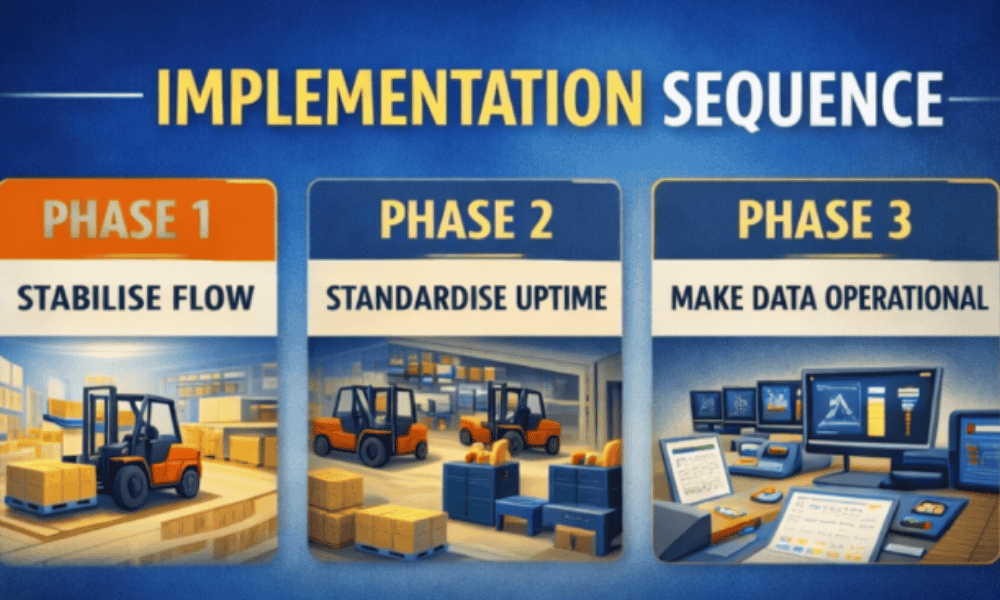
Step 5: The Implementation Sequence That Prevents Bottleneck Migration
Many projects stall because they try to speed up before stabilising. Use this sequence:
Phase 1: Stabilise flow before you add speed
-
Define staging rules and expiry times
-
Protect replenishment lanes
-
Re-slot fast movers to reduce travel
-
Introduce simple one-way rules in conflict areas
-
Add quality gates where rework is high
Phase 2: Standardise uptime, safety, and energy
-
Match equipment to aisle and load reality
-
Standardise short/long-move tools
-
Implement charging windows and accountability
-
Train collision-prevention behaviours
-
Put maintenance into a predictable rhythm
Phase 3: Make data operational
-
Exception routing and escalation ladder
-
Wave planning that reflects cutoffs and capacity
-
KPI reviews tied to actions, not presentations
-
Continuous slotting updates by velocity bands
Mini Case Snapshots (Practical Patterns)
These are field-style patterns that illustrate what changes when one-stop integration is applied.
Case 1: E-commerce cutoff misses (Jakarta-type volatility)
Problem: waves collapsed because replenishment always arrived late.
Fix: protected replenishment lane, velocity band slotting, disciplined wave timing.
Outcome pattern: fewer urgent replenishments, smoother pack queue, higher on-time cutoffs.
Case 2: Cold chain dock pressure (Bangkok-type constraint)
Problem: inbound congestion raised dwell time and created pack chaos.
Fix: dock appointment rules, cross-dock fast lane, stronger staging discipline.
Outcome pattern: cleaner flow, fewer exceptions, improved traceability.
Case 3: Industrial parts kitting errors (Ho Chi Minh-type complexity)
Problem: kitting errors created rework loops and late dispatch.
Fix: process checkpoints, error-proofing, exception workflow ownership.
Outcome pattern: fewer rework cycles, higher first-pass accuracy.
결론
Dispatch is rarely the true bottleneck. Dispatch is where upstream instability becomes visible. When inbound timing is inconsistent, staging has no ownership, replenishment is reactive, pick paths collide, and fleet charging is unpredictable, the facility builds a delay chain that ends at cutoff.
A One-Stop Warehouse approach reduces bottlenecks by removing the coordination gaps that cause delays to multiply. The core logic is system alignment: process discipline, equipment fit, data workflows, and energy planning must pull in the same direction. Many logistics engineering programmes and operational consulting frameworks emphasise the same principle: reliability beats isolated speed. A warehouse that runs as one integrated backbone can absorb volatility because it has predictable flow and clear ownership.
The practical payoff is not just higher throughput. It is fewer surprises, less firefighting, and fewer “multi-vendor blame loops.” If you want cutoffs to stop being a weekly drama, the solution is not to push dispatch harder. The solution is to make the warehouse behave like one business, one rhythm, one accountable system—so bottlenecks stop migrating and performance becomes repeatable.

원스톱 창고
FAQs
1) What is a One-Stop Warehouse?
원스톱 웨어하우스는 프로세스 설계, 자재 취급, 데이터 워크플로우 및 에너지 계획을 하나의 시스템으로 통합하여 부서 간 병목 현상이 이동하는 것을 방지하는 통합 운영 모델입니다.
2) What is the fastest bottleneck to fix first?
내부 이동. 슬롯팅, 스테이징 소유권 및 재보충 타이밍은 공간을 추가하지 않고도 종종 신속하게 처리 능력을 확보할 수 있습니다.
3) Do I need automation to reduce bottlenecks?
항상 그런 것은 아닙니다. 많은 운영 부문에서는 검증된 제약 요인을 자동화하기에 앞서 흐름을 안정화하고 SOP를 표준화하며 가동 시간을 개선하는 데서 더 큰 성과를 거둡니다.
4) Why does charging discipline matter so much?
예정되지 않은 충전은 숨은 가동 중지 시간을 초래하고 운행 간격을 방해합니다. 계획된 에너지 관리 절차는 차량군의 가용성을 예측 가능하게 만듭니다.
5) How do I know if one-stop integration is worth it?
자주 발생하는 컷오프 미스, 반복되는 네트워크 혼잡, 높은 예외 발생률 또는 공급업체 책임 전가의 악순환에 시달린다면, 분할화 비용을 지불하고 있을 가능성이 높습니다.
6) What KPIs should I track first?
Dock-to-stock time, pick travel time per line, replenishment response time, pack queue time, exception rate, and fleet availability.
A One-Stop Warehouse is not another optimisation tactic—it is an operating discipline. From an expert operations perspective, the core argument is clear: reliability always outperforms isolated speed. When receiving, putaway, replenishment, picking, packing, and fleet uptime are managed as separate functions, the warehouse does not eliminate bottlenecks—it merely relocates them. That is why recurring cutoff failures almost always reappear under pressure.Experienced logistics engineers consistently emphasise that true throughput gains come from system alignment, not from pushing individual departments harder. Mapping the delay chain exposes how small timing errors compound across zones. Once visible, those delays can be neutralised by aligning the four backbone layers—process discipline, material handling fit, operational data logic, and energy planning—so flow remains predictable even during peaks.
Another expert consensus is that performance indicators such as dock-to-stock time, replenishment response time, and pick travel per line are not just metrics; they are early-warning signals. When these indicators drift, the system is losing stability long before dispatch feels the pain. Finally, power and charging discipline has become a structural throughput factor. Fleet availability is no longer a maintenance concern—it directly determines whether waves hold or collapse.
In short, a One-Stop Warehouse works because it replaces firefighting with control. By treating the warehouse as one accountable system with one rhythm, bottlenecks stop migrating—and performance becomes repeatable rather than reactive.